Narrative
Memoirs of a Good-for-Nothing
Aus dem Leben eines Taugenichts
Joseph von Eichendorff · 1826
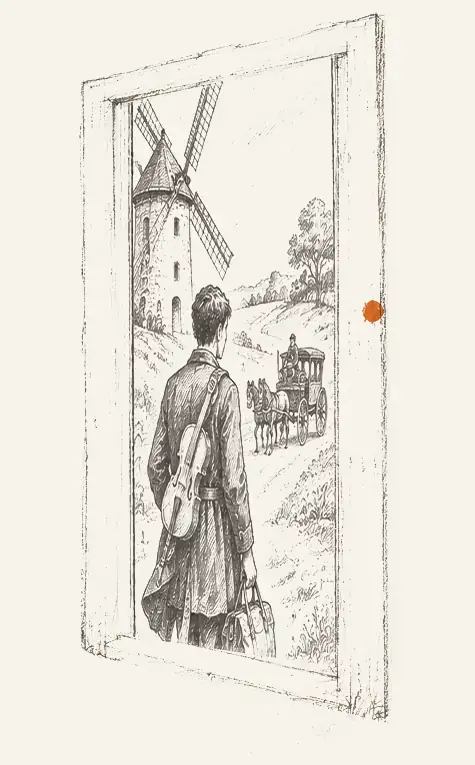
Opening lines
Das Rad an meines Vaters Mühle brauste und rauschte schon wieder recht lustig, der Schnee tröpfelte emsig vom Dache, die Sperlinge zwitscherten und tummelten sich dazwischen; ich saß auf der Türschwelle und wischte mir den Schlaf aus den Augen; mir war so recht wohl in dem warmen Sonnenscheine.
The wheel of my father's mill was once more roaring and rushing right merrily, the snow was dripping busily from the roof, the sparrows twittered and bustled about among it all; I sat on the doorstep and rubbed the sleep from my eyes; I felt thoroughly content in the warm sunshine.
Translation by Erostrate
Text quoted from gutenberg.org
Synopsis
Driven from the mill by his father, who calls him a good-for-nothing, a young man takes to the road with his violin. Two ladies passing in a carriage take him to their castle near Vienna, where he becomes a garden boy and then a toll collector, and falls in love with the younger one. When he sees her on the balcony with an officer and believes her beyond his reach, he takes to the road again towards Italy, in the company of two painters met one night on the way.
Context
Completed in 1822 or 1823, the tale appeared in extracts in a periodical in 1823, then in full in Berlin in 1826, in a volume that joined it to another novella by the author and to a selection of songs and romances. About fifty poems break up the prose, among them the song of the merry traveller. Thomas Mann saw in it the purity of the folk song united with that of the fairy tale. The text has been brought to the screen three times, in 1922, in 1973 by the East German studios and in 1978 by Bernhard Sinkel. In France, six translations have followed one another since 1929, among them that of Rémi Laureillard in the Pléiade.
Who it is for
About a hundred pages, told in the first person; the interspersed poems count as much as the plot.
Prizes and reception
Regarded as the pinnacle of late German Romanticism, and still popular in German-speaking countries since its publication.
Sources for this page 3
The pages consulted to check this page.