Narrative
Կարմիր ժամուց
Not translated into English
Arpiar Arpiarian · 1909
Synopsis
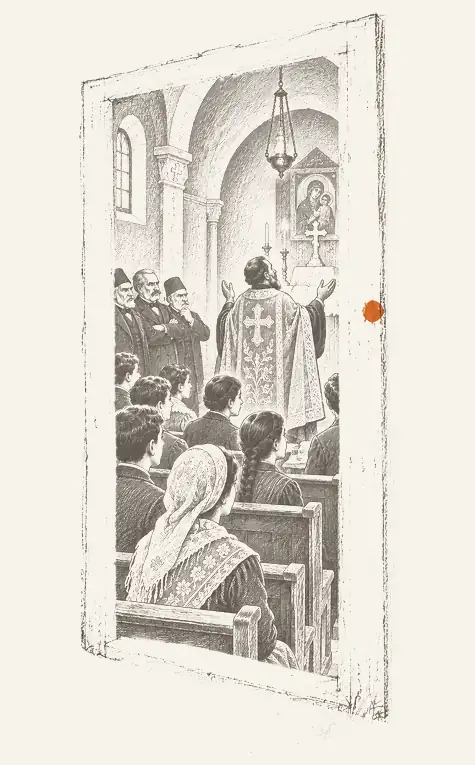
Coming from his distant village, Domuz, Father Houssik settles in Constantinople and serves at the church of Ortakeuy. There he sings at the top of his voice and celebrates in his own way, and his singing sounds less like a prayer than a call to revolt: the amira of the neighbourhood judges him useless, then dangerous, and he is scornfully nicknamed the migrant priest. Around him clash the youth of the provinces, won over to the revolution, and the wealthy effendis of the capital, attached to their peace and quiet.
Context
The author wrote this narrative in Venice in 1901, far from Constantinople, which he had fled five years earlier; the sources place its first publication in 1903 or in 1909, and it was often reprinted afterwards, in Beirut in 1937, in Cairo in 1950. In it he paints the rift that then ran through Armenian society, between the revolutionary drive of the provinces and the conservatism of the effendis, in a simple, biting language. The French translation adds a study of Archbishop Vramchabouh Kibarian, whose life recalls that of the hero.
Who it is for
A short narrative, in Western Armenian, accessible and often satirical. It helps to know the Armenian tensions of the 1890s.
Prizes and reception
Regarded as the masterwork of its author, the pioneer of realism in Armenian literature, and one of the most notable of his generation.