Poetry
Die Gaunerzinke
Not translated into English
Theodor Kramer · 1929
Synopsis
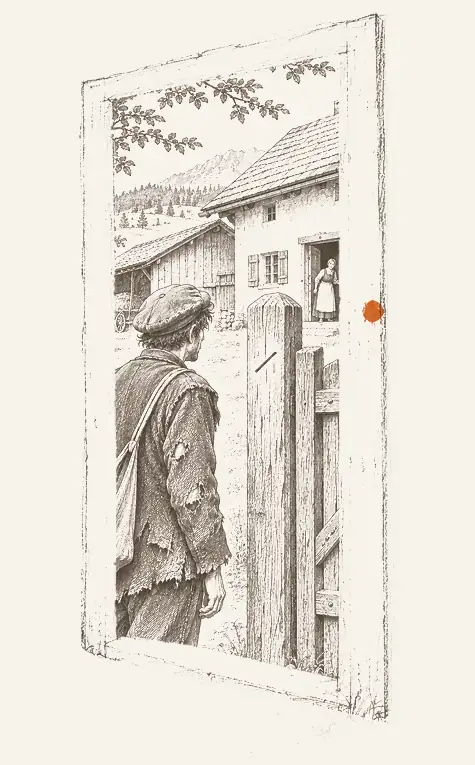
Poems in which those whom poetry hardly ever let speak speak in the first person: day labourers, seasonal workers, pedlars, farmhands, village vagabonds. In the piece that gives the collection its title, a man released from prison the day before arrives by the most deserted road, his bag empty and his jacket full of holes, and asks in a whisper for bread at the entrance to a farm. The Gaunerzinke is the secret sign that vagabonds leave for those who follow.
Context
The collection brings together poems from 1927 and 1928, part of which had appeared in newspapers. It arose from a poetry competition run by the publisher S. Fischer, in which its author was noticed without being awarded a prize, and Leo Perutz and Joseph Kalmer helped him find a publisher. Printed in 1928 by Rütten and Loening, in Frankfurt, it bears the date 1929. The sign on its cover was drawn after an image from Hans Prinzhorn's study of the art of prisoners.
Who it is for
Short poems in regular stanzas, which can be taken in any order. The language is simple, but the regional words sometimes call for a note.
Prizes and reception
Crowned with the Vienna city poetry prize, this first collection made its author known beyond the Austrian borders.
Sources for this page 11
The pages consulted to check this page.