Poetry
Song of Exile
Canção do exílio
Gonçalves Dias · 1846
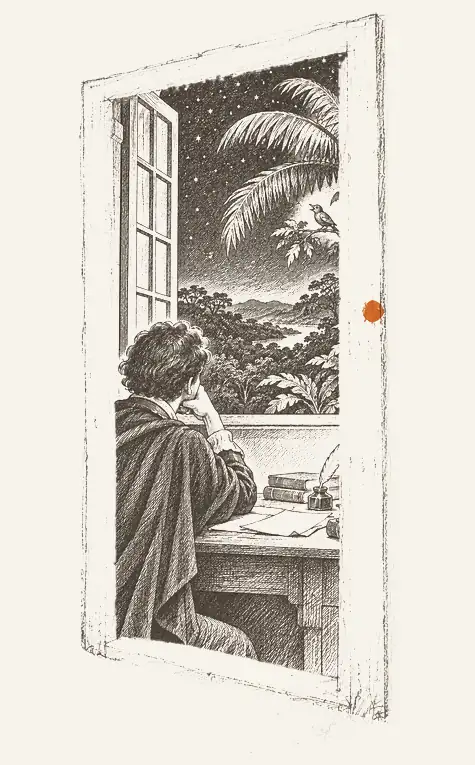
Opening lines
Minha terra tem palmeiras,
Onde canta o Sabiá;
As aves, que aqui gorgeião,
Não gorgeião como lá.
My land has palm trees
Where the sabiá sings;
The birds that warble here
Do not warble as they do there.
Translation by Erostrate
Text quoted from pt.wikisource.org
Synopsis
Placed under an epigraph taken from Goethe's Mignon, the poem relentlessly contrasts there and here. The native land has palm trees where the sabiá sings; its sky has more stars, its meadows more flowers, its woods more life, its loves more ardour. Far from it, the speaker finds more pleasure in dreaming at night of his land than in what surrounds him, and the refrain brings back the palm trees and the bird each time.
Context
The poem was written in Coimbra in July 1843, according to the journal of the São Paulo research foundation, and opens its author's first collection, published in 1846. Two of its lines on the woods and the loves of the homeland were taken up in the Brazilian national anthem. Joshua Alma Enslen, who drew a cultural history from it published in 2022, counts thousands of parodies and pastiches; Oswald de Andrade, Carlos Drummond de Andrade, Murilo Mendes, Chico Buarque and Tom Jobim have all taken it up.
Who it is for
A short poem, in Portuguese, read in a minute and heard even better; the parodies are best enjoyed after it.
Prizes and reception
The most popular poem in Brazil, known to every schoolchild according to Britannica, and one of the most imitated in the world.
Sources for this page 3
The pages consulted to check this page.