Novel
Memoirs of a Militia Sergeant
Memórias de um sargento de milícias
Manuel Antônio de Almeida · 1854
Opening lines
Uma das quatro esquinas que formam as ruas do Ouvidor e da Quitanda, cortando-se mutuamente, chamava-se nesse tempo-O canto dos meirinhos-; e bem lhe assentava o nome, porque era aí o lugar de encontro favorito de todos os indivíduos dessa classe (que gozava então de não pequena consideração).
One of the four corners formed by the crossing of the rua do Ouvidor and the rua da Quitanda was known in those days as the “bailiffs' corner”; and the name suited it well, for it was the favourite meeting place of all the members of that class (which then enjoyed no small esteem).
Translation by Erostrate
Text quoted from pt.wikisource.org
Synopsis
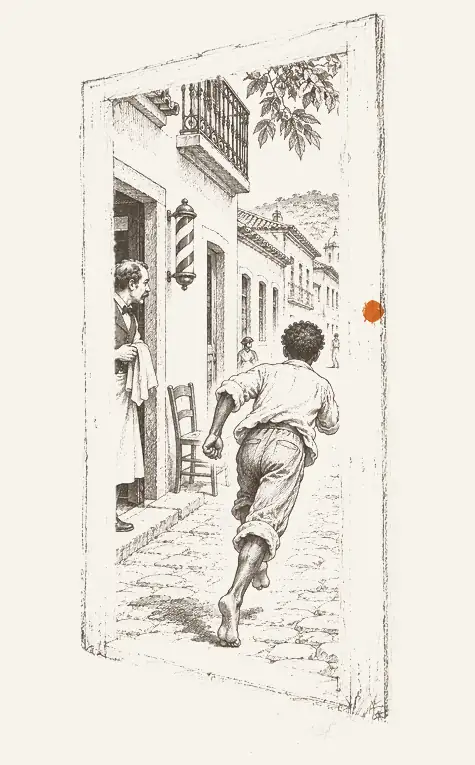
Leonardo-Pataca, a merchant turned bailiff, and Maria da Hortaliça, a peasant woman, met on the ship that took them from Lisbon to Rio; from their union Leonardo is born. After his mother leaves, his father abandons him, and the child is raised by his godfather, a barber who would like him to become a priest, and by his godmother, a midwife. In the Rio of King John VI, where Major Vidigal keeps order, the boy grows up as a rascal and constantly throws himself into trouble.
Context
The novel first appeared as a serial, without the author's name, in the Correio Mercantil of Rio, from 27 June 1852 to 31 July 1853, in forty-eight chapters. The book followed in two volumes, in 1854 and 1855, the second signed “um brasileiro”; the author's name appeared only in the third edition, after his death. Paul Rónai translated it into French in 1944, Ronald W. Sousa into English for the Library of Latin America series. InfoEscola sees in its hero the type of the malandro, the likeable rogue of Rio, facing the order embodied by Major Vidigal.
Who it is for
A short novel, translated into French; the chapters, brief and almost independent as the serial format required, can be picked up again at any page.
Prizes and reception
A turning point in Brazilian literature according to its English publisher, translated into French as early as 1944 and into Spanish in 1977.
Sources for this page 5
The pages consulted to check this page.