Narrative
Житие и страдания грешнаго Софрония
Not translated into English
Sophronius of Vratsa · 1805
Opening lines
Аз, грешний в человецех, родих ся на село Котел от отца Владислава, а от матери Мария и положили первое имя мое Стойко.
I, a sinner among men, was born in the village of Kotel, of my father Vladislav and my mother Maria, and the first name they gave me was Stoyko.
Translation by Erostrate
Text quoted from chitanka.info
Synopsis
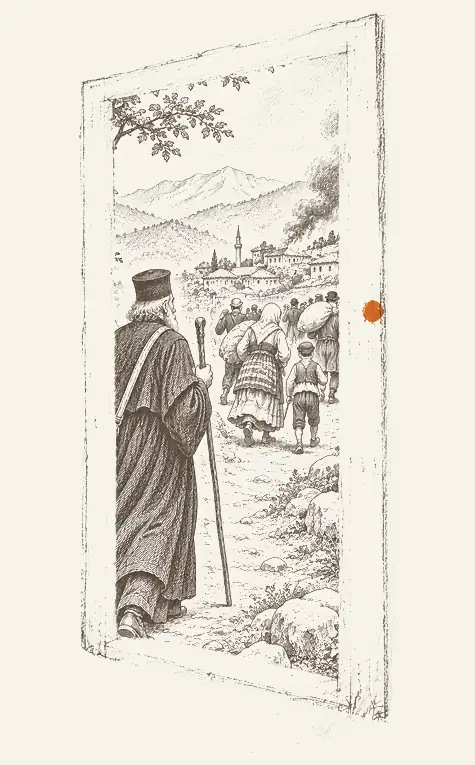
A priest from Kotel, who became bishop of Vratsa, recounts his own life in Ottoman Bulgaria at the end of the eighteenth century, when the kardjalis, Turkish deserters turned brigands, plundered towns and villages, and then in the years when the pasha of Vidin, Pazvantoglu, held the region. He portrays himself there as a humble martyr, with the frankness of a confession, and his account gives a vivid picture of the life of the Bulgarians of his time.
Context
Written in Bucharest in 1805, the narrative remained in manuscript for more than half a century: Georgi Rakovski published it in 1861, in exile, in his newspaper Dounavski lebed. Nadejda Dragova saw in it the chapter that follows the History of Paisius. Jack Feuillet translated and annotated it in French, first at Sofia-Presse in 1981, then in a revised edition subtitled “un évêque bulgare sous la domination ottomane”; a Russian edition appeared in Leningrad in 1976.
Who it is for
A short narrative, in the public domain, readable in French in Jack Feuillet's annotated translation.
Prizes and reception
Regarded as the first autobiography of modern Bulgarian literature, and read at the bicentenary celebrated at the Bulgarian Academy of Sciences.