Novel · A way to begin
Don Quixote
Don Quijote de la Mancha
Miguel de Cervantes · 1605
Opening lines
En un lugar de la Mancha, de cuyo nombre no quiero acordarme, no ha mucho tiempo que vivía un hidalgo de los de lanza en astillero, adarga antigua, rocín flaco y galgo corredor.
In a village of La Mancha, whose name I do not care to remember, there lived not long ago one of those gentlemen with a lance in the rack, an old shield, a lean nag and a greyhound for coursing.
Translation by Erostrate
Text quoted from gutenberg.org
Synopsis
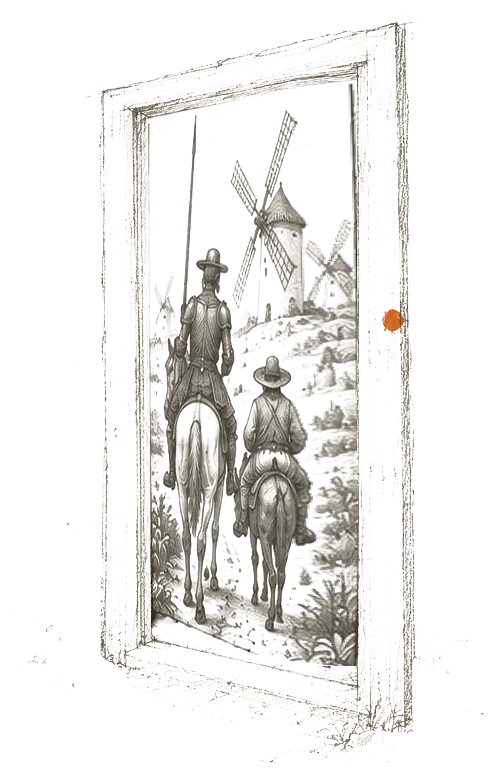
In a village of La Mancha, a poor hidalgo spends his days and nights reading romances of chivalry, to the point of losing his reason: he believes himself a knight errant. He calls himself Don Quixote of La Mancha, names his horse Rocinante and chooses a lady for himself. Setting out alone, he has himself dubbed a knight in an inn that he takes for a castle. Soon he sets out again with a neighbour, the peasant Sancho Panza, to whom he promises the governorship of an island, and he charges at windmills that he takes for giants.
Context
The first part, dated 1605, came out in Madrid in December 1604 from the presses of Juan de la Cuesta, for the bookseller Francisco de Robles. In 1614 an apocryphal second part appeared, signed Alonso Fernández de Avellaneda, whose prologue insulted the author; the true sequel came the following year. The two heroes have become famous in it: characters they meet have read the first book and recognise them, like the duke and duchess who receive them in their castle. The novel was translated into English by Thomas Shelton as early as 1612.
Who it is for
A long novel in two parts, published in 1605 and 1615, that follows the successive sallies of a master and his squire along the roads of Spain.
Prizes and reception
In 2002, a vote of one hundred writers from several dozen countries, organised in Norway, ranked it first among works of fiction.