Novel · A way to begin
Iceland's Bell
Íslandsklukkan
Halldór Laxness · 1946
Synopsis
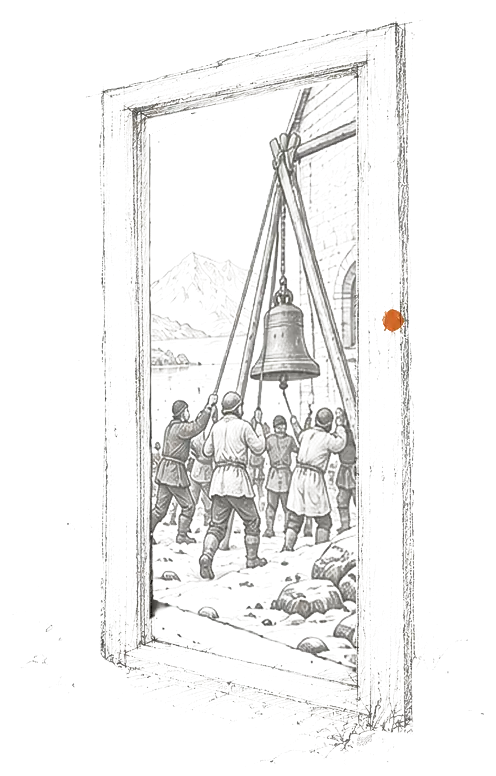
At the end of the seventeenth century, when Iceland is wholly under Danish law, the peasant Jón Hreggviðsson, convicted of stealing a rope, must help the king's executioner pull down the country's old bell, whose metal will be used to repair Copenhagen. For a mocking song about the king's mistresses, he is flogged; then the executioner is found dead after a drinking bout, and Jón, who remembers nothing, is sentenced to death. He flees to Denmark to obtain a pardon, while Snæfríður, daughter of the judge Eydalín, and Arnas Arnæus, a collector of manuscripts, appear.
Context
The novel appeared in three parts, Íslandsklukkan in 1943, Hið ljósa man in 1944 and Eldur í Kaupinhafn in 1946, and is set mainly in Iceland and Denmark. Arnas Arnæus is inspired by the scholar Árni Magnússon, who gathered the Icelandic manuscripts in Copenhagen, and Snæfríður by Þórdís Jónsdóttir. The scene of the felled bell was painted by Jóhannes Kjarval. Régis Boyer translated it into French in 1979, Philip Roughton into English in 2003.
Who it is for
Three parts, a little over five hundred pages in French; an archaizing language and historical reference points that call for attention.
Prizes and reception
Regarded as its author's masterpiece, praised by the Nobel jury for having renewed the great art of Icelandic storytelling.