Albania
- works
- 39
- 27 books · 12 films
- period covered
- 1504–1993
- language of writing
- Albanian
Twice in the nineteen eighties, a French publisher came to spend his holidays in Albania with his family and left again with manuscripts hidden in the false bottom of his suitcase. Claude Durand, director of Fayard, deposited them in the vault of a bank in the Saint-Germain-des-Prés quarter, with instructions to publish them only if something happened to their author. Ismail Kadare was writing books he could not have published at home and which he was putting out of reach three thousand kilometres away.
Read moreShow less
The most closed country in Europe produced a literature obsessed with enclosure, and that did not begin with the regime. Albanian is an isolated branch of Indo-European, with no close relative, written late and in three successive alphabets. Its first printed book is a missal of 1555. The mountains of the North lived until the twentieth century under a customary law of their own, the Kanun, with its given word and its blood vengeance, while the South looked towards Greece and whole communities settled in Italy from the fifteenth century onwards, where they still write.
The form that results is historical allegory. One cannot speak of the present, so one writes about the Ottoman Empire, about a medieval bridge, about an army that comes to collect its dead twenty years after the war. Kadare invented a way of saying everything while naming nothing, and this earned him both the protection of the authorities and their hostility: after a poem of 1975, a ban on publishing novels and dispatch to an agricultural cooperative. The price of that method is that one never entirely knows whether the author was resisting or negotiating, and Albanians are still debating it.
What awaits the reader is a cold and ceremonious prose in which an official, a file or a wall is enough to install the threat. The novel that opens this page sends an Italian general to exhume the remains of his soldiers in a land of rain and mud, and official critics passed it over in silence.
A way to begin
The General of the Dead Army
Ismail Kadare · 1963
Kadare's novel regarded as his most acclaimed work, written at twenty-six under the dictatorship.
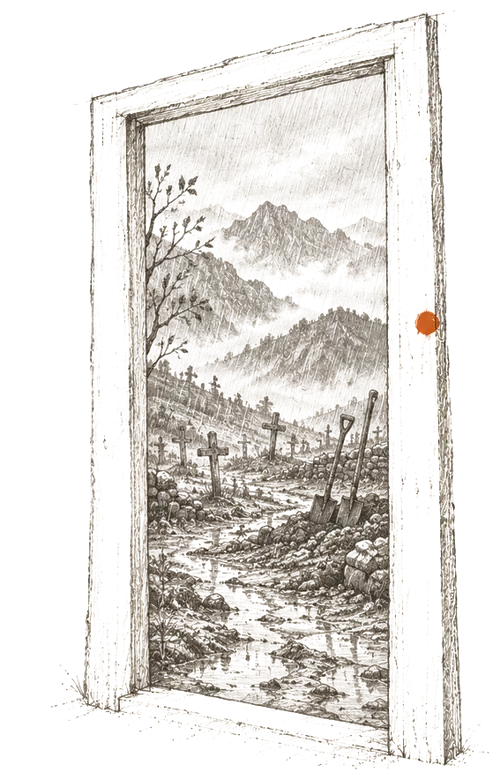
Nearly twenty years after the war, an Italian general comes to Albania, with a priest, to exhume the remains of the Italian soldiers who fell there. Across a land of rain and mud, where a German general is pursuing the same quest, his assurance turns to doubt, and he discovers the inglorious conduct of some of the men he has come to honour.
Timeline
- 1504–1898Before the stateBarleti in Latin, de Rada in Italy, Naim Frashëri: writing without a country.
- 1912–1938Between the warsKonica, Koliqi, Migjeni, Fishta. The language unifies, poetry opens up.
- 1948–1962Socialist realismFan Noli returns; the first cinema is born under Hoxha.
- 1963–1980KadareThe General of the Dead Army takes Albanian literature out of the country.
- 1972–1987Cinema of a closed countryKeko, Milkani, Anagnosti. Films made for Albanians alone.
Reading keys
- Albanian is written with digraphs of its own, xh, zh, dh, gj, and the final ë is pronounced. A badly transcribed name becomes unrecognisable.
- The patriarchal house, the fis, organises kinship, and a character is situated by his house before his first name.
- The first name is a declaration: Adem or Fatmir refer to the Muslim heritage, Agron or Ilir to the claimed Illyrian antiquity, Skënder to Skanderbeg.
- Besa, the given word, binds the whole house and is passed on to the heirs. A character who breaks it is socially dead.
- The dictatorship of 1944 to 1985, its camps and its thousands of bunkers, is told through allegory rather than direct testimony, including after 1991.
- Blood vengeance, which reappeared in the nineteen nineties, is a high-tension subject.
- The question of who resisted and who served the regime runs through literary life, and the Kadare case is the most discussed.
- Hospitality is an absolute duty, including towards an enemy, and the narrative uses it as a mechanism.
- Religious matters are handled with caution in a country where all religion was banned from 1967 to 1990.
- Three confessions coexist, a Sunni Muslim majority, Bektashi Sufism and Christianity, Orthodox in the south and Catholic in the north. National belonging took precedence over confession, and the formula according to which the religion of the Albanians is Albanianness remains a reference.
- Albania was the only state in the world to declare itself officially atheist, from 1967 to 1990. Mosques and churches were closed or converted.
- The zana of the mountains and the ora, protective doubles attached to each person, belong to the pre-Christian stock and appear in the heroic songs.
- The kulshedra, a water dragoness confronted by the drangue, is the central creature of the Albanian bestiary.
- Mourning is marked by black and by organised condolence visits, men and women receiving separately.
- Funeral lamentation sung by women is a codified practice that the texts describe.
- The kulla, the stone tower-house of the North, with its room reserved for guests and its loopholes, is a setting with a strong social charge.
- 28 November, the day of the flag of 1912, is the main civil landmark.
- Skanderbeg, the fifteenth-century lord who stood up to the Ottomans, is the absolute national reference, and Barleti devoted a siege narrative to him as early as 1504.
- The Kanun of Lekë Dukagjini, the customary code of the mountains, with besa and blood vengeance, serves as an implicit charter in many narratives.
- The cycle of the Kreshnikë, heroic songs of the North with the brothers Mujo and Halil, sung to the lahuta, is shared with Kosovo.
- The Arbëresh communities of Italy, settled in the fifteenth century, produced a literature of their own, including the Songs of Milosao.
- Albanian is neither Slavic nor Greek: it is an isolated branch of Indo-European, and confusing it with its neighbours grates.
- The Kanun is not a code of violence but a complete customary law, with its procedure, its truces and its mediations.
- State atheism did not erase beliefs: it drove them underground, which the narratives indicate through minute details.
- The bunkers, now a tourist image, are in the texts the sign of an organised fear and not a picturesque feature.
Tales and mythologies 1
- EpicSongs of the Frontier WarriorsKëngë kreshnikëshAnonymous · 1937The mountains of northern Albania, where bards recited these songs from memory, accompanying themselves on the lahuta.Literature
Available in English 7
The books from this country that can be read in English, in the original or in translation.
- ChronicleThe Siege of ShkodraDe obsidione ScodrensiMarin Barleti · 1504Shkodra, a Venetian city, in 1478 and 1479, when its citadel holds out for nearly a year against the Ottoman army.Literature
- PoetryFrashëri's Song of AlbaniaBagëti e BujqësiaNaim Frashëri · 1886Ottoman Albania in the 1880s, sung by an official posted far from his native village.Literature
- NovelWhy?!Nga jeta në jetë, Pse?!Sterjo Spasse · 1935Albania in the thirties, where young people educated in the city clash with the family customs of their villages.Literature
- PoetryFree VerseVargjet e liraMigjeni · 1936Shkodra and the poor villages of northern Albania in the thirties, under a regime that censors what is printed.LiteraturePublic domain
- EpicThe Highland LuteLahuta e MalcísGjergj Fishta · 1937The mountains of northern Albania and the Montenegrin border from 1858 to 1913, where the clans defend their lands.LiteraturePublic domain
- NovelThe General of the Dead ArmyGjenerali i ushtrisë së vdekurIsmail Kadare · 1963Albania in the early sixties, less than twenty years after the Italian occupation.Literature
- NovelThe LoserI humburiFatos Kongoli · 1992A man who did not take the boat tells his life as a loser: the great Albanian novel of the post-dictatorship years.Literature
A selection to begin with 10 / 39
- PoetryKëngët e MilosaosJeronim de Rada · 1836not translated into EnglishShkodra in the fifteenth century, dreamed from Calabria by an Arbëresh student of the 1830s.LiteraturePublic domain
- PoetryFrashëri's Song of AlbaniaBagëti e BujqësiaNaim Frashëri · 1886Ottoman Albania in the 1880s, sung by an official posted far from his native village.Literature
- NovelWhy?!Nga jeta në jetë, Pse?!Sterjo Spasse · 1935Albania in the thirties, where young people educated in the city clash with the family customs of their villages.Literature
- PoetryFree VerseVargjet e liraMigjeni · 1936Shkodra and the poor villages of northern Albania in the thirties, under a regime that censors what is printed.LiteraturePublic domain
- EpicThe Highland LuteLahuta e MalcísGjergj Fishta · 1937The mountains of northern Albania and the Montenegrin border from 1858 to 1913, where the clans defend their lands.LiteraturePublic domain
- Short filmZana and MiriZana dhe MiriVlash Droboniku · 1975A kindergarten in Albania in the seventies, seen from the height of two small ball players.Cinema
- Feature filmBeni Walks on His OwnBeni ecën vetëXhanfize Keko · 1975A family from Korça in the mid-seventies, and the Albanian countryside as the place where a city child learns to do without his own people.Cinema
- Feature filmFace to FaceBallë për ballëPiro Milkani and Kujtim Çashku · 1979Albania in 1961, when the break with the Soviet Union plays out in a conference room in Moscow and at an anchorage on the Adriatic.Cinema
- CinemaAgimet e stinës së madheAlbert Minga · 1981The first postwar years in Albania, when the regime taking hold settles scores by force of arms with the classes it overthrows.Cinema
- Feature filmThe Distant TimesKohë e largëtSpartak Pecani · 1983Medieval Albania of the icon painters, under the twofold pressure of the occupiers and the clergy.Cinema