Saudi Arabia
- works
- 10
- 10 books
- period covered
- 550–1997
- language of writing
- Arabic
Arabic poetry was an accomplished art before it was written down. The Mu'allaqat, "the suspended ones", which tradition says were hung on the wall of the Kaaba, were composed by poets who set nothing down. A professional transmitter, the rawi, learnt the poem by heart and carried it from tribe to tribe. The text was held in a memory, not in a book, and its transmission engaged a man's reputation.
Read moreShow less
This poetry obeys a rule that says a great deal. The qasida opens almost obligatorily on an abandoned camp: the poet arrives, recognises the stones of an extinguished hearth, the traces of a tent, and understands that the woman he is looking for has left with her tribe. Only then can he speak of the rest, of the journey, the horse, the war, the praise. That opening is a convention and a way of saying that the essential has already taken place and that writing consists in addressing what is no longer there. The metre, the single rhyme sustained over a hundred lines and the order of the parts are fixed, so that invention is judged inside a frame that everyone knows by heart.
The form has never left the peninsula. Nabati poetry, in dialect, is still recited and judged there like a sport, and the prestige of a poet remains political. The move to the novel came late, and often elsewhere: Abd al-Rahman Munif published his first books from Iraq and Lebanon after being stripped of his Saudi nationality in 1963. He wrote the history of his country in five volumes without being able to live there. The price of literary modernity was paid in distance, and part of the Saudi novel is still written in Beirut, London or Cairo.
What awaits the reader is a prose that keeps the memory of verse: repetitions, enumerations, sentences that come back on themselves like a refrain. The novel that opens this page tells what oil did to the Bedouin of the peninsula, and it was banned in Saudi Arabia.
A way to begin
Cities of Salt
Abdul Rahman Munif · 1984
The founding novel of oil fiction: what black gold did to the Bedouin of the peninsula.
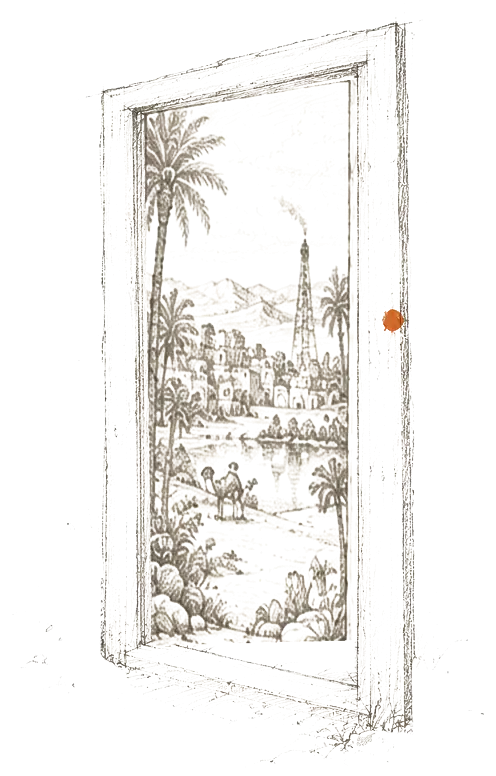
In the oasis of Wadi al-Uyoun, Bedouin live to the rhythm of water and caravans until Americans arrive in search of oil. Forced to move to the coast, where an oil town is born, yesterday's masters become labourers, while the emir amuses himself with the inventions he is given.
Timeline
- 500–650Pre-Islamic poetryThe suspended odes of the desert poets fix the language and forms of all Arabic poetry.
- 610–632The QuranThe text revealed at Mecca and Medina becomes the matrix of Arabic prose and metre.
- 1930–1960First booksThe founding of the kingdom sees the first printed narratives appear, mostly from the Hejaz.
- 1990–2010The novel's waveA generation of novelists, often published in Beirut, takes on the city, the family and censorship.
- 2018Cinemas reopenThe reopening of cinemas, closed since 1979, opens the way to a national film production.
Reading keys
- The name reads as a genealogy: ibn means "son of", bint "daughter of". Abd al-Rahman ibn Ali al-Munif reads as Abd al-Rahman, son of Ali, of the Munif family.
- A first name compounded with Abd, "servant of", followed by a divine name, is not to be cut: Abdallah, Abd al-Aziz form a single first name.
- The kunya, "father of" or "mother of" followed by the name of the eldest child, serves as a respectful form of address. A man called Abu Khalid has a son named Khalid.
- Tribal belonging, indicated by the last element of the name, places a character socially and geographically.
- Criticism of power and of the ruling family is not written head-on. The novels that address it do so through historical fiction or from abroad.
- The separation of male and female spaces organises the scenes. A conversation between an unrelated man and woman presupposes an arrangement that the narrative has to justify.
- Direct refusal is impolite. One answers with a pious formula, inshallah, which may mean yes, no or never depending on the intonation.
- Hospitality is a sacred duty and coffee served in successive small quantities regulates the length of the visit.
- Sunni Islam of Hanbali tradition, with a rigorist reading dominant since the eighteenth century, frames representation. Human figuration was long avoided, which explains the weight of calligraphy and the lasting absence of cinema.
- The two holy cities, Mecca and Medina, are not settings: mentioning them commits a register.
- The jinn belong to Quranic cosmology and not to folklore. A possessed character is not treated as mentally ill.
- A Shia minority is present in the east of the country, which makes the word "Saudi" less homogeneous than it appears.
- Mourning is brief and without display: burial on the same day, without a coffin, no flowers and no ornamented stone. A long funeral scene signals a non-Muslim family or a transgression.
- The white of the men's thobe and the black of the women's abaya are ordinary garments and not marks of circumstance.
- The calendar is lunar: Ramadan and the two feasts of Eid move through the seasons every year.
- Friday is the day of collective prayer and the landmark of the narrative week.
- The Mu'allaqat, seven great pre-Islamic odes including those of Imru al-Qays and Antara, are learnt at school and quoted as one would quote Racine.
- The Romance of Antar, an immense popular cycle around a poet-warrior, the son of a slave who became a hero, was recited for centuries by storytellers.
- The Thousand and One Nights is not a Saudi reference but a learned object under discussion, whose Indo-Persian origin is known.
- The account of the Queen of Sheba and Solomon, present in the Quran, circulates throughout the peninsula.
- The desert is not an emptiness in this literature: it is a named space, mapped by the poems, with its wells and its itineraries.
- Poetry here is not a minor or scholastic genre. It remains the genre of prestige, and a novel may be read as a concession to foreigners.
- The word "bedouin" designates a way of life and not a level of civilisation. The poets of the Mu'allaqat are men of letters of the oral.
- The absence of cinema until the twenty-tens does not indicate an absence of images, but a precise prohibition that nourished other forms.
Tales and mythologies 1
- PoetryThe Mu'allaqatالمعلقاتAnonymous · 550Before Islam, the poets of the tribes composed their verses and passed them on from memory.LiteraturePublic domain
Available in English 2
The books from this country that can be read in English, in the original or in translation.
- NovelCities of Saltمدن الملحAbdul Rahman Munif · 1984The oil discovered beneath the sand overturns, within a single generation, the lives of the Bedouin of the peninsula.Literature
- NovelAdamaالعدامةTurki al-Hamad · 1997A schoolboy from Dammam, fed on forbidden books, joins a clandestine Baathist cell in the time of Nasser.Literature
A selection to begin with 8 / 10
- NovelالتوأمانAbd al-Quddus al-Ansari · 1930not translated into EnglishTwo brothers, two schools: a novelistic plea for national education against foreign schools.Literature
- NovelفكرةAhmad al-Sibai · 1948not translated into EnglishA shepherdess with bold ideas and a man from Mecca, near Taif: a novel of ideas against rigid customs.Literature
- Theatreغرام ولادةHussein Siraj · 1952not translated into EnglishThe love affair of an Umayyad princess and a poet of Andalusia, brought to the stage in verse.Literature
- PoetryهمساتTaher Zamakhshari · 1952not translated into EnglishThe second collection by the poet of Mecca, in which homeland, the Hijra and pilgrims intersect.Literature
- Novelثمن التضحيةHamid Damanhuri · 1959not translated into EnglishA student from Mecca in Cairo, torn between the cousin he is to marry and an educated Egyptian woman.Literature
- Novelثقب في رداء الليلIbrahim al-Nasser al-Humaidan · 1961not translated into EnglishThe youth of a Najdi who emigrated with his family, caught between a forbidden love and the agitation against the British.Literature
- NovelالوسميةAbdulaziz Mishri · 1982not translated into EnglishThirteen village scenes from southern Saudi Arabia in the middle of the last century, set to the rhythm of waiting for the rains.Literature
- NovelAdamaالعدامةTurki al-Hamad · 1997A schoolboy from Dammam, fed on forbidden books, joins a clandestine Baathist cell in the time of Nasser.Literature