Azerbaijan
- works
- 30
- 16 books · 14 films
- period covered
- 1163–1989
- language of writing
- Azerbaijani
In one century, this country wrote its language in four alphabets. Arabic characters until 1929, the Latin alphabet from 1929 to 1939, Cyrillic from 1939 to 1991, Latin again since then. Each change made what preceded it illegible, and an Azerbaijani born in 1970 does not spontaneously decipher a book belonging to his grandmother. No literature has undergone so many cuts of access to its own library, and that graphic instability says everything about the country: none of those four choices was decided in Baku.
Read moreShow less
The depth is nevertheless considerable. Nizami, born in Ganja in the twelfth century, wrote in Persian five long narrative poems including the story of the lovers Leyli and Majnun, which circulates from Turkey to India. Fuzuli, in the sixteenth century, wrote indifferently in Azeri Turkish, in Persian and in Arabic, and one could not say which of the three was his language. In the nineteenth century, Akhundov composed the first comedies in a Turkic language of the Caucasus, and Baku became a city of oil, theatres and newspapers, with the first opera of the Muslim world in 1908 and a cinema from 1916.
The strangest fact of that history is the national novel. "Ali and Nino", a love story between an Azerbaijani Muslim and a Georgian aristocrat in Baku in 1918, appeared in Vienna in 1937 under a pseudonym. Nobody knows for certain who wrote it: several candidates are proposed, including an Azerbaijani who went into exile and a Jewish adventurer from Baku converted to Islam. The most widely read book in the country may have been written by a foreigner, and Azerbaijan claims it all the same, with reason, since nobody else has better described that city.
What awaits the reader is a literature of the frontier, written between Persian, Turkish and Russian, in which the belonging of every author is always under discussion with a neighbour. The novel that opens this page tells of the love of a Muslim from Baku and a Christian Georgian woman from 1914 to 1920, and it is regarded as Azerbaijan's national novel.
A way to begin
Ali and Nino
Kurban Said · 1937
A love between two worlds in Baku, free of rights: the book regarded as Azerbaijan's national novel.
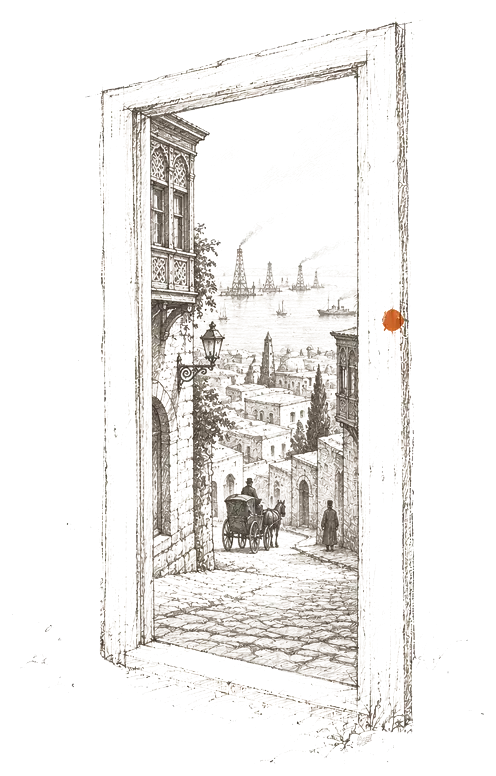
In Baku, from 1914 to 1920, Ali Khan Shirvanshir, a Muslim schoolboy from an old family, has loved Nino Kipiani, a Christian Georgian, since childhood. The city passes from the Russian Empire to the Azerbaijani republic, and between them pass East and West, Islam and Christendom.
Timeline
- 1163–1530ClassicsNizami, Nasimi, Fuzuli. Persian and Turkic share the verse.
- 1859–1912Baku awakeningAkhundov invents Azeri theatre; oil brings the newspapers.
- 1916–1937Baku on filmCinema arrives with oil; Ali and Nino appears in Vienna.
- 1934–1955Soviet periodChamanzaminli, Ildırım, Bülluri. Literature becomes official.
- 1964–1989Azerbaijani cinemaTahirzade, Seyidbeyli, Ocaqov, Gusman. The Baku studio is at work.
Reading keys
- Names often end in -ov or -ova, an inheritance of russification, and many have since 1991 taken up forms in -li, -zade or -oglu.
- The name may indicate the town of origin, Ganjavi, Shirvani, Tabrizi, and that origin remains socially legible.
- A large share of Azerbaijanis live in Iran, where they are more numerous than in Azerbaijan, which makes the word "Azerbaijani" ambiguous.
- Respect for elders imposes forms of address, and one does not call an elder by his first name alone.
- The Nagorno-Karabakh conflict, the two wars and the displacements of population are subjects on which every account is situated, and criticism of the authorities is risky.
- The massacres of 1918 and of 1990 are officially commemorated and recounted in a way incompatible with the Armenian accounts.
- The Soviet period produced an official literature and a forbidden literature, and several authors of the nineteen thirties were shot.
- Restraint and deference organise public speech.
- Shia Islam is in the majority, with a Sunni minority, but the society is one of the most secularised in the Muslim world, a Soviet inheritance.
- Zoroastrianism left traces, including the natural fires of the Absheron peninsula and the very name of the country, often linked to fire.
- The cult of the pirs, tombs of local saints visited to make vows, is a widespread practice.
- The jinn and the creatures of the tales, including the dev and the peri, belong to the common Turkic stock.
- Muslim mourning is brief, with burial on the same day, three days of condolences and commemorations on the seventh and the fortieth.
- Black is worn for a long time, and Shia Ashura gives rise to collective lamentations.
- Nowruz, the new year of 21 March, is the main festival, with the four Tuesdays of fire, water, earth and wind that precede it.
- Mugham, an improvised modal music listed as intangible heritage, accompanies ceremonies and is judged in competitions.
- The Book of Dede Korkut, a collection of Oghuz narratives, is the claimed founding text, also claimed by Turkey and Turkmenistan.
- Leyli and Majnun, carried by Nizami in the twelfth century, are the couple of unhappy lovers of the whole East, from the Caucasus to Bengal.
- Koroglu, an outlaw avenger sung by the ashiks, circulates in Turkey, in Central Asia and as far as Tajikistan.
- Mugham and the repertoire of the ashiks, bards who play the saz, constitute a shared knowledge.
- Azerbaijani is a Turkic language, close to the Turkish of Turkey, and not an Iranian language, despite the country's long belonging to the Persian world.
- Nizami wrote in Persian, which makes him a figure claimed by Iran as by Azerbaijan.
- The country is mostly Shia but highly secularised, and reading its works through a religious prism misses them.
- The four changes of alphabet are not an administrative anecdote: they cut off access to the national library four times.
Tales and mythologies 2
- EpicKurroglouKoroğluAnonymous · 1600The saga of a poet-brigand, sung by the bards of the Caucasus and Central Asia since the seventeenth century.Literature
- EpicThe Book of Dede KorkutKitabi-Dədə QorqudAnonymous · 1400The epic material of the Oghuz tribes, linked together by the figure of an old bard and soothsayer.Literature
Available in English 5
The books from this country that can be read in English, in the original or in translation.
- PoetryThe Treasury of MysteriesMəxzən-ül-əsrarNizami Ganjavi · 1163A book of wisdom in verse, the first of its author's five great poems.Literature
- TheatreCollected Dramatic Works of Mirza Fath-Ali AkhundzadehTəmsilatMirza Fatali Akhundov · 1859Six comedies of manners from the Caucasus, at the beginning of a national theatre.Literature
- NovelAli and NinoƏli və NinoKurban Said · 1937A love between two worlds, in Baku, written by an author whose identity remains disputed.Literature
- NovelDays in the CaucasusJours caucasiensBanine · 1945A Muslim childhood in the Baku of oil, told in French by an exile in Paris.Literature
- NarrativeIran: A Child's Story, a Man's ExperienceGholamreza Sabri Tabrizi · 1989Half a century of Iranian history, seen by a child from Tabriz who became an academic in Scotland.Literature
A selection to begin with 10 / 30
- PoetryThe Treasury of MysteriesMəxzən-ül-əsrarNizami Ganjavi · 1163A book of wisdom in verse, the first of its author's five great poems.Literature
- PoetryBeng ü BadəFuzuli · 1510not translated into EnglishA war of drinks at the banquet, an allegory of the rivalries of the time of Shah Ismail.Literature
- TheatreCollected Dramatic Works of Mirza Fath-Ali AkhundzadehTəmsilatMirza Fatali Akhundov · 1859Six comedies of manners from the Caucasus, at the beginning of a national theatre.Literature
- NovelDays in the CaucasusJours caucasiensBanine · 1945A Muslim childhood in the Baku of oil, told in French by an exile in Paris.Literature
- CinemaThe Cloth PeddlerArşın mal alanRza Tahmasib and Nikolai Leshchenko · 1945An operetta from Baku brought to the screen at the end of the war, in black and white, by the city's studio.Cinema
- CinemaBakhtiarBəxtiyarLatif Safarov · 1955A musical comedy produced in Baku in the mid-fifties, centred on an oil worker with a rare voice.Cinema
- CinemaIf Not That One, Then This OneO olmasın, bu olsunHuseyn Seyidzade · 1956An operetta from the beginning of the century about arranged marriages, brought to the screen in colour by the Baku studio.Cinema
- CinemaUlduzAgharza Guliyev · 1965A sung comedy based on an operetta from the national repertoire, shot in the south of the country in the mid-sixties.Cinema
- CinemaInterrogationİstintaqRasim Ojagov · 1980A corruption case in Soviet Azerbaijan, brought to the screen on the back of a party campaign against abuses.Cinema
- NarrativeIran: A Child's Story, a Man's ExperienceGholamreza Sabri Tabrizi · 1989Half a century of Iranian history, seen by a child from Tabriz who became an academic in Scotland.Literature