Bahrain
- works
- 7
- 7 books
- period covered
- -2000–1994
- language of writing
- Arabic
In the Sumerian texts there is a land where fresh water springs up in the middle of the sea, where neither sickness nor old age is known, and where the survivor of the flood is settled for eternity. That land is called Dilmun. Archaeologists locate it in Bahrain. This small archipelago was therefore somebody else's paradise, that of a civilisation that saw it from its rivers as we look at an island at the edge of a map.
Read moreShow less
The detail of the fresh water is not an invention: springs do indeed rise at the bottom of the gulf, and the island lived on them. Tens of thousands of burial mounds have been counted there, one of the largest ancient necropolises in the world, as though people had been coming there to die for four thousand years. A Sumerian trading post, then Persian, then Portuguese, then British, Bahrain has always been a place of passage where one stops, and its literature carries that porosity: one writes there with the vocabulary of several worlds. The island also had the first modern school and one of the first printing presses in the Gulf, which gave it a generation's advance.
That is what explains why the poetic modernity of the Gulf was born here. Ibrahim al-Urayyid published a first collection as early as 1931, printed in Baghdad, at a time when the region had almost no printers. Later, Qassim Haddad abandoned the classical metre for free verse, which amounts to renouncing collective memorisation and therefore part of the audience. Hamda Khamis, one of the first female voices of the peninsula, published her poems in the press from the late sixties. The price of that advance is a demanding literature, admired by Arab poets and little read by others, which gave up the audience that classical metrics guaranteed it.
What awaits the reader is therefore a dense poetry, without narrative, which assumes that one accepts not understanding everything at first. The collection that opens this page bears a title meaning the good tidings, after a custom that announced a recovery or a return from a journey, and it appeared the year before independence.
A way to begin
البشارة
Qassim Haddad · 1970
Qassim Haddad's first collection, published the year before Bahrain's independence: ardent verse dedicated to children.
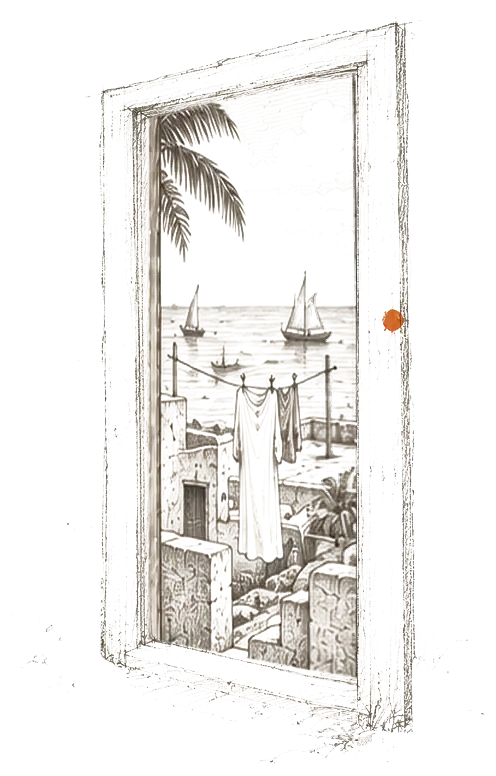
The poet dedicates the book to children, to whom he announces the coming dawn. His openly political verse speaks of his country's national aspiration. The title, the good tidings, comes from a local custom: a woman's coloured dress was hoisted over the house to announce a recovery, a return from a journey or a danger averted.
Timeline
- 1930–1965Before modernityIbrahim al-Urayyid, pioneer of written Bahraini poetry.
- 1969–1975The free-verse generationHamda Khamis, Qassim Haddad, Ali al-Shargawi break with metre.
Reading keys
- The name reads as a genealogy, with ibn and bint, and the last element indicates the family, the tribe or the geographical origin.
- The name often makes it possible to distinguish the Baharna families, Shia long settled there, from Sunni families of tribal or Persian origin.
- The kunya, "father of" followed by the name of the eldest child, is the ordinary form of address between adults.
- Names of Persian origin are frequent and attest to an old settlement from the other shore.
- The confessional question and the political tensions attached to it are the least direct subject of Bahraini literature. It expresses itself there through the image rather than through statement.
- The committed poetry of the nineteen sixties and seventies brought its authors trouble, and allusion served there as a method.
- The majlis, the reception room, is the place where public speech is held.
- Pious formulas punctuate conversation without necessarily indicating any particular devotion.
- A Shia majority and a Sunni government coexist, which gives the calendar two series of commemorations. Ashura, with its processions and its lamentations, is a social as much as a religious moment.
- The cult of saints and the mausoleums belong to local Shia practice.
- The jinn and the sea creatures belong to a stock common to the Gulf and not to an author's fancy.
- A Jewish community and Christian communities existed in Manama, which appears in the older narratives.
- Shia mourning is demonstrative: black is worn during the month of Muharram, and the majlis of lamentation are collective. This is not an excess but a rite.
- Muslim burial is swift and without ornament, and condolences last three days.
- Ramadan and the Eids shift the rhythm of the day: one lives at night.
- The burial mounds, present in the landscape, serve as a landmark and a literary motif.
- Dilmun, the paradise of the Sumerian texts, with Enki making the fresh water spring forth and Ziusudra settled there after the flood: the country thinks of itself through that narrative come from elsewhere.
- The sea songs, fjiri and the repertoire of the nahham, are shared with Kuwait and the Emirates.
- Bu Darya, the man of the sea, and the creatures of the pearl dive form a cast common to the Gulf.
- The story of Gilgamesh, of which Dilmun is one of the places, is known and quoted by the poets of the country.
- Bahrain is not a country without a written past: it had the first modern school and one of the first presses in the Gulf.
- The word "paradise" applied to Dilmun is a convenient translation. The Sumerian texts describe there above all a land of ritual purity and of trade.
- Haddad's poetry is not obscure out of a taste for obscurity, but because it refuses the form the public expected.
- The small size of the country does not imply a provincial literature: its poets are read throughout the Arab world.
Tales and mythologies 1
- EpicEnki and NinhursagAnonymous · -2000The Sumerian myth is set in Dilmun, which Assyriologists identify with present-day Bahrain.Literature
A selection to begin with 5 / 7
- PoetryالذكرىIbrahim al-Urayyid · 1931not translated into EnglishThe collection opens the work of the man whom critics regard as the pioneer of Romanticism in the Gulf.Literature
- Poetryأنين الصواريAli Abdallah Khalifa · 1969not translated into EnglishThe sea and the pearl divers of Bahrain, in a first collection that marked a turning point in the island's letters.Literature
- Poetryاعتذار للطفولةHamda Khamis · 1978not translated into EnglishThe author was the first woman to establish herself on the poetry scene of Bahrain.Literature
- Poetryهذي أنا القبرةIman Asiri · 1982not translated into EnglishThe author is said to have introduced the prose poem into the poetry of Bahrain.Literature
- Novelالتنور... غيمة لباب البحرينFareed Ramadan · 1994not translated into EnglishCritics have nicknamed the author the “novelist of identities”, for his work on the origins of the Bahrainis.Literature