Benin
- works
- 14
- 11 books · 3 films
- period covered
- 1700–2000
- language of writing
- French
In November 2021, twenty-six objects taken from Abomey in 1892 returned to Benin. Among them, statues of kings, a throne, carved palace doors: the booty of a French military column, exhibited for a hundred and thirty years in a Paris museum. Their return was a national event, with queues of several hours outside the exhibition in Cotonou. It was not only a matter of heritage, for those objects were supports of dynastic memory, and their absence had left a hole in the way the country could tell its own story.
Read moreShow less
The kingdom of Dahomey did indeed have a writing of history that did not go through the alphabet. Each king received a motto, a symbol and a set of signs, embroidered on appliqué hangings that recounted his reign, and court singers kept their chronology. It is one of the African states best documented from the inside, with its female regiments that Europeans called amazons, its economy of war and of the slave trade, and its oral archives that Paul Hazoumé drew on as early as 1938 to write a historical novel.
Beninese literature is therefore early and learned. Félix Couchoro published "The Slave" in 1929, one of the very first African novels in French, in a country that at the time supplied a large share of the senior staff of the colonial administration in West Africa. Olympe Bhêly-Quénum wrote in 1960 a novel of peasant fatality. The price was paid during the Marxist-Leninist period from 1974 to 1990, when production shrank and several authors wrote outside the country.
What awaits the reader is a writing attentive to history and to institutions, in which the royal past is not a setting but a system still legible in names, festivals and prohibitions. The novel that opens this page is called "Snares Without End", and it grew out of a dream its author had told André Breton.
A way to begin
Snares Without End
Olympe Bhêly-Quénum · 1960
Olympe Bhêly-Quénum's first novel, encouraged by André Breton: a wandering, read in African schools since 1960.
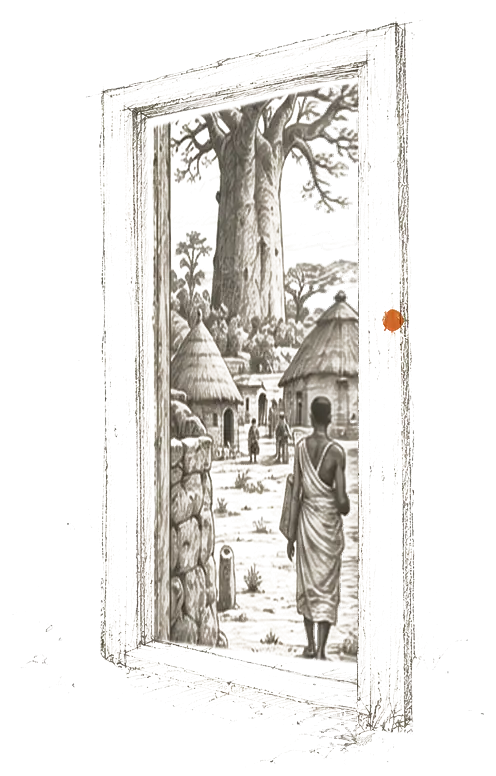
Taken in, at the end of his strength, by a man from Zado, Ahouna tells his life. He watched his father, subjected to forced labour and beaten by the colonial commandant, sink into despair. Married to Anatou, whom he loves, he finds one day that his wife accuses him, on the strength of her dreams, of an infidelity he denies; life together becomes unbearable, and Ahouna sets off on foot, without money or food.
Timeline
- 1929–1938First novelsFélix Couchoro and Paul Hazoumé, two founders of the West African novel.
- 1950–1960Collecting and fictionAlapini collects the tales; Bhêly-Quénum writes Snares Without End.
- 1971–1985Theatre and cinemaJean Pliya, Jérôme Carlos; Abikanlou films vodun from the inside.
- 1981–1988New voicesColette Senami Agosso, Flore Hazoumé, Okiki Zinsou.
Reading keys
- Fon first names often indicate the circumstances of birth, and surnames may be Portuguese, de Souza, d'Almeida, Hazoumé, inherited from the Afro-Brazilian families of Ouidah.
- Fon societies are patrilineal, with lineages that hold family vodun.
- Twins, hoho, have a sacred status and receive statuettes representing them after the death of one of them.
- The name of the neighbourhood or of the initiation convent places a character socially.
- The participation of the kingdom of Dahomey in the Atlantic slave trade is an established fact and an uncomfortable subject, which Hazoumé addressed as early as 1938.
- The revolutionary period from 1974 to 1990 and its people's courts are recounted with caution.
- Vodun has been practised openly since 1990 and has a national holiday, which changes the tone of recent texts.
- The initiation convents impose secrecy: a narrative may stop because what follows is not to be told.
- Vodun is at home here: Mawu-Lisa the creator couple, Legba at the crossroads, Sakpata the earth and smallpox, Hevioso the storm, Dan the serpent. The Haitian pantheon and Brazilian candomblé derive directly from it.
- Fâ, a divination system related to Yoruba Ifa, is consulted for every important decision and its verses are learnt by heart.
- Christianity and Islam are superimposed without erasing vodun, and the Celestial Church of Christ, born in Benin, mixes the two.
- The royal python of Ouidah, in its temple, is a sacred animal and not an attraction.
- Royal and lineage funerals take place in several stages, with deferred and costly ceremonies.
- White marks the initiates who have come out of the convent, and each vodun has its colours, its food prohibitions and its days.
- 10 January, the national vodun holiday since 1992, brings together adepts and visitors.
- The appliqué hangings of Abomey, sewn with symbols, recount the reigns and are read like a text.
- The vodun pantheon and Fâ constitute a common knowledge that the texts do not translate, and that is shared with Haiti, Cuba and Brazil.
- The mottoes and symbols of the kings of Abomey, each associated with an animal or an object, form a chronology that the country knows.
- The female regiments of Dahomey, called amazons, are a constant historical reference.
- The Fon tales collected from 1950, with the cunning tortoise and Yo the glutton, form the domestic stock.
- Vodun is not black magic: it is an organised religion, with a clergy, convents and a theology, from which the American forms derive.
- Present-day Benin has no territorial relation with the kingdom of Benin, situated in Nigeria, from which the famous bronzes come. The confusion is very frequent.
- The amazons of Dahomey were a regular military corps and not a curiosity, and their memory is national.
- The kingdom of Dahomey was both a victim of colonisation and an actor in the slave trade. Both are true.
Tales and mythologies 2
- TaleContes dahoméensJulien Alapini · 1941not translated into EnglishA Dahomean schoolteacher trained at the École William-Ponty publishes in France, in the middle of the war, a collection of tales from his country.Literature
- PoetryFáAnonymous · 1700not translated into EnglishThis knowledge is passed on by word of mouth, in a kingdom where no important decision is made without consulting the oracle.Literature
Available in English 3
The books from this country that can be read in English, in the original or in translation.
- NovelDoguicimiPaul Hazoumé · 1938A Dahomean schoolteacher and ethnologist publishes in Paris a novel drawn from twenty-five years of interviews with the elders of Abomey.Literature
- NovelSnares Without EndUn piège sans finOlympe Bhêly-Quénum · 1960In the year of independence, a Dahomean teacher of literature settled in Normandy publishes his first novel, rejected by about ten publishers.Literature
- EssayAfrican Philosophy: Myth and RealitySur la « philosophie africaine ». Critique de l'ethnophilosophiePaulin J. Hountondji · 1977A young Beninese philosopher trained in Paris breaks with the idea of an African wisdom shared by an entire people.Literature
A selection to begin with 10 / 14
- NovelL'EsclaveFélix Couchoro · 1929not translated into EnglishA commercial clerk from Dahomey, a former mission schoolteacher, publishes in Paris a novel set on the banks of the Mono.Literature
- NovelDoguicimiPaul Hazoumé · 1938A Dahomean schoolteacher and ethnologist publishes in Paris a novel drawn from twenty-five years of interviews with the elders of Abomey.Literature
- CinemaSous le signe du vaudouPascal Abikanlou · 1974Dahomey, soon to become Benin, sees the release of its first major fiction film, shot in colour on 16 mm.Cinema
- CinemaLe Nouveau VenuRichard de Medeiros · 1976Two years after the country's first feature-length fiction film, a literature teacher makes a comedy about the administration.Cinema
- EssayAfrican Philosophy: Myth and RealitySur la « philosophie africaine ». Critique de l'ethnophilosophiePaulin J. Hountondji · 1977A young Beninese philosopher trained in Paris breaks with the idea of an African wisdom shared by an entire people.Literature
- CinemaIronuFrançois Sourou Okioh · 1985A documentary maker trained in Eastern Europe makes a political fable and sets it in an invented country.Cinema
- NovelUne femme dans la lumière de l'aubeBarnabé Laye · 1988not translated into EnglishThe first novel of a Beninese poet settled in Paris, in which a young Frenchman discovers his father's continent.Literature
- Short storiesLes Enfants de MandelaJérôme Carlos · 1988not translated into EnglishIn Abidjan, an exiled Beninese journalist makes South African segregation the subject of a book, because a newspaper column seems too narrow to him.Literature
- NovelNotre pain de chaque nuitFlorent Couao-Zotti · 1998not translated into EnglishA former teacher turned satirical journalist publishes his first novel in Paris, three years after a first play.Literature
- NovelModukpè, le rêve briséAdélaïde Fassinou · 2000not translated into EnglishA literature teacher who teaches in the secondary schools of her country publishes in Paris a first novel, the story of a girl's adolescence.Literature