Bhutan
- works
- 7
- 4 books · 3 films
- period covered
- 1200–1999
- language of writing
- Dzongkha
The first Bhutanese feature film was directed by a lama recognised as a reincarnation. Khyentse Norbu, trained in the monasteries and a teacher of Tibetan Buddhism, shot in 1998 the story of young novice monks obsessed with the final of the football World Cup who manoeuvre to rent a television. The film is acted by real monks, in a real monastery, and it is funny without being mocking. A year later, in 1999, Bhutan authorised television and the internet on its territory for the first time.
Read moreShow less
That chronology is not a coincidence. The country built its policy on the idea that too rapid a modernisation would destroy what makes its inhabitants live, and it devised in 1972 an indicator of gross national happiness intended to compete with the domestic product. It was never colonised, it banned television for half a century, and it still limits the number of visitors through a daily tax. That prudence is also a cultural policy: the national language, Dzongkha, is written with the Tibetan alphabet, and the old literature is almost entirely religious, biographies of masters and treatises.
Hence a very slender written production and a cinema that takes on the representation of the country from the outset. A contest song of 1960, in which a yak speaks, constitutes one of the rare published literary texts, and contemporary authors write in English, the language of secondary education. The price of preservation is there: a country that protected its culture from images did not produce many images of itself, and the films shot in Bhutan long came from outside, with a guest's gaze.
What awaits the viewer is an unexpected gentleness and a gaze on the monastery without indulgence. The film that opens this page was shot in Tibetan and Hindi, in a monastery of Tibetan refugees in India, with real monks who had never acted.
A way to begin
The Cup
Khyentse Norbu · 1999
Young Tibetan monks in exile want to watch the World Cup final: the first film Bhutan submitted to the Oscars.
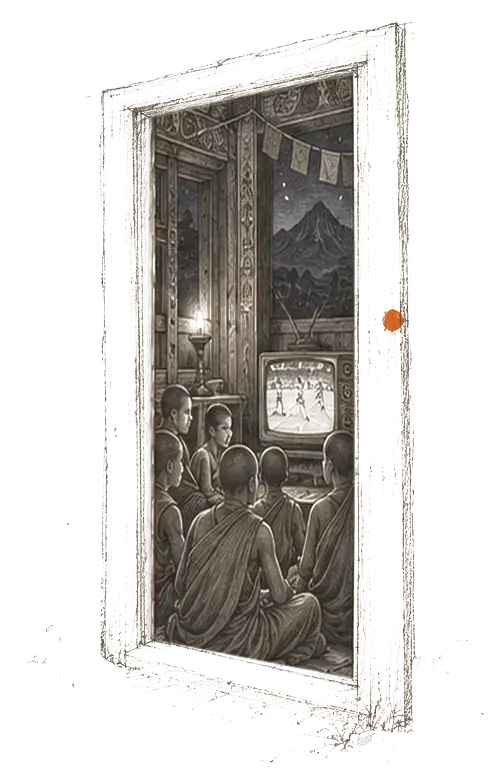
Two young refugees from Tibet arrive at a Tibetan monastery in exile in northern India. The 1998 World Cup is in full swing, and the novice Orgyen slips out at night to watch the matches in the nearby village. When the abbot forbids outings, he leads his companions into renting a television and a satellite dish to watch the final inside the monastery.
Timeline
- 1600–1900NamtharThe biographies of Buddhist masters, in classical Tibetan, form the country's written tradition.
- 1907MonarchyThe founding of the Wangchuck dynasty establishes the writing of state chronicles in Dzongkha.
- 1961–1990School and pressThe gradual opening introduces English, print and the national newspaper Kuensel.
- 1999–2003First filmsThe authorisation of television and Khyentse Norbu's films open a cinema in Dzongkha.
Reading keys
- There is no family name: everyone receives at birth two names given by a lama, often drawn from Buddhism, and brothers and sisters have no name in common.
- The names of the royal and noble families, Wangchuck and a few others, are an exception and are transmitted.
- The society of the west and the centre long practised flexible forms of marriage, including fraternal polyandry in the high mountains.
- Religious titles, including rinpoche and lopen, precede the name and indicate a real status, not a politeness.
- The expulsion in the nineteen nineties of more than a hundred thousand inhabitants of Nepali origin, refugees in Nepal since then, is a subject that national production does not address.
- The monarchy and the state religion may not be publicly criticised.
- The wearing of national dress is compulsory in official places, which is a political fact as much as a sartorial one.
- Restraint is a value, and the direct expression of disagreement is frowned upon.
- Tibetan Buddhism of the Drukpa school is the state religion, and the monasteries are political institutions as much as spiritual ones.
- Recognised reincarnation is an administrative fact: a child identified as a tulku receives a particular education and an authority.
- Bön and the cults of local divinities, protectors of valleys and passes, survive beneath Buddhism, and prayer flags are planted at crossing points.
- The masked dances of the tsechu, performed by monks, represent divinities and are a teaching as much as a spectacle.
- Mourning lasts forty-nine days, the duration that Tibetan Buddhism assigns to the passage between two existences, with rites every seven days.
- The white of the ceremonial scarves and the colours of the prayer flags have codified values.
- The tsechu, the annual festival of each valley's monastery, with its masked dances, is the great social gathering.
- The gho for men and the kira for women are the national garments, worn daily and compulsory in administrative buildings.
- The biographies of Padmasambhava and of the founding masters constitute the religious narrative stock, known through the dances and the paintings.
- The epic of Gesar, shared with Tibet and Mongolia, circulates in recited form.
- The narrative of Shabdrung Ngawang Namgyal, unifier of the country in the seventeenth century, is the political myth of foundation.
- The protecting divinities of the valleys, with their prohibitions and their offerings, are a common knowledge that the texts do not translate.
- Gross national happiness is not a tourist formula but an administrative device with its indicators and its commission.
- Bhutan is not Tibet: the language is close, the religion neighbouring, but the state is independent and has never been Chinese.
- The absence of television until 1999 was not a technical backwardness but an explicit political decision.
- The image of a preserved kingdom masks the mass expulsion of the nineteen nineties, which national production does not recount.
Tales and mythologies 2
- PoetryYak Legpai Lhadar GawoAp Chuni Dorji · 1960not translated into EnglishIn the high valleys, yak herders compete in improvised poetic duels before an audience.Literature
- EpicEpic of King Gesarགེ་སར།Anonymous · 1200The epic comes from the Tibetan and Mongol world; Bhutan knows it through a masked dance that came from Tibet.Literature
Available in English 2
The books from this country that can be read in English, in the original or in translation.
- NarrativeThe Divine Madman: The Sublime Life and Songs of Drukpa Kunley'Gro ba'i mgon po chos rje kun dga' legs pa'i rnam thar rgya mtsho'i snying po mthong ba don ldanGendün Rinchen · 1966The legendary life of the divine madman, a wandering yogi between Tibet and Bhutan, in anecdotes and songs.Literature
- TaleFolktales of BhutanKunzang Choden · 1994Tales from central Bhutan, collected from oral tradition by an author from Bumthang.Literature
A selection to begin with 4 / 7
- NarrativeThe Divine Madman: The Sublime Life and Songs of Drukpa Kunley'Gro ba'i mgon po chos rje kun dga' legs pa'i rnam thar rgya mtsho'i snying po mthong ba don ldanGendün Rinchen · 1966The legendary life of the divine madman, a wandering yogi between Tibet and Bhutan, in anecdotes and songs.Literature
- Feature filmGasa Lamai SingyeUgyen Wangdi · 1989The founding film of Bhutanese cinema, drawn from a legend of lovers parted in Punakha.Cinema
- TaleFolktales of BhutanKunzang Choden · 1994Tales from central Bhutan, collected from oral tradition by an author from Bumthang.Literature
- Feature filmRewaaTshering Wangyel · 1999A romantic rivalry between two students, in the first commercial success of Bhutanese cinema.Cinema