Belarus
- works
- 31
- 22 books · 9 films
- period covered
- 1844–1995
- language of writing
- Belarusian
On the night of 29 to 30 October 1937, more than a hundred Belarusians were shot in the NKVD inner prison in Minsk, among them twenty-two writers, poets, translators and critics. Mihas Charot and Ales Dudar, who had a whole body of work behind them, were among them. The country calls it the night of the executed poets: the literature built in the nineteen twenties stopped in a single night.
Read moreShow less
This country was long the territory of others. A grand duchy of Lithuania, then a republic of the Two Nations, then a Russian empire, it had a state only in 1918 and for a few months. Its first printed book, in 1517, was printed in Prague by Francisk Skaryna, for want of a press on the spot, and its first modern literature is contained in a newspaper founded in 1906. A spelling reform decreed in 1933 brought the language closer to Russian, which today dominates conversation and publishing, so that writing in Belarusian has become a choice and not a state.
The form found here is testimony. The war killed one inhabitant in four and burnt hundreds of villages with their inhabitants, and Ales Adamovich went to collect the accounts of the survivors, material for a book and then for a film of 1985 that remains the harshest in Soviet cinema. Vasil Bykau wrote short narratives in which a man must choose in the snow, without the author judging in his place. The price did not stop in 1937: Bykau left the country in 1998 and returned to it only to die there in 2003, the Nobel laureate whose book opens this page left in 2020, and the language itself is treated as a sign of opposition.
What awaits the reader is a literature of deposition, in which somebody recounts and nobody concludes. The book that opens this page is made of the voices of hundreds of Soviet women who went to war, snipers, pilots or nurses; completed in 1983, it stayed two years with the publisher before appearing in 1985.
A way to begin
The Unwomanly Face of War
Svetlana Alexievich · 1985
The Unwomanly Face of War: war told by women, by the Nobel laureate Svetlana Alexievich, in French.
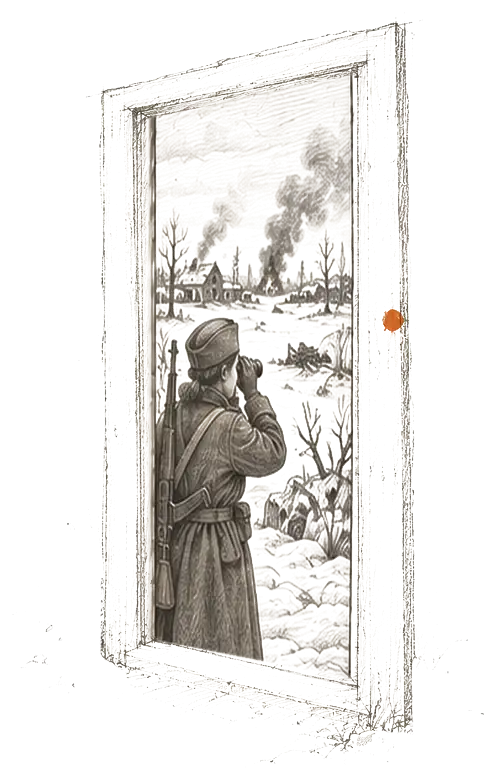
Hundreds of Soviet women, snipers, pilots, sappers, nurses, cooks or laundresses, tell of their war against Nazi Germany. Their voices speak of the fear of death, the memory of youth, love, and even the life of a German soldier saved during the siege of Stalingrad.
Timeline
- 1855–1913The language in printBahushevich, Kupala, Kolas. Belarusian becomes a written language.
- 1914–1930Nasha NivaBahdanovich, Haretski, Dubouka. Ten years of ferment.
- 1937The Great TerrorHartny, Chorny, Charot. An entire literature is shot.
- 1965–1980War and memoryBykau and Adamovich write the partisans without compulsory heroism.
- 1985–1986AlexievichThe Unwomanly Face of War: gathered speech becomes a genre.
Reading keys
- One and the same author often bears two forms of his name, Belarusian and Russian, and Western catalogues retain sometimes one and sometimes the other: Bykau and Bykov designate the same writer.
- Surnames in -vich and in -enka are in the majority, and the use of the first name followed by the patronymic derived from the father is the polite norm, as in Russia.
- Literary pseudonyms are the rule among authors of the early twentieth century, often chosen to signal peasant origin, and the civil name is almost forgotten.
- Families commonly mix Belarusian, Polish, Jewish and Russian ancestry, and belonging is stated by the village as much as by the name.
- The night of 29 October 1937 and the pits of Kurapaty, near Minsk, are commemorated by part of society and minimised by the authorities, and the mere fact of laying flowers there is a political act.
- The war is the central official narrative, with its figures and its monuments, and doubting it is impossible while questioning it through testimony was long suspect.
- The open repression after 2020, the exile of the writers and the trials for extremism make any contemporary text legible as a taking of position.
- Using Belarusian in an official or urban context is interpreted as a signal, independently of the content.
- The country is divided between an Orthodox majority and an important Catholic minority in the west, an inheritance of the Polish period, and the Uniate Church was suppressed in 1839.
- The pre-Christian stock is well preserved in the nineteenth-century collections: Kupala and his night, the spirits of the lakes and the forests, the king of the serpents.
- Village healers, with their whispered formulas, are documented until a recent period and appear in rural prose.
- Radunitsa, the day on which people eat on the graves after Easter, is a public holiday, which gives an idea of the place of the dead.
- The white of the traditional costume, with its woven red patterns, is a system of regional signs, and the white-red-white flag draws from it its present political charge.
- Kupala night, at the solstice, with fires, wreaths thrown into the water and the gathering of fern, is the great popular festival.
- The autumn Dziady gather families for a meal at which a portion is set aside for the dead, a rite earlier than Christianity.
- Mourning is marked by three-day vigils, commemorative meals at fixed dates and the collective maintenance of graves.
- Jan Barszczewski's collection, published between 1844 and 1846 in Polish because Belarusian was forbidden in print, is the base of the legends, with its serpent king and its lake spirits.
- Michał Federowski's collection, between 1897 and 1903, is the scientific reference of folklore, also in Polish.
- Skaryna, a sixteenth-century printer, is the founding figure of written culture, and a 1969 film is devoted to him.
- Bahushevich's Belarusian flute, in 1891, with its preface asking that the language not be abandoned, is the manifesto that every text assumes is known.
- Belarusian is not a dialect of Russian: it is a distinct East Slavic language, with its grammar and two competing spellings since 1933.
- The country is not a little Russia: its history is that of the grand duchy of Lithuania and of Poland-Lithuania, and its Catholic and Jewish past is considerable.
- War literature is not a patriotic literature: it is made of testimonies that often contradict the official heroic account.
- The authors best known abroad sometimes write in Russian, which does not remove them from this literature and feeds a constant internal debate.
- The catalogue stops essentially in the nineteen eighties, which reflects the state of translations and not the country's production.
Tales and mythologies 1
- TaleNobleman Zavalnia, or Belarus in Fantastical TalesSzlachcic ZawalniaJan Barszczewski · 1844Tales of popular terror from northern Belarus, told at the evening gathering by passing guests, in a Polish steeped in peasant beliefs.Literature
Available in English 5
The books from this country that can be read in English, in the original or in translation.
- NarrativeTwo SoulsДзве душыMaksim Haretski · 1919An officer who discovers his peasant origins, amid the camps of the civil war.LiteraturePublic domain
- TheatreThe LocalsТутэйшыяYanka Kupala · 1924An opportunist who changes his coat with every occupation, in the Minsk of the civil war years.LiteraturePublic domain
- NovelPeople of the MarshЛюдзі на балоцеIvan Melezh · 1962A village lost in the Polesian marshes after the revolution, amid the division of land, amorous rivalries and the first great public works.Literature
- NovelThe OrdealСотнікаўVasil Bykau · 1970Two partisans who have fallen into the hands of the auxiliary police, facing a choice between life and loyalty.Literature
- NarrativeThe Unwomanly Face of WarУ войны не женское лицоSvetlana Alexievich · 1985The Second World War told by the women who fought it, whose accounts were gathered in the early eighties.Literature
A selection to begin with 10 / 31
- PoetryДудка беларускаяFrancishak Bahushevich · 1891not translated into EnglishPeasant verses printed in Kraków, outside the empire of the tsars, in the last years of the nineteenth century.LiteraturePublic domain
- PoetryБосыя на вогнішчыMihas Charot · 1922not translated into EnglishThe revolution seen as a blaze into which the poor throw themselves, in the Belarus of the occupations.LiteraturePublic domain
- PoetryВежаAles Dudar · 1928not translated into EnglishAn old tower laden with legends, which the radio turns into a relay for distant voices: a poem of the new era.Literature
- NovelВойна под крышамиAles Adamovich · 1960not translated into EnglishA town in occupied Belarus, where ordinary families choose between submission and resistance.Literature
- Feature filmBelovedЛюбимаяRichard Viktorov · 1965A young woman just out of school chooses the building site, between two boys, in a capital under construction.Cinema
- Feature filmThe City of MastersГород мастеровVladimir Bychkov · 1966A city of craftsmen enslaved by an occupier, where the humblest of its inhabitants is destined to free it.Cinema
- NovelThe OrdealСотнікаўVasil Bykau · 1970Two partisans who have fallen into the hands of the auxiliary police, facing a choice between life and loyalty.Literature
- Feature filmЯ, Франциск Скорина…Boris Stepanov · 1970A young Belarusian of the sixteenth century who became a scholar and printer, between Kraków and Prague.Cinema
- CinemaThe Adventures of BuratinoПриключения БуратиноLeonid Nechayev · 1976A puppet tale turned into a musical comedy for television, with children in the roles of the marionettes.Cinema
- Feature filmThe Savage Hunt of King StakhДзікае паляванне караля СтахаValeri Rubinchik · 1980A legend of a phantom hunt and a haunted manor, in the marshes of Polesia at the end of the nineteenth century.Cinema