Brunei
- works
- 3
- 3 books
- period covered
- 1847–1988
- language of writing
- Malay
In 1847, on returning from a voyage towards Brunei, a nobleman of the court, Pengiran Indera Mahkota, addressed to the sultan a letter in verse, the Syair Rakis. In it he laments the loss of the island of Labuan, ceded shortly before to the British, and warns against foreigners who call themselves friends. A few years earlier the Englishman James Brooke had pushed him out of Sarawak, of which he had made himself raja.
Read moreShow less
Brunei had dominated a large part of Borneo, and Magellan's expedition found a powerful sultanate there in 1521. In the nineteenth century it lost Sarawak, Labuan and the future Sabah, and in 1888 became a British protectorate. Oil, exploited from 1929 around Seria, changed its destiny. Independent since 1 January 1984, the country has had as its official ideology, since 1990, Malay Islamic monarchy, Melayu Islam Beraja. Part of the capital still lives on stilts, in the water village of Kampong Ayer.
The country's modern Malay literature begins, according to its historians, with this poem of 1847. The first novel, Mahkota Berdarah, appeared in 1951, the year of the coronation of Sultan Omar Ali Saifuddien, who prefaced it. Muslim Burmat, winner in 1986 of the S.E.A. Write Award, told in 1988 of a family of fishermen from Kampong Ayer caught up in the oil economy. The price, here, is closeness to power: the country's first novelist was also head of government and author of the words of the national anthem, and his novel was cut before it appeared, under the protectorate.
What awaits the reader is an old Malay, sometimes in Arabic script, tales of court, of lineages and of vengeance, and a country that tells its story through its sultans. The novel that opens this page appeared in 1951 in Jawi script; it follows a royal chronicle to tell of the civil war of the seventeenth century, without taking the side of either of the two sultans.
A way to begin
Mahkota Berdarah
Yura Halim · 1951
The first novel of Brunei: a seventeenth-century civil war between two sultans, prefaced by the reigning sultan.
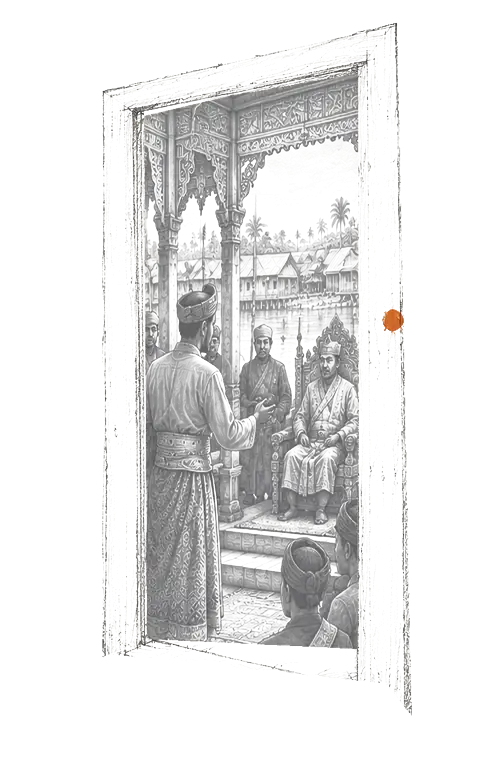
In the seventeenth century, after a cockfight, a son of Sultan Muhammad Ali kills the son of the Bendahara. The prince flees, and the sultan, who offers his own life, is put to death. The Bendahara ascends the throne under the name of Abdul Mubin, but a Kedayan chief urges vengeance, night attacks trouble the capital, and Brunei slides towards a civil war between two sultans.
Timeline
- 1847The Syair RakisA letter in verse to the sultan, after the loss of Labuan: the beginning of the country's modern Malay literature.
- 1951The first novelMahkota Berdarah appears in Jawi, the year of the coronation, with a preface by the sultan.
- 1984–1988Independence and oilBrunei becomes independent; Muslim Burmat tells of a family of fishermen caught up in the oil economy.
Reading keys
- A Malay man bears his given name followed by his father's, linked by bin; a woman, by binti.
- In formal usage, Awang precedes the name of a commoner and Dayang that of a woman.
- Pengiran denotes the hereditary nobility, and titles such as Pehin or Dato are conferred by the sultan.
- Haji or Hajjah is added to the name of one who has made the pilgrimage to Mecca.
- Malay Islamic monarchy is the ideology of the state, and the activity of political parties is severely restricted.
- Islamic criminal law was extended in two stages, in 2014 and then in 2019.
- The revolt of 1962, put down with British help, opened a state of emergency.
- During Ramadan, eating in public or refusing the refreshments offered is considered discourteous.
- Islam is the state religion, and the sultan is the head of the Muslim community.
- About two-thirds of the inhabitants are Muslims; Buddhists, mostly Chinese, make up about 13%, and Christians about 10%.
- Some indigenous peoples, Iban, Murut or Dusun, keep animist practices.
- Visits avoid prayer times, and one removes one's shoes before entering a mosque or a Muslim home.
- The great feasts are those of Islam: Hari Raya Aidilfitri, at the end of Ramadan, and Hari Raya Haji, at the time of the pilgrimage.
- The Malay wedding unfolds in several stages, from the proposal and the betrothal to the marriage contract and the reception, the bersanding.
- Muslim dead are buried without delay, and prayers, the takhil, follow the burial.
- One greets with a light handshake followed by a gesture towards the chest, and gives and receives with the right hand.
- Sultan Bolkiah and the empire that covered a large part of Borneo in the sixteenth century are the reference point of past greatness.
- The Syair Rakis, counsel to the sultan in the face of the English, is regarded as the birth certificate of the country's modern literature.
- Kampong Ayer, the water village, keeps the memory of the old town, and about one inhabitant in ten still lives there.
- The oil of Seria, exploited since 1929, is the backdrop of the country's wealth and modern life.
- Brunei is not part of Malaysia: it shares Borneo with Malaysian Sarawak and Sabah and Indonesian Kalimantan.
- Brunei Malay and the old spelling make the texts difficult even for a reader of modern Malay.
- The Syair Rakis is not an epic but a letter of counsel in quatrains.
- Bruneian novels are translated neither into French nor into English: the English titles given by critics are glosses.
A selection to begin with 2 / 3
- PoetrySyair RakisPengiran Indera Mahkota Muhammad Salleh · 1847not translated into EnglishA poem of counsel to the sultan, written when Brunei was losing its territories to the British and to Brooke.Literature
- NovelPuncak PertamaMuslim Burmat · 1988not translated into EnglishA family of fishermen caught up in the birth of Brunei's oil economy, from the 1950s to the 1980s.Literature