Cambodia
- works
- 16
- 11 books · 5 films
- period covered
- 1600–1998
- language of writing
- Khmer
In 1979, a handful of dancers were left alive. The Khmer royal ballet, whose gestures are sculpted on the walls of Angkor and which had been passed from mistress to pupil for centuries, had lost almost all its performers in four years: the Khmer Rouge had eliminated about nine artists in ten. The survivors found one another in the refugee camps and began to reconstitute the repertoire from memory, position by position, correcting each other's recollections. The dance exists today because a few women remembered, and because they were believed.
Read moreShow less
That erasure struck a culture that rested on direct transmission. Classical Khmer literature was written on palm leaves and kept in the monasteries, many of which were destroyed or turned into warehouses, and the monks massacred or sent back to the fields. The Reamker, the Khmer version of the Ramayana, was recited and danced more than it was read. Tum Teav, the story of a monk and a young girl separated by a forced marriage, is the national love narrative, learnt at school, and it ends very badly.
Modern literature was cut down twice. Rim Kin published in 1941 the first Khmer novel, about a poor child who succeeds, and Nou Hach in 1949 a critique of arranged marriage; that generation had laid the foundations of a social novel. Almost all those authors died between 1975 and 1979, with their manuscripts. What has been written since therefore starts from very low and often from abroad, and cinema was refounded by Rithy Panh, himself a survivor, who came back to film first the peasants, then, for thirty years, the memory of the crime.
What awaits the reader is a literature that counts its absent and a form that favours testimony, often at the cost of invention. The novel that opens this page is regarded as the first great success of the Khmer novel, in a country where people still wrote mostly in verse, and it was on the school syllabus from 1955 to 1975.
A way to begin
សូផាត
Rim Kin · 1941
The founding novel of Khmer prose, on Cambodia's school curriculum from 1955 to 1975.
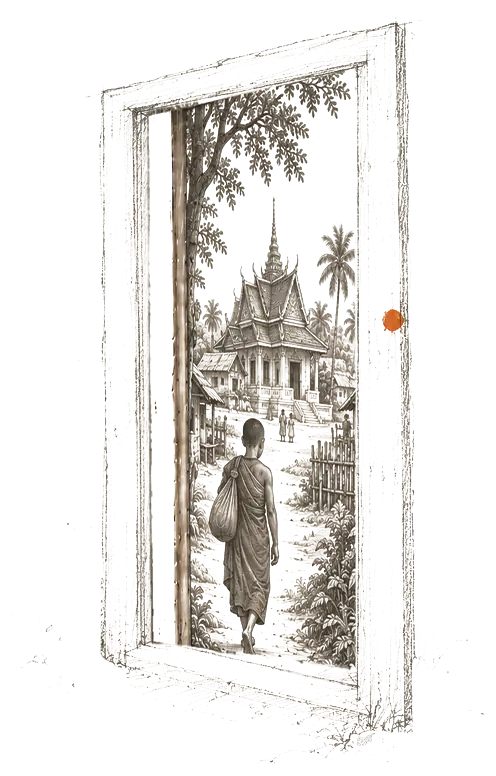
Suon, a civil servant in Sisophon, goes back to Phnom Penh, mindful of his career, leaving behind Soya, an orphan he has made pregnant. Their son Sophat, raised at the pagoda, sets out at twelve to look for his father in the capital, is taken in there by a rich family and falls in love with Man Yan, who lives under the same roof.
Timeline
- 1600–1620Classical textsThe Khmer Reamker and the praise of Angkor Wat, both in verse.
- 1915–1949Birth of the novelPreah Botumthera Som, Rim Kin, Nou Hach. Prose replaces verse.
- 1960–1972Golden ageSihanouk directs; Ly Bun Yim and Tea Lim Kun make a popular cinema.
- 1975–1979Khmer RougeAlmost the entire output is destroyed; authors disappear.
- 1988–1994RebuildingYvon Hem films again; Rithy Panh films the return to the village.
Reading keys
- The family name precedes the first name, contrary to French usage: Rim Kin's family name is Rim.
- Names are often monosyllabic and the first name may have two syllables; Western catalogues frequently reverse the order.
- Kinship terms strictly encode relative age, and one does not address an elder without the corresponding term.
- The extended family and the neighbourhood form the social unit, and many families were reconstituted after 1979 around survivors with no blood link.
- The Khmer Rouge regime, from 1975 to 1979, with nearly two million dead, structures all recent production, and the silence of the survivors is itself a subject.
- The individual responsibility of the former cadres, many of whom still live in the villages, is a locally dangerous subject.
- The monarchy and the Sihanouk period are judged in contrasting ways.
- Restraint is a value, and one does not recount one's misfortunes to a stranger without a long preparation.
- Theravada Buddhism is very much in the majority and was annihilated and then rebuilt: the monasteries were closed, the monks defrocked or killed between 1975 and 1979.
- The neak ta, protective spirits of a place or a village, receive offerings, and their permission is asked before building.
- The cult of the ancestors and the anxiety about the dead without burial weigh heavily in a country where thousands of bodies have never been found.
- The Brahmanism of the Angkorian origins survives in court rites, and the dancers are considered intermediaries with the gods.
- White is the colour of mourning, and close relatives shave their heads for the funeral of a parent.
- Cremation and then the keeping of the ashes in a family stupa close the mourning, and the absence of a body prevents that closure.
- Pchum Ben, the festival of the dead over fifteen days, requires carrying food to the ancestors in several monasteries.
- The Khmer New Year in April brings the country to a halt and imposes the return to the village.
- The Reamker, the Khmer version of the Ramayana, is known through dance, shadow theatre and the bas-reliefs of Angkor.
- Tum Teav, a tragic love narrative of the nineteenth century, is the school classic and has been brought to the cinema.
- The poem of Angkor Wat, from the seventeenth century, describes the temple at a time when nobody knew who had built it.
- The narratives about the neak ta and the naga serpent, mythical ancestor of the Khmer kings according to the foundation legend, are a common knowledge.
- Angkor is not a lost ruin rediscovered by the French: the monasteries there were active and the poem of 1620 bears witness to it.
- The family name precedes the first name, and Western bibliographies constantly get it wrong.
- Classical dance is not a tourist entertainment: it has a ritual status and was reconstituted at the cost of an effort of collective memory.
- The genocide is not the only subject of Khmer literature, which includes a social novel of the nineteen thirties and forties almost entirely destroyed.
Tales and mythologies 2
- EpicReamkerរាមកេរ្តិ៍Anonymous · 1600The Indian epic of Rama, known in Cambodia from the seventh century and sculpted at Angkor, rewritten in Khmer verse in a Buddhist spirit.Literature
- Poetryល្បើកអង្គរវត្តAnonymous · 1620not translated into EnglishAfter the capture of Longvek by the Siamese in 1594, the court of Oudong seeks to refound its power on the prestige of Angkor.Literature
Available in English 3
The books from this country that can be read in English, in the original or in translation.
- PoetryTum TeavទុំទាវPreah Botumthera Som · 1915A love story that has circulated in Cambodia since at least the middle of the nineteenth century, put into verse by a monk.Literature
- NovelA New Sun Rises Over the Old Landព្រះអាទិត្យថ្មីរះលើផែនដីចាស់Suon Sorin · 1961The great bestseller of Sihanouk's Cambodia, the life of a poor man of Phnom Penh before and after independence.Literature
- PoetrySacred VowsU Sam Oeur · 1998After the genocide, a poet trained in the United States reconstructs from memory the verses he had destroyed in order to survive.Literature
A selection to begin with 10 / 16
- PoetryTum TeavទុំទាវPreah Botumthera Som · 1915A love story that has circulated in Cambodia since at least the middle of the nineteenth century, put into verse by a monk.Literature
- Novelកុលាបប៉ៃលិនNhok Them · 1943not translated into EnglishUnder the French protectorate, the Khmer prose novel is in its beginnings, and its author comes out of the world of the pagodas.Literature
- Novelផ្កាស្រពោនNou Hach · 1947not translated into EnglishIn the time of the protectorate, the marriage arranged by the parents remains the rule in Cambodian families.Literature
- NovelA New Sun Rises Over the Old Landព្រះអាទិត្យថ្មីរះលើផែនដីចាស់Suon Sorin · 1961The great bestseller of Sihanouk's Cambodia, the life of a poor man of Phnom Penh before and after independence.Literature
- Feature filmApsaraអប្សរាNorodom Sihanouk · 1966In the sixties, the prince who governs Cambodia himself makes films to give his country another image.Cinema
- Feature filmThe Snake King's Wifeពស់កេងកងTea Lim Koun · 1970On the eve of the civil war, Khmer cinema, then flourishing, draws its greatest successes from the legends of the country.Cinema
- Feature filmAn Aeuy Srei Anអនអើយស្រីអនLy Bun Yim · 1972As war spreads through the country, the Khmer cinema of the golden age is still making its musical comedies.Cinema
- Feature filmShadow of Darknessស្រមោលអន្ធការYvon Hem · 1987Ten years after the fall of the Khmer Rouge, Cambodian cinema is reborn by telling the story of their years in power itself.Cinema
- Feature filmRice Peopleអ្នកស្រែRithy Panh · 1994After the genocide and two decades of war, a filmmaker returned from exile shoots in Cambodia, in Khmer, with a Cambodian crew.Cinema
- PoetrySacred VowsU Sam Oeur · 1998After the genocide, a poet trained in the United States reconstructs from memory the verses he had destroyed in order to survive.Literature