Cameroon
- works
- 40
- 34 books · 6 films
- period covered
- 1930–1996
- language of writing
- French and English
In 1896, the king of the Bamoun decided that his people would have their own script. Njoya devised a system of five hundred and ten signs, which he simplified over fourteen years until he obtained a syllabary of some sixty characters. He opened free schools, had copper type cast, printed, had treatises of medicine and law translated, and administered his kingdom in his own written language. After 1918, France banned the teaching of that script, destroyed the printing works, burnt the manuscripts and exiled the king in 1931.
Read moreShow less
That episode says what Cameroon is: a country where several sovereignties were superimposed and where none erased the previous ones. A German colony, then a territory divided between France and Britain, it today has two official languages inherited from that division and more than two hundred national languages, with the Grassland kingdoms in the west, forest societies in the south and Muslim emirates in the north. The country is sometimes said to be Africa in miniature, and that is true in the least flattering sense: every line of fracture of the continent passes through it.
The form Cameroon has pushed furthest is the satire of administration. Ferdinand Oyono published in 1956 the diary of a priest's houseboy who notes what he sees without understanding it, and the reader understands everything. Mongo Beti spent thirty years in exile and his most political book was banned in France, not in Cameroon. Cinema took over in the nineteen seventies, with Dikongué-Pipa filming a love story prevented by the bride price. The price was exile, censorship and a generation of authors published in Paris and read late at home.
What awaits the reader is an irony that passes through the naïve: the narrator does not judge, he records, and the accumulation makes the case. The novel that opens this page follows a young man torn between the free woman he loves and the wife his parents are negotiating for him, in a village on the outskirts of Douala.
A way to begin
Agatha Moudio's Son
Francis Bebey · 1968
A funny and tender novel, Grand Prix littéraire d'Afrique noire in 1968: a village on the outskirts of Douala and its gossip.
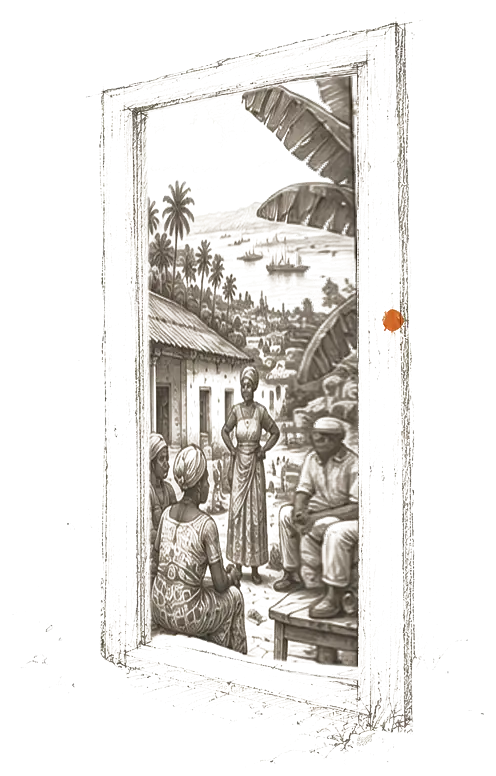
Mbenda loves Agatha Moudio, a free young woman whom the village rejects and his mother does not want for him; his parents negotiate his marriage to little Fanny, brought up according to custom. Agatha comes to smash the crockery at his house, gossip does the rest, and Mbenda finds himself torn between tradition and what he desires.
Timeline
- 1930–1955First writingsIsaac Moumé Etia, Njemba Medou. Duala and French at the same time.
- 1956–1965Oyono and Mongo BetiHouseboy, Mission to Kala. Colonial satire hits hard.
- 1966–1975After independenceBebey, Oyônô-Mbia, Philombé. Novel, theatre and music mingle.
- 1975–1987New voicesDikongué-Pipa and Kamwa on screen; Werewere Liking and Beyala on the page.
- 1995–1997The Bekolo generationBassek ba Kobhio, Bekolo, Teno. A recognised Cameroonian cinema.
Reading keys
- Names indicate the region and often the ethnic group: a Njoya comes from the Bamoun west, an Oyono from the Beti country in the south, a Bebey from the Douala coast, a Hausa or Fulani name from the Muslim north.
- The chiefdoms of the west are hierarchical and a chief, the fon, has real authority. A notable is not named without his title.
- The bride price, paid by the groom's family, is negotiated at length and its amount is a constant narrative stake.
- Classificatory kinship extends the terms brother and uncle, and a "brother" may be a cousin or a neighbour from the same village.
- The anglophone question, born of the colonial partition and become an armed conflict since 2016, is the country's most sensitive subject.
- The wars of independence and the repression of the maquis in the nineteen fifties and sixties were long erased from official narratives.
- Criticism of power proceeds by the fable, animal allegory or the historical novel.
- Sorcery is a grave accusation and not a superstition. A suspected character is in real danger.
- Three ensembles share the territory: Christianity in the south and the west, Islam in the north, ancestral cults everywhere beneath them.
- Sorcery, often called famla or ekong according to the region, explains success as well as misfortune, and rapid enrichment is always suspect.
- The masked initiatory societies of the west, including the Grassland masks, are political institutions as much as ritual ones.
- The skull of the ancestors, kept and consulted, is the place of the link with the dead in several societies of the south.
- Funerals take place in two stages: the burial, then months or years later the "funerals" proper, a costly celebration that releases the dead person and the family. A character who has not held his father's funerals is at fault.
- The return to the village for those ceremonies structures the life of city dwellers and of emigrants.
- Masks and the dress of initiatory societies identify rank and occasion.
- The calendar mixes Christian feasts, Muslim feasts and chiefdom ceremonies.
- The Douala fables published from 1930 by Isaac Moumé Etia, the first Cameroonian author in print, constitute the country's first written corpus.
- The Bulu and Fang narratives of the south, with their heroes and their forest spirits, form the southern narrative stock.
- The spider and the cunning tortoise are the tricksters of the southern tales, as elsewhere in West Africa.
- King Njoya and his script are a reference of national pride, and his palace at Foumban a place of memory.
- "Africa in miniature" is an official formula that masks a country crossed by real linguistic and regional conflicts.
- Official bilingualism is not a balance: the anglophone minority contests its place, and the subject is an armed one.
- The bride price is not a purchase of the woman but a transfer between families, with reciprocal obligations and the possibility of restitution.
- Late funerals are not a delay but a second ceremony that is planned and expected.
Tales and mythologies 2
- TaleLes Contes et légendes du BamilékéMartin Sop Nkamgang · 1970not translated into EnglishThe spoken word of Bamileke evening gatherings set down in writing in French, and published at the author's own expense.Literature
- TaleLes Fables de DoualaIsaac Moumé Etia · 1930not translated into EnglishDouala around 1930, where a writer and linguist sets down in writing what was told in his community.Literature
A selection to begin with 10 / 40
- NovelHouseboyUne vie de boyFerdinand Oyono · 1956A town in colonial Cameroon seen from the pantry, by a houseboy whom the whites pay no attention to.Literature
- NovelMission to KalaMission terminéeMongo Beti · 1957A schoolboy who has failed his exams among villagers of the interior, who take him for a learned man.Literature
- NovelBecause of WomenMbella Sonne Dipoko · 1969A Cameroonian village on the riverbank, its work, its intrigues and its love affairs.Literature
- Feature filmMuna MotoJean-Pierre Dikongué-Pipa · 1975The Cameroonian countryside of the mid-seventies, where money wins out over one's given word.Cinema
- NovelThe White Man of GodKenjo Jumbam · 1980A child of Nso country caught between the Catholic mission and his grandmother's religion, in the English-speaking part of Cameroon.Literature
- NovelIt Shall Be of Jasper and CoralElle sera de jaspe et de corailWerewere Liking · 1983A diary kept by a woman who invents the word she needs to name herself, and dreams of a humanity to come.Literature
- Feature filmThe Great White Man of LambarénéLe Grand Blanc de LambarénéBassek ba Kobhio · 1995Colonial Gabon, from the forties to independence, around a hospital founded by a European admired throughout the world.Cinema
- DocumentaryAsientosFrançois Woukoache · 1995Gorée, off Dakar, a major site of the Atlantic slave trade, seen from Africa in the mid-nineties.Cinema
- Feature filmAristotle's PlotJean-Pierre Bekolo · 1996Southern Africa, at the moment when a hundred years of cinema are being celebrated and when the continent's screens show mostly Hollywood.Cinema
- Feature filmClandoJean-Marie Teno · 1996Douala in the mid-nineties, under repression, and Cologne, where Cameroonian émigrés live.Cinema