Colombia
- works
- 49
- 33 books · 16 films
- period covered
- 1589–1994
- language of writing
- Spanish
In December 1928, the Colombian army fired on banana plantation workers gathered in a square at Ciénaga. The number of dead has never been established: the official reports count a few dozen, other sources far more. In 1967, a novelist born in the region wrote a scene in which three thousand bodies are loaded onto a train, and that is the figure Colombians have quoted ever since. The novel did not replace the archive by mistake: it occupied the place the archive refused to hold, and its author owned that.
Read moreShow less
It is a good way into a country where violence is a named object of historiography. La Violencia is the name given to the latent civil war from 1948 to 1958, set off by the assassination of a presidential candidate, and the conflict that followed lasted half a century. Colombian literature produced an entire genre about it, called the novel of the violence, and the country also has a geography that isolates: three cordilleras, a Caribbean coast, a mostly Afro-Colombian Pacific coast, an Amazon, regions that do not speak to one another.
From that dispersal comes a remarkable formal inventiveness. José Eustasio Rivera published in 1924 the journal of a man lost in the rubber forest, which ends with the sentence the jungle swallowed them. Jorge Isaacs had given in 1867 the most widely read love novel on the continent. Manuel Zapata Olivella brought African memory into the national literature. Álvaro Mutis invented a wandering sailor who runs aground everywhere. Cinema developed late but as early as 1927 a film, now recovered, accused the United States of having stolen Panama.
What awaits the reader is a prose of avowed abundance and a national memory that passes through fiction for want of reliable archives. The novel that opens this page announces a murder in its first line, then tells, as an inquiry, how a whole town knew and did nothing.
A way to begin
Chronicle of a Death Foretold
Gabriel García Márquez · 1981
A murder announced in the first line that a whole town lets happen: a million copies in the first printing.
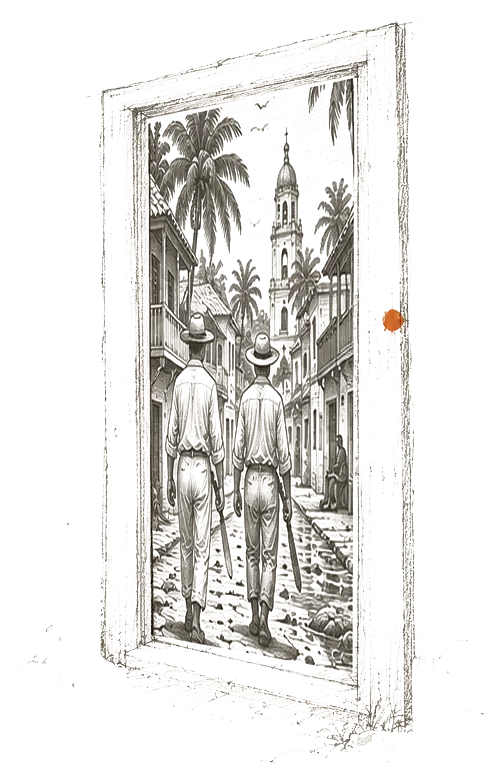
Bayardo San Román sends his wife back to her mother on their wedding night. Ángela Vicario's brothers make her name a man, sharpen their butcher's knives and tell anyone who will listen that they are going to kill Santiago Nasar. The whole village learns of it in a morning, and everyone believes someone else will warn him, or that no one will go through with it.
Timeline
- 1867MaríaThe great Romantic novel of Latin America, read everywhere in the nineteenth century.
- 1948–1960La ViolenciaA smouldering civil war, three hundred thousand dead, haunting all the literature that follows.
- 1967One Hundred Years of SolitudeGarcía Márquez gives the continent its book, and the world magical realism.
Reading keys
- The Spanish usage of two surnames applies, and one classifies by the father's name.
- The names of the Caribbean coast and those of the Andean interior differ by their accent more than by their form, and speech places a character socially more than the surname does.
- The extended family, compadrazgo and godparenthood organise solidarities and obligations.
- The Afro-Colombian communities of the Pacific have Spanish names and an organisation by family trunks that structures access to land.
- La Violencia, the armed conflict and the massacres committed by every camp form a history in which every account is situated and in which writing has cost journalists their lives.
- The banana plantation massacre of 1928 is a textbook case: the official figures and the collective memory diverge by a factor of a hundred.
- The mass graves and the disappeared are the object of judicial work in progress.
- Drug trafficking is an omnipresent subject that literature approaches while generally refusing the aesthetic of the heroic criminal.
- Catholicism is very much in the majority and its political influence was considerable until the nineteen sixties.
- The Afro-Colombian communities of the Pacific practise sung funeral rites, including the chigualo for dead children, and the currulao to the drum.
- The Muisca cults have disappeared as a practice but their narratives, preserved by the chroniclers, found the imagery of El Dorado.
- The Kogi of the Sierra Nevada have maintained a complete cosmology, with priests trained in darkness for years, and they call themselves guardians of the world.
- The wake and the nine days of prayers organise the mourning, with specific songs on the Pacific coast.
- Black is worn in mourning, and white for dead children, whose wake is sung and not wept.
- The carnival of Barranquilla, listed as intangible heritage, mixes cumbia, congo dances and masks, and lasts four days.
- The Holy Week of Popayán and the festivals of the Virgin of Carmen mark the religious calendar.
- The Muisca narratives preserved by the chronicler Pedro Simón in 1626, with Bachué emerging from the lake and Bochica the civiliser, are the principal source on that vanished world.
- El Dorado, the investiture rite of the Muisca sovereign on Lake Guatavita transformed by the Spaniards into a legend of a golden city, is a textbook case of a myth fabricated by the desire of the conquerors.
- La Madremonte and el Mohán, spirits of the forests and the rivers, are a living bestiary in the countryside.
- Macondo, a village invented in 1967, has become a common noun that Colombians use to designate their own country.
- Magic realism is not a way of making Colombia exotic: it is an answer to a country in which the facts themselves are implausible and badly established.
- Colombia is not a homogeneous Andean country: the Caribbean coast, the Afro-Colombian Pacific and the Amazon are three distinct worlds.
- El Dorado was not a city but a rite, and the legend is a European production.
- The country has an old and learned literary tradition, with Bogotá nicknamed the Athens of South America in the nineteenth century.
Tales and mythologies 1
- ChronicleHistorical Accounts of the Conquests of Tierra FirmeNoticias historiales de las conquistas de Tierra FirmePedro Simón · 1627The Muisca narratives and the ceremony of the gilded chieftain, recorded by a Franciscan.LiteraturePublic domain
A selection to begin with 10 / 49
- NovelMaria: A South American RomanceMaríaJorge Isaacs · 1867Two cousins raised together fall in love on a hacienda in the Cauca, and one must leave for Europe.LiteraturePublic domain
- NovelThe VortexLa vorágineJosé Eustasio Rivera · 1924A man follows into the forest the woman who was taken from him, and comes upon the plantations hidden there.LiteraturePublic domain
- CinemaBambucos y corazonesGabriel Martínez · 1945A sung comedy in which the airs of the Andes take precedence over the story.Cinema
- NovelTierra mojadaManuel Zapata Olivella · 1947not translated into EnglishRice growers of the Sinú, and the land that is slowly slipping away from them.Literature
- CinemaThe Blue LobsterLa langosta azulÁlvaro Cepeda Samudio · 1954An agent who has come to find radioactive lobsters loses his own, and the film becomes the portrait of a village.Cinema
- CinemaColombia lindaCamilo Correa · 1955Sung numbers and tableaux of the regions, held together by a slender narrative thread.Cinema
- CinemaEl milagro de la salLuis Moya Sarmiento · 1958Salt, the mine and the cathedral carved out within it, between reportage and melodrama.Cinema
- CinemaPasado el meridianoJosé María Arzuaga · 1965An office clerk is refused leave to bury his mother, and the day goes on.Cinema
- NovelLiveforever¡Que viva la música!Andrés Caicedo · 1977An heiress leaves her milieu for the orchestras and the streets of Cali.Literature
- NovelThe Snow of the AdmiralLa nieve del AlmiranteÁlvaro Mutis · 1986A man travels up a river towards sawmills that he already knows will bring him nothing.Literature