Egypt
- works
- 56
- 33 books · 23 films
- period covered
- 1881–1998
- language of writing
- Arabic
An Egyptian speaks and the whole Arab world understands. That is true of no other dialect, and there is nothing natural about it: it is the result of a century of films, songs and radio serials broadcast from Morocco to Iraq. Cairo produced from the nineteen thirties hundreds of feature films per decade, with its studios, its stars and its supreme star, Umm Kulthum, listened to on the first Thursday of every month by millions of people. An industry imposed a language on an entire region.
Read moreShow less
That cultural power has an ancient depth. Egypt is the first Arab country to have had a printing press, installed at Bulaq in 1820, which republished the classics and launched the intellectual renaissance of the nineteenth century. It produced the first modern Arabic novel in 1914, the first literary autobiography with the blind Taha Hussein in 1929, and the first Arabic feature fiction film, produced and acted in 1927 by a woman, Aziza Amir. Cairo was long the place where people came to publish when they could not publish at home, and a good part of the century's Arabic literature first appeared there.
The dominant form is urban realism, with the neighbourhood as narrative unit. Naguib Mahfouz wrote a whole city street by street, received the Nobel prize in 1988, and at eighty-two was stabbed in the neck for a novel written thirty-five years earlier. Youssef Chahine filmed railway stations, slums and his own life for fifty years. Nawal al-Saadawi, a doctor, wrote the bodies of women and paid for it with prison and exile. The price was religious censorship as much as political.
What awaits the reader is a literature of the street and the café, in which the collective counts for more than the individual and in which one alley suffices to contain a world. The novel that opens this page is set in an alley of old Cairo during the war, and it makes that alley a microcosm of Egyptian society.
A way to begin
Midaq Alley
Naguib Mahfouz · 1947
An alley in old Cairo and its inhabitants during the war, by the first Arabic-language writer to win the Nobel Prize.
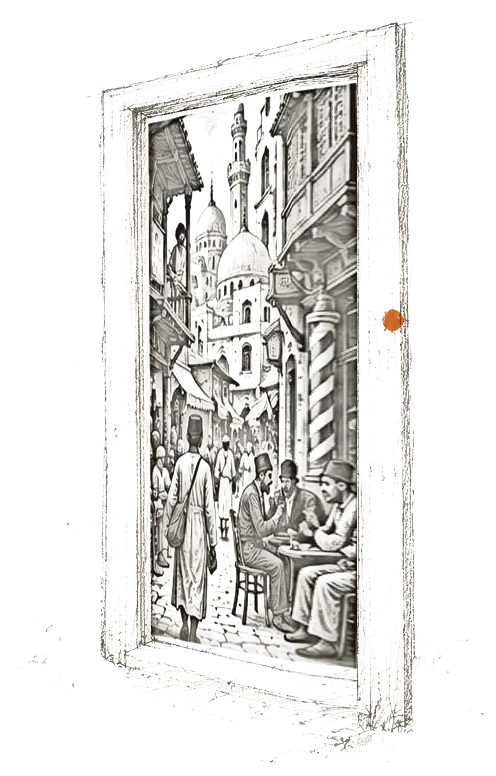
In an alley of old Cairo near Khan al-Khalili, in the mid-1940s, a small society lives cheek by jowl: the Kirshas' café, Abbas the barber, Umm Hamida the matchmaker, Zaita who manufactures cripples for begging, the rich merchant Salim Alwan. Hamida, beautiful and ambitious, dreams of escaping the alley; to win her, Abbas joins the British army, while the war dangles other lives before each of them.
Timeline
- -1900Ancient EgyptThe Shipwrecked Sailor, Sinuhe. The oldest written narratives that have reached us.
- 1870–1920NahdaThe Arab renaissance sets out from Cairo and Beirut: press, novel, theatre.
- 1930–1960The Egyptian novelTaha Hussein, then Mahfouz, who gives Cairo its Balzac.
- 1940–1960Hollywood on the NileEgyptian cinema supplies the whole Arab world. Umm Kulthum reigns.
- 1952–1970NasserismEnthusiasm, then the 1967 defeat, which runs through all of literature.
Reading keys
- The name reads as a genealogy, often reduced to three elements: first name, father's first name, grandfather's first name. There is not always a fixed family name.
- The compound first name with Abd, "servant of", followed by a divine name, is not to be cut: Abd al-Rahman is a single first name.
- The kunya, "father of" followed by the name of the eldest child, is the respectful form of address in constant use.
- Copts bear Christian first names that identify them immediately, and that legibility is a social fact.
- Religion is the most dangerous subject: several authors have been prosecuted for blasphemy, a novel by Mahfouz remained banned for decades, and its author was attacked because of it.
- Criticism of the army and of the president is legally risky under every regime since 1952.
- Sexuality is a constant theme of the Egyptian novel and a permanent motive for censorship.
- Refusal is expressed by a pious formula, and the host's insistence is part of politeness.
- Sunni Islam dominates, with al-Azhar as a thousand-year-old institution whose opinion has the force of moral authority.
- The Orthodox Copts, about a tenth of the population, form one of the oldest churches in the world, with its own calendar and its fasts.
- Popular Sufism, with its brotherhoods and the moulids, festivals around the tomb of a saint, gathers enormous crowds and provides a frequent narrative setting.
- The jinn belong to Quranic cosmology, and the zar, possession rites practised above all by women, coexist with official Islam.
- Muslim mourning is brief, with burial on the same day, condolences for three days under a tent set up in the street, and a commemoration on the fortieth.
- Black is worn for a long time by bereaved women, notably in the countryside.
- Ramadan reverses the rhythm of the city, with its evening gatherings, its lanterns and its television serials awaited all year.
- Sham el-Nessim, the spring festival inherited from ancient Egypt, is celebrated by Muslims and Copts alike.
- The tales of the papyri, including the Tale of the Two Brothers, translated into French as early as 1882, are the oldest reference and serve as a national pride.
- The Thousand and One Nights, whose Egyptian recension is the most widely circulated, are a common material that literature reworks.
- The moulids and the vocabulary of popular Sufism are a shared knowledge that the texts do not translate.
- Umm Kulthum and the repertoire of songs she imposed constitute a reference quoted in novels as a common stock.
- Ancient Egypt and contemporary Egypt are two distinct objects, and Egyptian literature speaks almost exclusively of the second.
- The Egyptian dialect is understood everywhere in the Arab world, but the reverse is not true: an Egyptian does not spontaneously understand a Moroccan.
- The Copts are not a recent minority but the descendants of the Egyptian population from before arabisation.
- The strength of the Egyptian culture industry does not imply freedom: the country has one of the oldest and most active censorships in the region.
Tales and mythologies 1
- TalePopular Stories of Ancient EgyptLes Contes populaires de l'Égypte ancienneAnonymous · 1881Some twenty ancient Egyptian tales, from court magic to metamorphoses, gathered in a single volume.Literature
A selection to begin with 10 / 56
- CinemaLailaليلىAziza Amir · 1927An oasis girl abandoned while pregnant by her fiancé, in a silent film that opens Egyptian cinema.Cinema
- NarrativeThe DaysالأيامTaha Hussein · 1929The childhood of a boy deprived of sight in an Egyptian village, then his student years, told by the adult he has become.Literature
- CinemaCairo Stationباب الحديدYoussef Chahine · 1958A crippled newspaper seller, a drinks seller and the crowd of a great railway station.Cinema
- PoetryThe Book of QuestionsLe Livre des questionsEdmond Jabès · 1963Two lovers separated by deportation, invented rabbis, and a book that questions itself.Literature
- CinemaLast Nightالليلة الأخيرةKamal El Sheikh · 1963After a bombing, a woman loses fifteen years of her life, and no one around her calls her by her name any more.Cinema
- NovelThat Smellتلك الرائحةSonallah Ibrahim · 1966A former political prisoner, watched every evening, relearns a city that no longer expects him.Literature
- CinemaThe Night of Counting the YearsالمومياءShadi Abdel Salam · 1969The son of a tribal chief discovers that his people have always lived off the looting of a royal cache.Cinema
- CinemaAdrift on the Nileثرثرة فوق النيلHussein Kamal · 1971A disillusioned civil servant discovers, on a Nile houseboat, a circle that smokes so as to stop seeing the country.Cinema
- NovelZayni Barakatالزيني بركاتGamal al-Ghitani · 1974A puritan administrator holds Cairo of the last Mamluks through his spies, in a political fable.Literature
- NovelThe Fall of the Imamسقوط الإمامNawal El Saadawi · 1987An orphan with no father's name, in a country with no name ruled by an Imam in the name of divine law.Literature