Eritrea
- works
- 11
- 10 books · 1 film
- period covered
- 1902–1996
- language of writing
- Tigrinya
During the war of independence, the Eritreans installed a printing works underground. In the mountains of the north, around Nakfa and Orota, the front dug galleries to shelter a hospital, workshops, a school and a press, all of it out of reach of the bombing. Newspapers, textbooks and collections of poems in Tigrinya and in Arabic were composed there and distributed in the liberated zones. Thirty years of war, from 1961 to 1991, produced a literature of the maquis with its authors, its readers and its print runs, and a generation trained to read in the trenches.
Read moreShow less
There was nevertheless a writing long before that. Eritrea shares the Geez alphabet with Ethiopia, and Tigrinya has been written since the nineteenth century. Ghebreyesus Hailu wrote a short novel, published in 1950, about Eritrean conscripts sent by Italy to fight in Libya, a lucid text on the condition of the colonial soldier and one of the very first novels written in an African language. Asmara was then an Italian city of modernist architecture, with its cinemas, its cafés and its theatre in Tigrinya.
The dominant form is therefore poetry and theatre rather than the novel, with a direct relation to the audience. Yacob Ghebreyesus published in 1949 a collection of legends, tales and proverbs that remains the reference collection. Teklai Zeweldi wrote in 1954 a novel about freedom. The price began after independence: since 2001 there has been no independent press in the country, national service is of indefinite duration, and a large part of the writers have left. Eritrean literature is today published in Europe and North America.
What awaits the reader is a sober, restrained writing, in which endurance is the subject and not the setting. The novel that opens this page follows an Eritrean askari sent into Italy's Libyan war, and it is among the first novels written in Tigrinya.
A way to begin
The Conscript
Ghebreyesus Hailu · 1950
The first novel in Tigrinya: an Eritrean askari in Italy's Libyan war, written in 1927 and translated into English.
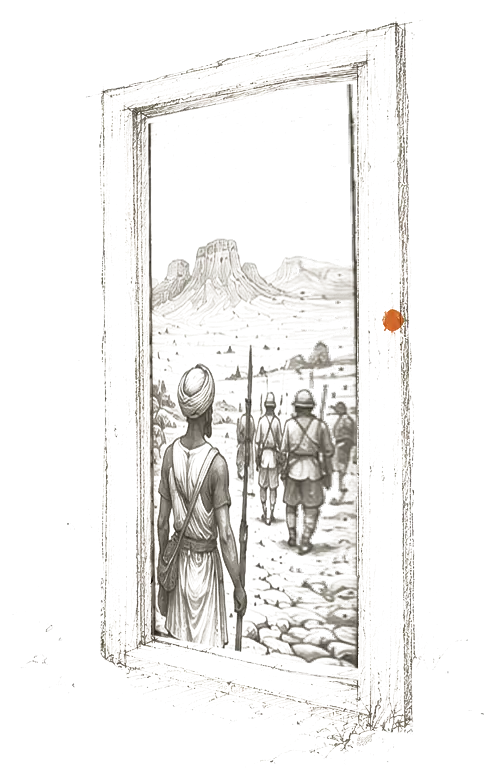
Tuquabo, only son of a well-off family in Italian Eritrea, is won over by the propaganda celebrating the Libyan war and enlists as an askari in the colonial troops. He discovers the burning desert, conscripts without shoes, Italian officers who treat their soldiers like beasts, and gradually understands that he is fighting someone else's war, against men defending their own country.
Timeline
- 1902–1927First texts in TigrinyaGhebre-Medhin Dighnei, then Ghebreyesus Hailu's The Conscript.
- 1949–1954Tales and narrativesYacob Ghebreyesus, Zegga-Iyesus Iyasu, Teklai Zeweldi.
- 1988–1996After the warErminia Dell'Oro writes Asmara from Italy; cinema starts again.
Reading keys
- There is no family name: everyone bears his first name followed by that of his father, as in Ethiopia.
- First names are often religious phrases in Geez: Ghebreyesus means "servant of Jesus", Tesfai "my hope".
- Names make it possible to distinguish the Christian Tigrinya of the highlands from the Muslim populations of the lowlands, Tigre, Afar, Saho, which is a major social datum.
- Kinship is thought through lineage and village of origin, and belonging to the village remains determining including in the diaspora.
- The regime in place since 1991, the absence of elections and the indefinite national service are unsayable inside the country.
- The war with Ethiopia from 1998 to 2000 and the question of the border are subjects officially closed and really open.
- The division between Christian highlands and Muslim lowlands is a politically sensitive subject.
- Restraint is valued, and the expression of suffering passes for a weakness.
- Tewahedo Orthodox Christianity dominates the highlands, Sunni Islam the lowlands, and the two share the country almost equally.
- The Orthodox calendar, with its thirteen months and its gap of seven to eight years, is the same as in Ethiopia.
- The zar, possession spirits, and the associated healing rites have been documented since the beginning of the twentieth century.
- Local saints and the mountain monasteries are ancient places of pilgrimage.
- Mourning includes a wake, a swift burial and lamentations sung by the women.
- The white of the cotton shawl is the garment of religious ceremonies.
- The Orthodox fasts, very numerous, structure food and therefore meal scenes.
- 24 May, the day of independence in 1991, is the great civil landmark.
- The Tigrinya legends, tales and proverbs published in 1949 form the country's reference corpus.
- The Tigre texts collected between 1910 and 1915 by an American expedition, with songs, proverbs and possession narratives, constitute the most extensive documented corpus.
- The narratives of the war of independence and the songs of the maquis are a memory shared by a whole generation.
- The Geez stock and the Kebra Nagast are common with Ethiopia, including in the dispute over their ownership.
- Eritrea is not an Ethiopian province: it was an Italian colony, which gave it a distinct history, architecture and administrative language.
- The country is half Muslim, which the image of a Christian Horn makes disappear.
- Names do not function as surnames, and cataloguing an author under his father's name is an error.
- The absence of recent literary production inside the country does not indicate an absence of literature, but a complete displacement towards the diaspora.
Tales and mythologies 3
- TaleApologhi ed aneddoti volti in lingua TigriññaGhebre-Medhin Dighnei · 1902not translated into EnglishIn the Italian colony of Eritrea, fables and tales of the highlands pass into writing in Tigrinya and are printed in Rome in Ethiopic script.Literature
- TaleZennan tereten qeddamotYacob Ghebreyesus · 1949not translated into EnglishUnder British administration, a priest and schoolteacher has the tales and proverbs of the country printed in Asmara, in Tigrinya, for his pupils.Literature
- TalePublications of the Princeton Expedition to AbyssiniaEnno Littmann · 1910At the beginning of the twentieth century, in Italian Eritrea, a German scholar and a young Tigre man of letters set down in writing an oral tradition.Literature
Available in English 2
The books from this country that can be read in English, in the original or in translation.
- NovelThe Conscriptሓደ ዛንታGhebreyesus Hailu · 1950Italy sends soldiers recruited in its Red Sea colony to conquer Libya: an ascari draws an anticolonial novel from it.Literature
- NovelMezghebe: Would You Say He Was Mad?Abidu do tibluwoBeyene Haile · 1965In Eritrea under the Ethiopian federation, a young author writes in Tigrinya the novel of a painter whom those around him consider mad.Literature
A selection to begin with 7 / 11
- PoetryHow the World Was Set Ablaze because of Two SerpentsAnonymous · 1916not translated into EnglishIn the midst of the Great War, an anonymous poem in Tigrinya, printed in Rome, reads the European conflict as a war of religion.Literature
- Narrativenə’əgziabəher zəsa’ano nəgär yälbon. tənsa’en ‘awätənZegga-Iyesus Iyasu · 1950not translated into EnglishAround 1950, one of the first long narratives in Tigrinya takes the form of a religious allegory.Literature
- Novelwägahta natsənätTeklai Zeweldi · 1954not translated into EnglishDuring the federation with Ethiopia, a novelist tells, in Tigrinya, the story of a family that opposes Italian colonisation from one generation to the next.Literature
- NovelMezghebe: Would You Say He Was Mad?Abidu do tibluwoBeyene Haile · 1965In Eritrea under the Ethiopian federation, a young author writes in Tigrinya the novel of a painter whom those around him consider mad.Literature
- NovelAsmara addioErminia Dell'Oro · 1988not translated into EnglishAt a time when Italy speaks little of its colonial past, a child of Asmara tells of the colony from the inside.Literature
- PoetryAulò. Canto-poesia dall'EritreaRibka Sibhatu · 1993not translated into EnglishAn Eritrean woman takes up her country's oral poetry to tell of her life and of exile, in a bilingual edition.Literature
- CinemaBarud 77Bereket Yowhannes · 1996A few years after independence, former amateurs found a national cinema in Tigrinya, nourished by the war.Cinema