Estonia
- works
- 58
- 48 books · 10 films
- period covered
- 1861–2000
- language of writing
- Estonian
The first book printed in Estonian no longer exists except in pieces. It was a Lutheran catechism that came off the presses of Wittenberg in 1535, and it is known only through fragments found in 1929 by a historian in the archives of Tallinn. The texts that follow are the work of German pastors, who wrote Estonian with the grammar of German and for the use of worship.
Read moreShow less
The language was therefore put into writing by those who held the country. The Baltic German barons had owned the land since the thirteenth century, serfdom was lifted only between 1816 and 1819, and Estonian remained until the nineteenth century a language of peasants without a literature of its own. The reversal was rapid: an epic in 1861, a collection of runic songs that gathered tens of thousands of pages, song festivals from 1869, and two generations later a country that read its own novels.
The Estonian form is the long narrative backed onto land and law. Tammsaare constructed from 1926 five volumes about a farm, a ditch and a lawsuit that lasts a lifetime. The price was exile or the camp. After 1944, half the writers left: Kalju Lepik published in Sweden, Arved Viirlaid in Canada, and their books did not circulate at home. Jaan Kross, deported in 1946 and back eight years later, chose the historical novel in order to say in the nineteenth century what could not be written in the twentieth, and his tsar's madman of 1978 is a man punished for having written the truth to the emperor. The year 1949 sees the appearance of a poem to Stalin signed by a writer who would become an official classic.
What awaits the reader is a slow prose, attached to labours and seasons, and a poetry that served as a common language when prose was under surveillance. The poem that opens this page was composed by a doctor from Võru, who wove folk songs and tales together with his own verse, and it appeared from 1857 to 1861 in bilingual instalments, at the time of the national awakening.
A way to begin
Kalevipoeg
Friedrich Reinhold Kreutzwald · 1861
The epic in twenty cantos that became the founding text of Estonian culture, free of rights.
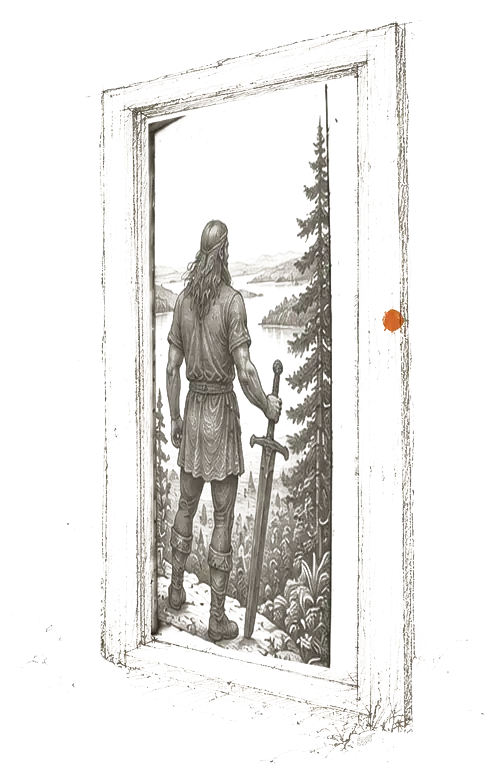
Born after the death of his father, King Kalev, the giant Kalevipoeg sets out for Finland to look for his mother Linda, abducted by a sorcerer: he swims across the sea, kills the abductor and buys the sword his father had ordered from a smith, but, drunk at a banquet, he kills the smith's son, and the smith curses the weapon. Back home, he reigns, ploughs, builds towns and descends to the underworld to face the Horned One.
Timeline
- 1862–1900National awakeningThe Kalevipoeg, Koidula, Vilde. Writing Estonian against the German of the landlords.
- 1905–1925Young Estonia and SiuruSuits, Under, Tuglas. Europe enters Estonian poetry all at once.
- 1926–1940TammsaareTruth and Justice gives the country its great peasant novel.
- 1944–19601944, exileFourteen writers leave the same year; Kangro publishes freely in Lund.
- 1962–1988Thaw and returnKaplinski, Runnel, Kross, and a national cinema at Tallinnfilm.
Reading keys
- Many surnames were assigned by the German proprietors at emancipation, often German words or farm names, then Estonianised en masse in the nineteen thirties: the same man may appear under two names according to the date.
- The name of the farm precedes the name of the person in old rural usage, and the characters of a novel are designated by their holding as much as by their family.
- First names follow the successive waves, German Lutheran, then national ones drawn from the songs, then Russian during the Soviet period.
- Kinship is counted narrowly, and belonging to a parish or an island, Saaremaa, Hiiumaa, Setomaa, places a character more surely than his occupation.
- The deportations of 1941 and of 1949, mobilisation into both armies and collaboration are an ensemble on which every family has a version, and a text situates itself by what it leaves unsaid.
- The Soviet occupation is called an occupation, and speaking of voluntary annexation or of liberation is a political position.
- The Russian-speaking minority, a quarter of the population, citizenship and the language of instruction are constantly open subjects.
- The Setos and the Võros, with their southern languages, claim a difference that the national norm long erased.
- Lutheranism was the religion of the German administration, and practice today is among the weakest in Europe, which does not prevent the rites of passage.
- The late Christianisation imposed by the crusade explains the persistence of a pre-Christian stock: spirits of places, sacred trees, offering stones still visited.
- The runic songs, in eight-syllable lines without rhyme, are a ritual form as much as a poetry, carried above all by women.
- The Orthodox north-east and the community of Russian Old Believers of Lake Peipus form a second religious landscape, with its villages and its prohibitions.
- The song festival, every five years in Tallinn, gathers tens of thousands of choristers, and it served as a political form in 1988, in what was called the singing revolution.
- Midsummer, the shortest night of the year, with fires and a vigil, is the great popular festival, ahead of Christmas.
- 24 February, the independence day of 1918, and 20 August, that of 1991, are two distinct dates that a text never confuses.
- The cemeteries are maintained like gardens, with candles lit on Christmas eve, and the visit to the dead is a family obligation.
- The epic of 1862 and Kreutzwald's collection of tales, published in 1866, form the common school base.
- Jakob Hurt's collection of songs, between 1875 and 1907, with its thousands of named informants, is the source from which the epic was drawn, and its existence recalls that the epic is a composition.
- The character of the son of Kalev, a giant builder ploughing the sea, serves as an ironic reference as much as a patriotic one.
- The manors, the hundred and eighty years of serfdom and the village lawsuit are the default setting of the nineteenth-century novel.
- Estonian is neither a Baltic nor a Slavic language: it is a Finno-Ugric language, close to Finnish, with no grammatically marked gender and no future tense.
- The country is not Scandinavian, but its cultural horizon is more so than that of its southern neighbours, and it looks towards Helsinki.
- The national epic is not a transcribed oral tradition, it is a scholarly reconstitution of the nineteenth century, and Estonians know it.
- A major part of twentieth-century literature was written outside the country and published in Stockholm or Toronto: an author's absence from the Soviet catalogues does not prove his silence.
- The singing revolution is not an image: the gatherings of choristers were the material setting of independence.
Tales and mythologies 3
- EpicKalevipoegFriedrich Reinhold Kreutzwald · 1861An epic in twenty cantos composed in the nineteenth century from legends and folk songs, in the time of the national awakening.Literature
- TaleVõrumaa jutudJuhan Jaik · 1924not translated into EnglishTales of devils, river creatures and peasants of south-eastern Estonia, between dread and mischief.Literature
- PoetryVana kannelJakob Hurt · 1875not translated into EnglishWhat two Estonian parishes used to sing, published with the variants collected.Literature
A selection to begin with 10 / 58
- NovelTruth and JusticeTõde ja õigusAnton Hansen Tammsaare · 1926Five volumes and half a century of Estonia, from a marsh farm to the town and the revolution.LiteraturePublic domain
- PoetryNägu koduaknasKalju Lepik · 1946not translated into EnglishFirst poems of the Swedish exile, turned towards the childhood home and the lost country.Literature
- PoetryPoeem StalinileJuhan Smuul · 1949not translated into EnglishA long poem in praise of the Soviet leader, written in 1949 by an islander of twenty-seven.Literature
- CinemaValgus KoordisGerbert Rappaport · 1951A postwar village being pushed into the kolkhoz, filmed by the authorities who are pushing it.Cinema
- NovelGraves Without CrossesRistideta hauadArved Viirlaid · 1952Resistance fighters sheltering in the Estonian forests, in the autumn of the second Soviet occupation.Literature
- CinemaThe Last RelicViimne reliikviaGrigori Kromanov · 1970A relic worth its weight in gold, a free man, a girl promised to another, and songs of freedom.Cinema
- CinemaSpringKevadeArvo Kruusement · 1970A country school of long ago, its pranks and its first, silent love.Cinema
- CinemaAsk the Dead About the Price of DeathSurma hinda küsi surnuteltKaljo Kiisk · 1977A condemned revolutionary, offered his life in exchange for a recantation, in the Estonia of 1925.Cinema
- NovelThe Czar's MadmanKeisri hullJaan Kross · 1978A Baltic nobleman facing absolute power, seen through the diary of his peasant brother-in-law.Literature
- CinemaThe Master of KõrbojaKõrboja peremeesLeida Laius · 1979A farm girl back from the city, a neighbour out of prison, and a piece of land waiting for its master.Cinema