Grenada
- works
- 5
- 5 books
- period covered
- 1970–1992
- language of writing
- English
In October 1983, a revolution destroyed itself in a week. Since 1979, Grenada had been governed by a movement that had opened schools, clinics and cooperatives, and that had made culture an instrument of popular education. An internal struggle led to the execution of the prime minister by his own comrades, and six days later the United States invaded the island. The writers who had served the revolution had to write that, and Merle Collins published two years later a collection of poems that keeps the account of what was lost.
Read moreShow less
Four and a half years of history thus weigh on an entire literature, and one still writes today with that date in the middle. The country is tiny, it produces nutmeg, it was French and then English, and a French-based creole patois was spoken there until the middle of the twentieth century before yielding to English, leaving behind it words, recipes and all the place names. The storyteller occupies there a place that the book has not taken: the wake, the riddle and the call-and-response narrative organise transmission, and the audience has a part to play.
Hence a largely oral and poetic production. Paul Keens-Douglas published in 1976 a collection that takes its title from the formula with which a West Indian tale is opened and to which the audience must reply, and he made the performance of the tale a recognised stage genre throughout the region. Wilfred Redhead wrote for the theatre in the nineteen sixties, F. M. Coard his memoirs as a civil servant. Merle Collins, who worked for the revolutionary government, writes from London. The price is that of an island without publishing: the authors publish elsewhere and rarely come home.
What awaits the reader is a literature that is listened to, in which the storyteller presupposes a reply and in which political mourning is expressed in verse. The novel that opens this page follows three generations of women from the revolt of 1951 to the American intervention of 1983, and its author had worked for the revolutionary government.
A way to begin
Angel
Merle Collins · 1987
Thirty years of Grenada's history seen through three generations of women, Merle Collins's major work.
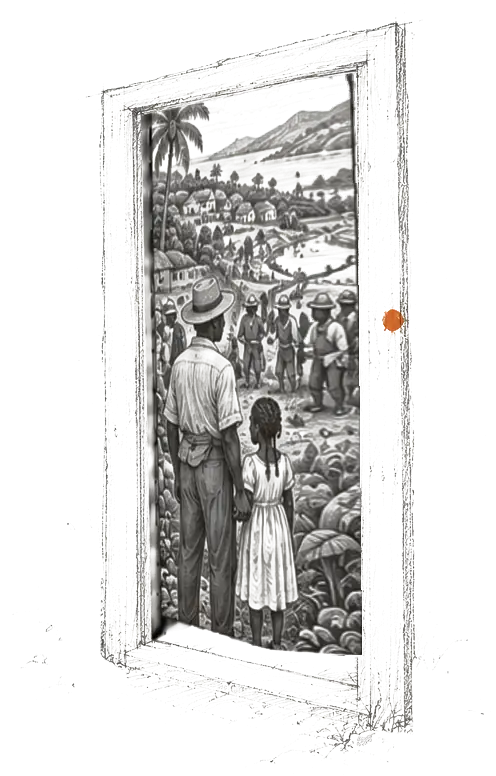
In Hermitage, Doodsie, a peasant woman struggling with poverty, watches her daughter Angel grow up, born around 1951, the year the workers rise against the white estate owners. When the leader of the revolt grows corrupt, the mother knows which side to take; Angel, whom university has opened to Black Power, is more divided.
Timeline
- 1966–1976First voicesWilfred Redhead, F. M. Coard, and Paul Keens-Douglas with his spoken tales.
- 1985Merle CollinsBecause the Dawn Breaks, written after the collapse of the revolution.
Reading keys
- Family names are English or French, inherited from two successive colonisations, and indicate no European ancestry.
- French place names survive everywhere, Sauteurs, Grand Anse, Gouyave, whereas the language is today English.
- Families are often matrifocal, with massive emigration to Trinidad, England and the United States.
- Creole kinship terms extend the family to the neighbourhood.
- The events of October 1983, the execution of the prime minister and the American invasion are a trauma on which every account is politically situated.
- The fate of the leaders imprisoned after 1983 and the question of collective responsibility are raw subjects.
- Economic dependence and the emigration of graduates are little approached head-on.
- The creole patois, long repressed at school, is today almost extinct, and its evocation is nostalgic.
- Catholicism, a French inheritance, and Protestantism share the population, with recent evangelical churches.
- The cult of the ancestors and healing practices inherited from West Africa coexist with the church, notably in the ceremonies called Big Drum.
- La Diablesse, the Ligahoo who changes shape and the Soucouyant belong to the bestiary of the Lesser Antilles.
- The Big Drum, drum and dance of the Grenadine islands, summons the ancestors and is practised at weddings and at deaths.
- The wake with songs, narratives and rum is held at the home of the deceased, and a ceremony closes the mourning on the fortieth day.
- Black is worn in mourning.
- The August carnival, called Spicemas, is the national event, with its Jab Jab covered in molasses and its traditional masks.
- 25 October, the day of the invasion of 1983, is commemorated as a day of thanksgiving, which is in itself a political position.
- The opening formula of the tale, to which the audience replies, is a knowledge common to all the Lesser Antilles, and it gives its title to the 1976 collection.
- The tales collected by Parsons in the nineteen thirties cover Grenada and form the documented corpus.
- The leap of the Caribs at Sauteurs, where the last Kalinago are said to have thrown themselves from the cliff in 1651 rather than surrender to the French, is the founding narrative of the island.
- La Diablesse, the Ligahoo and the Big Drum constitute the supernatural and ritual stock.
- Grenada is not Granada in Spain: the name comes from the Spaniards but the island was French and then British, and the local pronunciation is in no way Iberian.
- The Grenadian creole patois was French-based, which explains the place names in a country that is today anglophone.
- The revolution of 1979 was not overthrown by the American invasion: it had destroyed itself six days earlier.
- The commemoration of 25 October as a day of thanksgiving is a political choice that not all Grenadians share.
Tales and mythologies 1
- PoetryTim TimPaul Keens-Douglas · 1976Returned to Trinidad two years earlier, the author brings the spoken language of the eastern Caribbean to the stage and the radio.Literature
A selection to begin with 3 / 5
- NarrativeBitter-Sweet and SpiceFrederick McDermott Coard · 1970Grenada is then a state associated with the United Kingdom, four years before its independence.Literature
- TheatreHoist Your FlagWilfred Redhead · 1978A short comic play by a writer from Grenada, in a series devoted to Caribbean theatre.Literature
- NovelUnder the Silk Cotton TreeJean Buffong · 1992Like many Grenadian books, this novel is written and published in London, by an author settled in England.Literature