Greenland (Denmark)
- works
- 13
- 13 books
- period covered
- 1859–1999
- language of writing
- Greenlandic
The first newspaper in Greenland was set, printed, illustrated and hand-coloured by the same man. Atuagagdliutit appeared in Nuuk on 1 January 1861, on a lithographic press landed four years earlier, and Lars Møller, a Greenlander trained in printing, pulled the plates, coloured them one by one, then distributed them. He kept up that work for more than fifty years, in a colony where the readership was counted in hundreds.
Read moreShow less
A country of fifty-six thousand inhabitants that writes in its own language is an exception. Kalaallisut received a complete orthography in 1851, the school was run by Greenlandic catechists, and the language became the sole official one in 2009, a case without equivalent for an Inuit language. The counterpart is a market of a few hundred copies, without publishing able to live from it, in which narrative passes through the newspaper, the radio, song and the drum rather than through the book.
What the country has produced of most substance is a corpus of narratives, collected in part by those who administered it. Hinrich Rink published from 1859 the great collection of Greenlandic tales, engraved on wood by Inuit artists, among them Aron of Kangeq, a tubercular hunter who painted lying down. Knud Rasmussen, born on the spot and speaking the language, noted from one end of the Arctic to the other the songs and the narratives of the shamans. The price, here, is administrative. In 1951, twenty-two children were sent to Denmark to be raised as model Danes, then placed on their return in a home in Nuuk, far from their families; Denmark apologised for it in 2020. Between 1966 and 1975, thousands of women and girls received an intrauterine device without having consented to it.
What awaits the reader is a narrative stock in which the sea has a mistress, in which souls change bodies and in which hunger is a character, then a contemporary production made of poetry, song and very small print runs. The novel that opens this page appeared in Copenhagen in 1914, and its author, the son of seal hunters, had in 1910 become the first Greenlander to be a pastor of the Church of West Greenland.
A way to begin
A Greenlander's Dream
Mathias Storch · 1914
Regarded as the first novel written in Greenlandic, or one of the first two: a gifted boy leaves his village for the seminary.
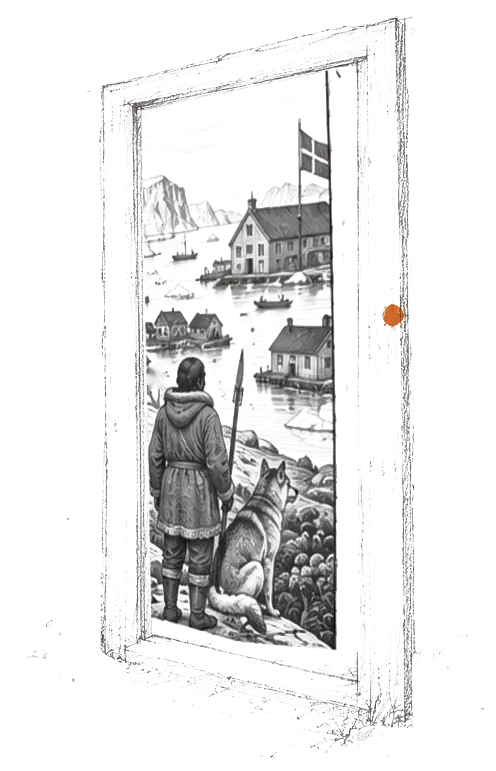
Pavia, a boy from a coastal village whom the pastor judges gifted, discovers at the Danish colony houses finer than his people's and is astonished. Against the wishes of his mother, who wanted him to be a hunter, he goes off to study at the seminary in Godthåb. Around him pass hunting, famine, village quarrels and the thwarted love of Sofie and Silas.
Timeline
- 1721–1850MissionThe Danish mission press fixes written Kalaallisut and publishes catechisms and primers.
- 1861AtuagagdliutitThe illustrated newspaper in Greenlandic, one of the oldest in the Arctic, forms a readership.
- 1914SingnagtugaqMathias Storch publishes the first novel in Greenlandic, the dream of a country governing itself.
- 1979–2010Home ruleHome rule and then extended self-government accompany poetry, theatre and a cinema in Kalaallisut.
Reading keys
- Surnames are Danish, inherited from the mission and the colony, while first names are often Greenlandic, and the gap between the two indicates no Danish ancestry.
- The first name of a dead person is given again to a newborn, who receives with it a part of the departed person and the corresponding kinship ties, so that a child may be called grandmother.
- Adoption is common and takes place between families, without rupture or secrecy, and a novel does not see a drama in it.
- The family name may vary from one generation to another according to successive administrative usages, which complicated genealogies before the modern registers.
- The relation to Denmark is the central subject, from the colonial status abolished in 1953 to the reinforced autonomy of 2009, and it runs through every text.
- The children of the 1951 experiment, the displacements linked to the American base at Thule in 1953 and the intrauterine device campaign are open subjects, carried by associations and official inquiries.
- Seal and whale hunting is a question of subsistence, and the international campaigns against it are felt as an attack, with real economic effects.
- Restraint is the rule: one does not complain, one does not speak loudly, and silence in a dialogue is an answer.
- Lutheranism is old, implanted by the mission in the eighteenth century, and it coexists with an Inuit cosmological stock still named in the texts.
- Sedna, mistress of the sea, holds back the game when the prohibitions are broken, and a shaman is needed to go and comb her hair.
- The angakkoq, the shaman, travels beneath the sea and in the sky, and the tupilak, a figure made to harm at a distance, has otherwise become a carved object sold to visitors.
- The prohibitions bearing on hunting, sewing and mourning govern ordinary life in the old narratives, and their transgression is the motor of the plot.
- 21 June, the national day, falls at the solstice, and the social calendar is commanded by the light: continuous night in winter, continuous day in summer.
- The return of the sun after weeks of darkness is celebrated locally and serves as a narrative landmark.
- The national costume, beads and sealskin, is worn at confirmations, weddings and the start of the school year, and it costs months of work.
- The kaffemik gathers visitors around cakes for a birthday or a death, each coming at their own hour, without a personal invitation.
- Rink's collection, published in 1866 with Inuit engravings, is the reference volume, and the corpus gathered by Rasmussen completes it for the whole Arctic.
- The cycle of the woman of the sea, the origin of the sun and the moon and the narratives of ill-treated orphans become powerful form the common narrative stock.
- The drum song, a sung contest that settles conflicts by public mockery, is a legal institution as much as a form.
- The narratives about the vanished Norse and about the first encounters with Europeans provide a memory of the foreigner earlier than Danish colonisation.
- The word Eskimo is proscribed, Inuit designates the persons and Greenlanders the people of the country; Kalaallisut is the language.
- Greenland is not an uninhabited desert of ice but a country of coastal towns with no roads between them, where one moves by boat and by plane.
- The language is polysynthetic: one word may be worth a sentence, which makes translations longer than the original and explains the apparent brevity of the texts.
- The country belongs to the kingdom of Denmark, with the euro absent and the Danish crown in use, and it left the European Community in 1985.
- The catalogue counts only one work, which measures access to translations and not the country's production.
Tales and mythologies 1
- TaleTales and Traditions of the EskimoKaladlit OkalluktualliaitHinrich Rink and Aron of Kangeq · 1859Greenlandic legends written by Greenlanders, on the first printing press of the island.Literature
Available in English 2
The books from this country that can be read in English, in the original or in translation.
- NovelA Greenlander's DreamSingnagtugaqMathias Storch · 1914A gifted boy leaves his village for the seminary, in colonial Greenland at the beginning of the century.Literature
- NovelTuumarsiFrederik Nielsen · 1934A family driven out by hunger, in the Greenland of the 1850s, between the old world and modernisation.Literature
A selection to begin with 10 / 13
- TaleMyter og Sagn fra GrønlandKnud Rasmussen · 1921not translated into EnglishThe great narratives of the Inuit tradition of Greenland, collected from storytellers and rendered into Danish.Literature
- NovelUkiut 300-nngorneratAugo Lynge · 1931not translated into EnglishA novel from 1931 that imagines the Greenland of 2021, modern, prosperous and bilingual.Literature
- NovelTuumarsiFrederik Nielsen · 1934A family driven out by hunger, in the Greenland of the 1850s, between the old world and modernisation.Literature
- NovelErsinngitsup piumasaaHans Lynge · 1938not translated into EnglishTwo brothers confront the murder of their father, in the Greenland of Inuit tradition.Literature
- NovelNiuertorutsip paniaPavia Petersen · 1944not translated into EnglishA mixed-race heroine, caught between two peoples, in a Greenlandic trading post around 1900.Literature
- NovelTaseralikOtto Rosing · 1955not translated into EnglishA woman who wants to be baptised, at the great summer gathering of a Greenland fjord, around 1850.Literature
- NovelQooqaOle Brandt · 1971not translated into EnglishA hunter of ancient Greenland, who breaks with the law of retaliation, opens a family saga.Literature
- NovelBussimi naapinneqMâliâraq Vebæk · 1981not translated into EnglishA Greenlandic woman follows to Denmark the worker who came for a summer: the first novel signed by a Greenlandic woman.Literature
- NovelUmiarsuup tikinngilaattaaniHans Anthon Lynge · 1982not translated into EnglishA small Greenlandic town awaits the supply ship, while a Dane keeps watch, motionless.Literature
- NovelTarrarsuumi tarraqOle Korneliussen · 1999not translated into EnglishA day in Copenhagen, alongside a lonely man who judges the lives of others without pity.Literature