Guinea-Bissau
- works
- 7
- 5 books · 2 films
- period covered
- 1934–1994
- language of writing
- Portuguese
Before making war, he made an inventory of the soils. Amílcar Cabral, an agronomist trained in Lisbon, was charged by the colonial administration in the mid-nineteen fifties with carrying out the agricultural census of Portuguese Guinea. He travelled the territory village by village, noting the crops, the yields, the debts, the languages, the balances of power. When he founded a few years later the movement that would take up arms, he knew his country better than those who administered it. He was assassinated in 1973, eight months before independence.
Read moreShow less
That method left a lasting imprint. Cabral held that liberation had to produce a culture and not only a state, and the country followed that programme: a film school, a team of young people sent to train in Cuba, a determination to film the war while it was being fought. Guinea-Bissau has some thirty languages, a creole that serves as a common language, and a religious stock in which the spirits of places, the irans, guard shrines that Christianity and Islam have not replaced. No centralised state had preceded colonisation on the coast, and authority there was negotiated through age classes.
Hence a production in which cinema weighs more than the book. Flora Gomes, trained in Cuba, directed in 1988 the first fiction feature of the independent country, about a woman who crosses the war to join her husband at the front, then must rebuild her life with him in a ruined land. Sana Na N'Hada filmed in 1994 a peasant community of the nineteen sixties on the eve of the uprising. The price was paid afterwards: the repeated coups emptied the cultural institutions that liberation had built.
What awaits the viewer is a slow cinema, attentive to the gestures of work and to rites, in which the camera stays a long time on faces. The film that opens this page follows a woman who joins her husband at the front in 1973, then the couple in the ruined country after the war.
A way to begin
Those Whom Death Refused
Flora Gomes · 1988
The first fiction feature shot in independent Guinea-Bissau: the liberation war seen at the level of a couple.
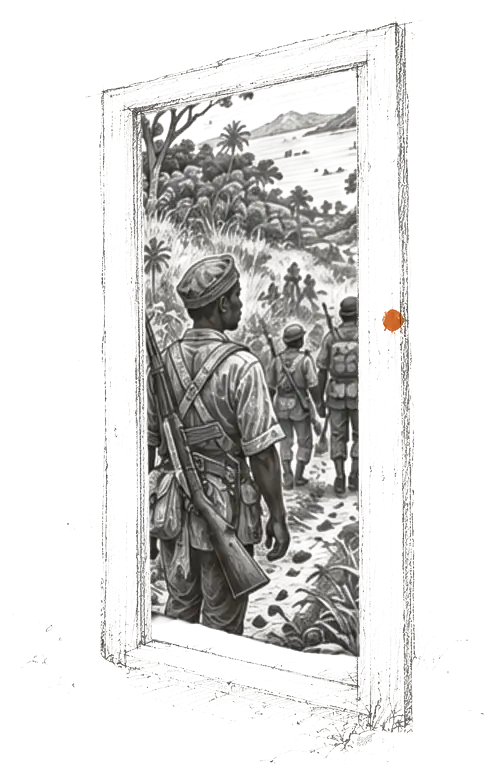
In 1973, during the war of independence, Diminga wants to join her husband Sako, who is fighting the Portuguese army at the front. She crosses the bush with a column of fighters and discovers a devastated country; she finds Sako wounded and helps him survive. When peace comes, the couple must rebuild themselves in a ruined land, where drought follows war.
Timeline
- 1934–1981Poetry of the struggleFausto Duarte, José Carlos Schwarz, Vasco Cabral.
- 1987–1994Flora GomesMortu Nega, then Xime: the liberation war and its aftermath.
Reading keys
- Names combine Portuguese, Arabic for the Islamised groups of the north-east, and the local languages: Balanta, Papel, Manjaco, Mandinka, Fulani.
- Guinean Creole, Kriol, serves as a common language and its use in a dialogue indicates an urban or intercommunity context.
- Several coastal societies, among them the Balanta, had no centralised chiefdom: authority belongs to the age classes and to the elders.
- Initiation by age class, the fanado, marks entry into adulthood more than civil age does.
- The repeated coups since 1980 and the army's role in drug trafficking are subjects approached with caution.
- The war of liberation, from 1963 to 1974, is recounted with a sobriety that refuses heroisation.
- Knowledge relating to the irans and to the shrines is reserved and is not told outside the circle.
- Respect for the elders organises speech: one does not cut off an old man, and the palabre takes the time it takes.
- Three ensembles coexist: the cults of the irans, spirits of places to whom shrines are dedicated, Islam in the north and the east, Christianity in the cities.
- The irans receive offerings and sacrifices, and a character who neglects his own exposes himself.
- The djumbai, evenings of narrative and music, are the social framework of storytelling.
- The sacred woods where initiations take place are forbidden places whose access is not described.
- Mourning is accompanied by wakes, drums and sacrifices, and the lifting of mourning may be deferred by a year.
- The toca tchur, the Balanta funeral ceremony with ox races and wrestling, is a major rite that the films show.
- Masks and initiation dress identify age and group.
- The Bissau carnival, mixing traditional masks and urban parades, is the great annual gathering.
- The narratives of the coastal groups, collected in the Portuguese colonial bulletins, form the older documentation.
- Amílcar Cabral, his writings and his death, are the political and moral reference of the country.
- The irans and their shrines are a common knowledge that the texts do not translate.
- The narratives of the war of liberation, transmitted orally by the fighters, constitute a still living narrative stock.
- Guinea-Bissau is not to be confused with Guinea-Conakry or with Equatorial Guinea, three distinct countries with different colonial histories.
- Kriol is not a deformed Portuguese but a language in its own right, close to that of Cape Verde without being the same.
- The irans are not divinities of an organised pantheon but powers attached to precise places.
- The weakness of the state since independence does not cancel the richness of the cultural project of the nineteen seventies, of which cinema is the legacy.
Tales and mythologies 1
- TaleJunbai: storias de Bolama e do outro mundoAnonymous · 1979not translated into EnglishIt is the first collection of tales published in the Creole of Guinea-Bissau.Literature
A selection to begin with 5 / 7
- NovelAuá: novela negraFausto Duarte · 1934not translated into EnglishThe novel, awarded a colonial literature prize, was meant as an ethnographic document.Literature
- PoetryA luta é a minha primaveraVasco Cabral · 1981not translated into EnglishThe author, a companion of Amílcar Cabral, published his poems of struggle after years of political responsibilities.Literature
- TaleContes créoles de Guinée-BissauEmilio Giusti · 1981not translated into EnglishTwenty Creole tales from Bissau and Casamance, transcribed and translated into French.Literature
- Feature filmXimeSana Na N'Hada · 1994The film shows, on the eve of the war of independence, a village torn between tradition and revolt.Cinema
- NovelEterna paixãoAbdulai Sila · 1994not translated into EnglishThis novel, published twenty years after independence, is regarded as the first Guinea-Bissauan novel.Literature