Iran
- works
- 51
- 29 books · 22 films
- period covered
- -1000–2000
- language of writing
- Persian
Around the year one thousand, a landowner from Khorasan spent thirty years writing fifty thousand couplets so that his language would survive. Two centuries after the Arab conquest, Persian risked becoming a domestic dialect faced with the Arabic of scholars and administrations. Ferdowsi gathered the narratives of the kings from before Islam, put them into verse in a Persian deliberately stripped of loanwords, and produced a book that fixed the language. An Iranian today reads it without a translation, which no French reader can do with a text of the eleventh century.
Read moreShow less
Persian then became a language of culture far beyond Iran. It was written in Delhi, in Bukhara, in Istanbul and in Sarajevo, the Mughal emperors made it their court language, and the poetry of Hafez or of Saadi circulated from Bosnia to Bengal. That extension without a state explains the status of poetry in Iran: it is recited, opened at random to have the future told, quoted in ordinary conversation, and the tombs of poets are places of visit.
The dominant form in the twentieth century came from a solitary rupture. Sadegh Hedayat published in 1936, in Bombay, a hallucinated narrative printed in fifty copies bearing the note "not for sale in Iran", and that book founded modern Persian prose. Nima Yushij had blown up classical metrics, Forough Farrokhzad wrote desire in the feminine and filmed in 1963 a leper colony in a twenty-two-minute documentary that remains a summit. After 1979, cinema made censorship into a method: children as protagonists, cars as confessionals, and everything that cannot be shown displaced off screen.
What awaits the viewer and the reader is an art of litotes and of detour, in which the essential is played out in what is not said. The novel that opens this page follows a reclusive painter, haunted by a single image, who no longer knows what he has seen or dreamed, and its author first ran off some fifty copies of it, outside Iran.
A way to begin
The Blind Owl
Sadegh Hedayat · 1936
A reclusive painter, haunted by a single image, no longer knows what he has seen or dreamed: the first great Persian modernist novel, free of rights.
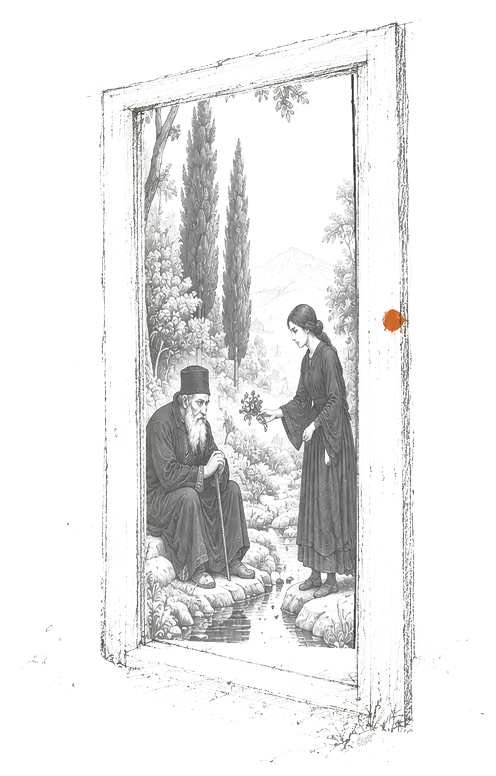
A painter of pen cases lives reclusively outside the city, amid wine and opium, and always paints the same scene: an old man bent beneath a cypress, and a girl in black holding out a flower to him across a stream. One evening, through a window that does not exist, he sees the real scene; later, the girl comes into his house.
Timeline
- 1010The Book of KingsFerdowsi saves Persian from Arabisation in fifty thousand couplets.
- 1120–1390The great poetsKhayyam, Rumi, Saadi, Hafez. Persian poetry shines from Anatolia to India.
- 1920–1940ModernityHedayat and modern prose. Nima Yushij breaks the classical line.
- 1969–1979Iranian New WaveAn auteur cinema is born under the Shah, and will survive the revolution.
- 1990–2000World recognitionKiarostami, Makhmalbaf, Panahi. Iran becomes a cinematic power.
Reading keys
- Family names have existed only since 1919: many were formed on a trade, a place or a title, which explains the endings in -i, -zadeh or -pour, "son of".
- The suffix -jan added to the first name marks affection, and one addresses elders by a kinship term even without a blood link.
- Taarof, a code of politeness made of successive refusals and repeated offers, governs exchanges. A character who accepts too quickly commits a fault.
- First names may be ancient Persian, Rostam, Sohrab, Anahita, or Islamic, and the choice indicates a cultural orientation.
- The revolution of 1979, the war against Iraq and the repression of protest movements are subjects bounded by a censorship that reads everything before publication.
- The body, physical contact and alcohol cannot be shown on screen, which produced a grammar of ellipsis that became a style.
- The question of minorities, Kurdish, Azerbaijani, Arab, Baluchi, and that of the Baha'is are difficult subjects.
- Taarof makes speech indirect: a yes may be a no, and the host's insistence is obligatory.
- Twelver Shiism has been the state religion since the sixteenth century, with its holy places, its pilgrimages and the central role of Imam Hussein.
- Zoroastrianism, the religion of pre-Islamic Iran, survives in small communities, and its vocabulary permeates the language and the festivals.
- Sufism and mystical poetry, with Rumi and Hafez, are practised and quoted by people who do not call themselves religious.
- The Baha'is, the Jews, the Armenians and the Assyrians have very different statuses, from the most protected to the most persecuted.
- Black is worn in mourning, and Ashura, with its processions and its lamentations, is a social as much as a religious moment that produced its own theatre, the taziyeh.
- Nowruz, the new year of 21 March, is the country's main festival and is not Islamic: it is Zoroastrian, with its table of seven objects.
- The fortieth day after a death, then the anniversary, structure the time of mourning.
- The carpet, the walled garden and the samovar are objects with a strong symbolic charge in the narratives.
- The Book of Kings, with Rostam, Sohrab, Jamshid and the serpent-tyrant Zahhak, is the narrative stock that every Iranian knows, including through the café storyteller.
- Hafez is opened at random for divination, a common practice called fal, and his verses are quoted in conversation.
- The Persian tales, collected in 1919 in their original dialects, form the accessible documented corpus.
- The Avesta, the Bundahishn and Zoroastrian cosmogony provide a depth claimed by modern authors.
- Iran is not an Arab country: Persian is an Indo-European language and Iranian history is distinct from Arab history.
- Persian is written in Arabic characters, which is misleading: the language has no kinship with Arabic.
- Censorship did not impoverish Iranian cinema: it produced a grammar of the indirect that the whole world has imitated.
- Nowruz and a good part of the Iranian festivals predate Islam, which explains their survival under every regime.
Tales and mythologies 1
- PoetryThe Zend-AvestaاوستاAnonymous · -1000The sacred book of the ancient Iranian religion, transmitted by word of mouth long before being written down.Literature
A selection to begin with 10 / 51
- PoetryShahnameh: The Persian Book of KingsشاهنامهFerdowsi · 1010The kings and heroes of ancient Iran sung in a Persian almost free of Arabic words.Literature
- PoetryThe Divan-i-Hafizدیوان حافظHafez · 1410The ghazals of a poet of Shiraz, in which love of a face and love of God cannot be told apart.Literature
- Poetryدیوان پروین اعتصامیParvin E'tesami · 1935Poems in which animals, things and people dispute the lesson, in the forms inherited from the ancients.Literature
- CinemaThe House Is Blackخانه سیاه استForough Farrokhzad · 1963The daily life of a community of sick people filmed like a poem, between sacred verses and battered faces.Cinema
- Short storiesFear and Tremblingترس و لرزGholam-Hossein Saedi · 1968A Gulf coast where the sea commands everything and fear takes the place of knowledge.Literature
- NovelThe Princeشازده احتجابHoushang Golshiri · 1969The end of a princely line, told from the depths of a sickroom.Literature
- CinemaDownpourرگبارBahram Beyzai · 1972A shy intellectual parachuted into a working-class suburb, amid love, rivalry and gossip.Cinema
- CinemaThe TravelerمسافرAbbas Kiarostami · 1974A provincial boy whom nothing stops, neither lies nor cunning, on the road to a football match.Cinema
- CinemaThe Night It Rainedاون شب که بارون اومدKamran Shirdel · 1974A heroic news item from Gorgan province, taken apart testimony by testimony.Cinema
- CinemaStill Lifeطبیعت بیجانSohrab Shahid Saless · 1974An old level-crossing keeper and his wife, in the monotony of an isolated post, in the time of the country's rapid industrialisation.Cinema