Ireland
- works
- 27
- 14 books · 13 films
- period covered
- 1766–2000
- language of writing
- English
On 26 January 1907, the audience at the Abbey Theatre in Dublin interrupted a new play in the third act. The pretext was one word, the one that designates women's undergarment, used in a line about girls from Mayo. The real motive lay elsewhere: the play presented a parricide as a village hero and made people laugh at everything that nationalism held sacred. The performances of the week were played under police protection, and Yeats went to testify against the rioters in court.
Read moreShow less
A theatre that provokes a riot is a theatre that stands in for a parliament. The country then had neither a state nor a majority language: Irish, spoken by most inhabitants around 1800, had become a minority language after the famine of the forties and the massive emigration that followed. The revival movement wanted to restore it while producing its masterpieces in English, the language of the occupier, and that contradiction is the motor of all Irish literature.
The form is speech: the stage, the monologue, the bar-counter narrative, and a virtuosity that comes from the oral. The price was departure and prohibition. Joyce left Dublin in 1904, came back only for short visits until 1912, and had his great novel printed in Paris in 1922, out of reach of the English and American censors. The Irish censorship law of 1929 had thousands of titles banned, including those of almost all the country's novelists. Beckett settled in France and wrote his 1952 play in French before translating it himself. Flann O'Brien, a civil servant, published under a pseudonym a novel that nobody read before its reissue.
What awaits the reader is an English language worked by another, a black comedy and a consciousness of departure. The play that opens this page, first staged in German in Vienna in 1913, has a phonetician bet that he can pass off a flower girl as a duchess; its author, a Dubliner settled in London, received the Nobel Prize in 1925.
A way to begin
Pygmalion
George Bernard Shaw · 1912
A phonetician bets he can make a lady of a flower girl: Shaw's comedy, free of rights, which became My Fair Lady.
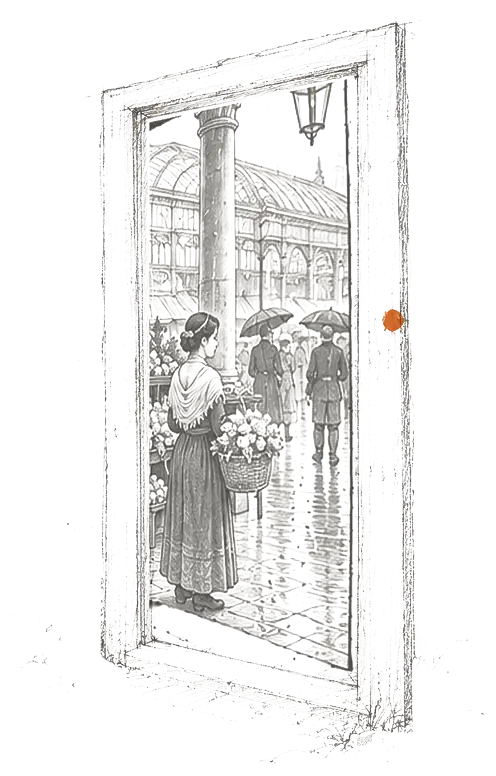
In Covent Garden, one rainy evening, the phonetician Henry Higgins boasts that he could pass off Eliza Doolittle, a flower girl with a London street accent, as a duchess. Colonel Pickering takes up the bet. Eliza moves into the professor's house and submits to a gruelling apprenticeship in speech and manners, in which class distinctions are at stake.
Timeline
- 800–1150ManuscriptsIrish monks copy Europe and write their own epics.
- 1890–1920Celtic RevivalYeats, Lady Gregory, Synge. A culture is reinvented in order to found a nation.
- 1904–1939Joyce and BeckettTwo Dublin exiles remake the novel and the theatre of the century.
- 1916–1922Independence and civil warThe break with London, then the split among the Irish themselves.
Reading keys
- The prefixes O' and Mac mean descendant of and son of, and many families lost them under the English administration before taking them up again in the twentieth century.
- One and the same name exists in two forms, English and Irish, and the choice of one or the other by an author is a political gesture.
- Irish first names reintroduced since independence signal a cultural position, and their pronunciation does not follow English spelling.
- Kinship extends to the village and the parish, and the narratives designate a character by his farm, his father or his county.
- The partition of 1921, the conflict in Northern Ireland and the vocabulary used to name it situate a text immediately.
- The civil war of 1922 and 1923 divided families and long remained more difficult to write than the war of independence.
- The role of the Church, the Magdalene laundries, the industrial schools and the forced adoptions were the object of official inquiries and of reparations, and that subject dominates recent literature.
- The famine of the forties, a million dead and a million departures, is a living memory and a point of historiographical disagreement.
- Catholicism was the national identity in the face of the Protestant coloniser, then the institution that ran schools and hospitals until the nineteen nineties, before a rapid collapse.
- The Sidhe, people of the hills, are not fairy-tale fairies but powers with which one comes to terms, and Lady Gregory collected those beliefs in the field in 1920.
- The banshee who announces a death, the holy wells and the mountain pilgrimages belong to a mixed Christianity, documented and alive.
- The wake, with narratives, drink and laughter around the body, is a complete social rite that the texts use without explaining it.
- 17 March, Saint Patrick's day, has become a worldwide festival and its Irish version is more religious and more local.
- Samhain, at the end of October, marks the passage to winter and the opening of the world of the dead, and Halloween is its exported form.
- Green is political, orange is too, and the use of the two colours in a text is a signal.
- The pub is a social institution where business is settled and history is told, and not a picturesque setting.
- The Ulster cycle and its hero Cú Chulainn, alone against an army, are the epic stock, transmitted by medieval manuscripts and put back into circulation by Lady Gregory in 1902.
- The Book of Invasions, a clerical compilation, gives the six successive peoplings of the island and the Tuatha Dé Danann.
- The Easter Rising of 1916, its sixteen executions and the poem Yeats drew from it are the common political and literary reference.
- Bloomsday, 16 June, the day on which the 1922 novel takes place, has become a national festival of reading.
- Ireland is not Great Britain, and Northern Ireland is not the Republic: the catalogue treats the island as a literary whole, which is a convention.
- Irish is a living language, official and taught, but almost all of this literature is written in English, which is the result of a policy and not of a choice.
- Celtic picturesqueness is in part an English invention, and Irish authors spend their time defending themselves against it.
- Verve and humour are not a national temperament but a worked literary technique, issued from oral culture.
- The catalogue is slender in literature and well supplied in cinema of the nineteen eighties, which reflects the state of translations and archives.
Tales and mythologies 1
- TaleCuchulain of MuirthemneLady Gregory · 1902The legends of the Ulster hero gathered into a single narrative, in the time of the Irish literary revival.LiteraturePublic domain
A selection to begin with 10 / 27
- NovelUlyssesJames Joyce · 1922A day in the life of a Dublin advertising canvasser, captured as close as possible to his thoughts.Literature
- PoetryThe TowerWilliam Butler Yeats · 1928An ageing poet, in his tower in the west of Ireland, in the aftermath of the fratricidal struggles of independence.Literature
- Feature filmThe DawnTom Cooper · 1936A young man from Kerry bears the shame of a grandfather accused of treason, in the time of the armed struggle.Cinema
- NovelAt Swim-Two-BirdsFlann O'Brien · 1939A Dublin student writes a novel whose characters rise up against their author.Literature
- NovelThe Heat of the DayElizabeth Bowen · 1949A woman caught between a lover suspected of treason and the man who is blackmailing her, in a bombed capital.Literature
- TheatreWaiting for GodotEn attendant GodotSamuel Beckett · 1952An endless wait on a country road, in the aftermath of the war.Literature
- Feature filmTravellerJoe Comerford · 1981An arranged marriage among Travellers and a smuggling run across the Northern border.Cinema
- Short filmThe Ballroom of RomancePat O'Connor · 1982The dance nights of a countryside the young men have left, in the middle of the twentieth century.Cinema
- Feature filmPigsCathal Black · 1984Unemployed and excluded people brought together in a squat in the capital, in the time of the crisis.Cinema
- Feature filmEat the PeachPeter Ormrod · 1986Two unemployed men from the Midlands dream of glory by riding motorbikes on a circular wall.Cinema