Japan
- works
- 82
- 42 books · 40 films
- period covered
- 759–1999
- language of writing
- Japanese
Her name is not known. "Murasaki Shikibu" is a court nickname, formed from her father's title and the colour of a wisteria. Around 1008, this lady-in-waiting wrote the Tale of Genji, fifty-four chapters on the loves and the ageing of a prince. Nothing really happens in it. Everything passes through it.
Read moreShow less
That sentence holds for a good part of what Japan has produced since. Its works do not readily recount a story that ties itself up and then unties itself, they record states, seasons, intervals. The word ma designates the empty space between two things, and it applies to architecture, to music and to narrative. A chronicle by Sei Shōnagon, a travel notebook by Bashō, a film by Ozu rest on what the author has decided not to fill.
That economy has a reverse side. Japan absorbs forms come from elsewhere and turns them around quickly enough that one can no longer say what was borrowed: Chinese writing first, then Buddhism, the European novel, cinema. Sōseki had studied in London and hated that stay, and came back from it with a prose that resembles nothing English. The movement also plays internally, and a collection of fantastic tales from 1776 becomes in 1953 one of Mizoguchi's finest films. Three writing systems finally coexist in the language and a text may play on their textures; translation loses half of that, which explains why two French versions of the same novel sometimes resemble two different books.
What awaits the reader is an art of restraint that may at first pass for coldness. The characters almost never say what they want, the scenes stop before the crisis, the endings do not conclude. Emotion is not absent, it is displaced into a detail, a season, an object, a silence. The novel that opens this page follows a student and a silent man who promises to tell him everything one day, and its third part is the long letter in which the man tells his past.
A way to begin
Kokoro
Natsume Soseki · 1914
A student and a silent man who promises to tell him everything one day, in writing: a novel by Sōseki, free of rights.
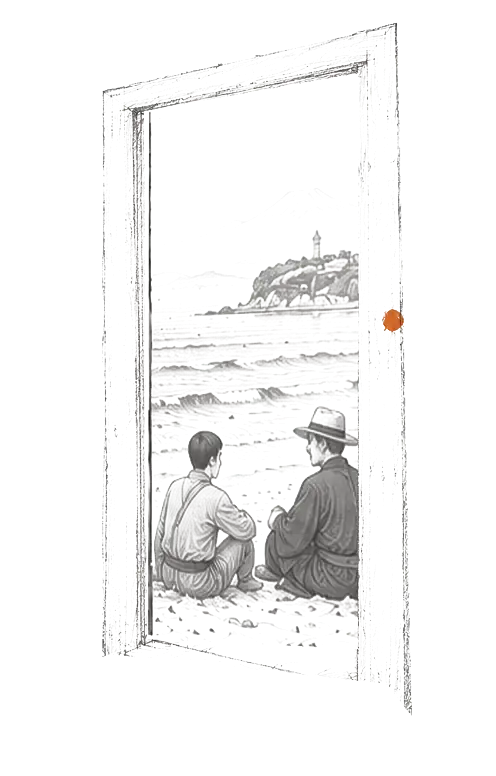
A student on holiday in Kamakura notices an older man on the beach, eventually approaches him and calls him "Sensei". In Tokyo he visits him and learns that he goes to a grave every month; Sensei will not say who lies there, and his wife hints at an old secret. Called back to the provinces to his sick father, the student learns there of the death of the Meiji emperor.
Timeline
- 794–1185Heian periodThe Tale of Genji, often held to be the world's first novel, written by a court lady.
- 1600–1868Edo periodBashō's haiku, Chikamatsu's theatre, woodblock prints. A refined urban culture.
- 1868–1912Meiji eraJapan opens all at once. Sōseki and Ōgai invent the modern Japanese novel.
- 1920–1940ModernismTanizaki, Akutagawa, Kawabata. Japanese silent cinema is already among the world's richest.
- 1950–1965Golden age of cinemaKurosawa, Mizoguchi, Ozu. The world discovers Japan through its films.
- 1945–1970After the bombMishima, Abe, Ōe. Writing a country defeated, occupied, transformed.
Reading keys
- The family name precedes the first name. "Natsume Sōseki": Natsume is the family name, and Sōseki a pen name, which explains why one commonly says "Sōseki".
- Characters very rarely call each other by their first name. One addresses somebody by their function or their rank: father, big sister, teacher, section head. A character who suddenly moves to the first name has just crossed a considerable threshold of intimacy.
- The suffixes count: -san is neutral, -sensei marks the master or the doctor, -chan affection, -kun the inferior or the young man. Their change in mid-narrative is an event.
- The adoption of a son-in-law who takes his wife's family name is common and in no way exceptional.
- The scene of crisis is frequently skipped. A marriage, a death, a break-up may take place off screen and be known only through their consequences.
- Refusing explicitly is almost impossible. A "that is a little difficult", a silence, a change of subject are worth a firm no.
- Silence is not an emptiness in conversation, it is a position taken.
- One takes off one's shoes at the threshold. The vestibule, the genkan, is an intermediate zone: what is said there has not yet been said in the house.
- The bow replaces the handshake and its depth measures the hierarchical relation. Physical contact in public is rare, including between close relations, and a hand placed on a shoulder is a strong gesture.
- The cinema of before the nineteen sixties deals with successive censorship, imperial and then American under the Occupation, which lastingly encouraged allusion.
- Shintō and Buddhism cohabit without conflict and share out the moments of life: births and marriages on the Shintō side, funerals and ancestors on the Buddhist side. The same character frequents both without inconsistency.
- The dead have not gone away. They receive food, one speaks to them, they come back during the obon festival in summer. A dialogue with a deceased person is not necessarily fantasy.
- The yōkai and the spirits belong to a common stock and not to an imported supernatural. A fox, a cat, a bridge, an old umbrella may be inhabited.
- White is the colour of the shroud and of old mourning. Black established itself in the twentieth century for funeral clothes, so that the two cross according to the period of the work.
- Red and white together signal celebration and display, never mourning.
- The numbers four and nine are pronounced like death and suffering, and are avoided: a building with no fourth floor is not a scriptwriter's oddity.
- The seasons are not a setting. The cherry blossom stands for what passes, snow for isolation, autumn for melancholy. A mention of the weather is almost always a comment.
- Suicide occupies in the literary tradition a place without equivalent in Europe: the warrior's seppuku, the double suicide of lovers in Chikamatsu. It is not systematically presented as a defeat.
- The Tale of Genji functions as a reserve of allusions, in the manner of the Bible or the Odyssey elsewhere.
- The forty-seven rōnin, patient vengeance and collective suicide, are the national story par excellence, taken up in theatre and cinema dozens of times.
- Momotarō the child born from a peach, Urashima Tarō the fisherman who returns after three centuries, the kappa of the rivers: three figures that every Japanese child knows.
- Amaterasu, the sun goddess withdrawn into her cave, opens the Kojiki and founds imperial legitimacy.
- Extreme politeness is not sincere deference and does not announce agreement. It organises distance.
- A character who weeps is not necessarily weak, an impassive character is not necessarily hard.
- The word "family" covers the house, the ie, which includes the ancestors and the patrimony, and not the conjugal household alone.
- The absence of a conclusion is not a fault of construction. Looking for the moral of the narrative leads away from the narrative.
Tales and mythologies 2
- EpicThe Tale of the Heike平家物語Anonymous · 1371A warrior epic chanted to the lute by blind monks, on the rise and fall of a warrior house in the twelfth century.Literature
- TaleTales of Moonlight and Rain雨月物語Ueda Akinari · 1776Nine fantastic tales of 1776, drawn in part from Chinese collections and transposed to Japan.Literature
A selection to begin with 10 / 82
- EssayThe Pillow Book枕草子Sei Shōnagon · 1002Notes taken around the year one thousand by a lady of the imperial palace, made up of lists, court scenes and forthright opinions.Literature
- NovelThe Tale of Genji源氏物語Murasaki Shikibu · 1008A narrative in fifty-four chapters, written at the beginning of the eleventh century by a court lady, about the love life of a prince kept from the throne.Literature
- PoetryThe Narrow Road to the Deep North奥の細道Matsuo Bashō · 1702Account of a five-month walk towards the north of the country in 1689, alternating prose and very short poems.Literature
- NovelMilitarized Streets武装せる市街Kuroshima Denji · 1930A novel of 1930 on the Japanese expedition to Jinan, banned as soon as it appeared.LiteraturePublic domain
- NarrativeNight on the Galactic Railroad銀河鉄道の夜Kenji Miyazawa · 1934An unfinished narrative, reworked over many years and published in 1934 in the collected works of its author.LiteraturePublic domain
- CinemaTokyo Story東京物語Yasujiro Ozu · 1953A 1953 film about parents who travel from the provinces to see, in Tokyo, children who have no time to receive them.Cinema
- CinemaUgetsu雨月物語Kenji Mizoguchi · 1953Film of 1953 in which two men leave their village in wartime, one to sell, the other to bear arms.Cinema
- CinemaThe Last War世界大戦争Shūe Matsubayashi · 1961A 1961 film in which an ordinary Tokyo family follows the escalation of two blocs towards nuclear confrontation.Cinema
- CinemaAkitsu Springs秋津温泉Yoshishige Yoshida · 1962A 1962 film in which a man returns, from one season to the next and from one year to the next, to the woman of a mountain inn.Cinema
- CinemaThe Face of Another他人の顔Hiroshi Teshigahara · 1966A film of 1966 about a disfigured man who has a borrowed face made for himself and puts his own wife to the test.Cinema