Kosovo
- works
- 11
- 11 books
- period covered
- 1955–1988
- language of writing
- Albanian
Between September and December 1990, Albanian teachers and students were expelled from the University of Pristina, and Albanian-language secondary schools closed. The answer came in one sentence: classes would be held elsewhere. For ten years, some four hundred thousand pupils followed lessons in private houses and garages, sometimes sitting on the floor for lack of tables, with around twenty thousand teachers. An entire generation learnt to read its own language illegally.
Read moreShow less
There is nothing surprising, then, in this territory being a matter of literature before being a state. Two memories dispute the same ground: for the Serbs, the battle of 1389 is the founding myth of a heavenly kingdom preferred to the earthly one; for the Albanians, the same land carries the cycle of the Kreshnikë, sung to the lahuta, with its heroic brothers protected by mountain fairies. Two corpora, two one-stringed instruments, a single field. The two traditions have in fact fed on each other, borrowing heroes, formulas and metres, which the national narratives of both camps prefer to forget.
Hence a formal consequence, striking as soon as one looks at what is written here: Kosovo is a country of poets. Almost the whole corpus is poetic, and that is not an aesthetic preference. In a language long tolerated and then prevented, the poem is what circulates: it is copied out, recited, memorised, it crosses a border in a pocket. Esad Mekuli founded in 1949 the review that would house this poetry, Ali Podrimja gave it its barest form, Eqrem Basha and Rexhep Qosja widened the field towards the essay and the narrative.
What awaits the reader is therefore short, elliptical texts in which private mourning and collective mourning are not separated. There is neither setting nor explanation in them. The collection that opens this page was written by a poet after the death of his young son, and Robert Elsie sees in it a turning point in Kosovar poetry.
A way to begin
Lum Lumi
Ali Podrimja · 1982
A collection written after the death of the poet's son, regarded as his masterpiece and a turning point in Kosovo's letters.
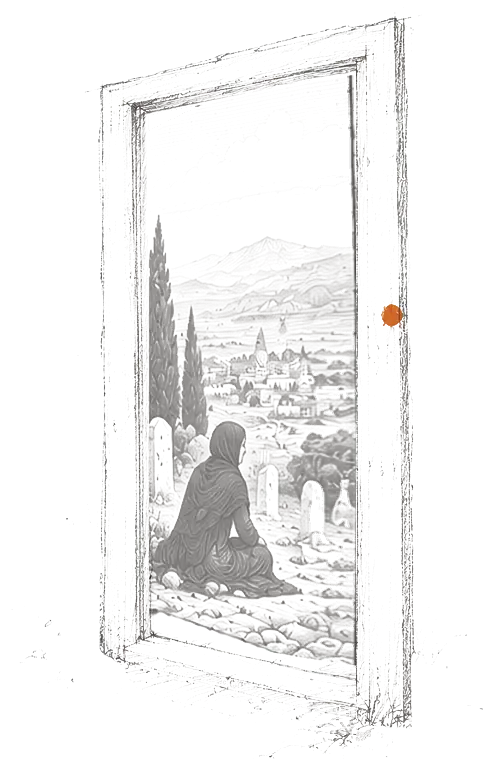
A collection written after the death of the poet's young son, Lumi, and dedicated to his memory. Grief opens onto a meditation on solitude, fear, death and fate. The poems are short, with direct images and discreet rhymes, and the title repeats the child's name in its simple and then its definite Albanian form.
Timeline
- 1955–1961First voicesEsad Mekuli, Gjerqeku, Azem Shkreli, Gunga. Poetry first.
- 1971–1973Prose and criticismEqrem Basha, and Rexhep Qosja, who writes the history of Albanian letters.
- 1982PodrimjaLum Lumi, written after the death of his son, becomes a summit of Albanian verse.
Reading keys
- Albanian names in Kosovo have no Slavic diacritics but digraphs of their own: xh, zh, ç, dh. The final ë is pronounced and counts.
- The extended family, the fis, and the patriarchal house organise kinship. A character is situated by his house before his first name.
- First names may be Muslim, Illyrian or national: Adem, Agron, Besa. The choice of a first name is in itself a declaration.
- The word besa, one's given word, binds the whole house and is passed on to the heirs.
- The war of 1998 to 1999 and the missing remain a raw subject. Works often approach it by ellipsis rather than by narrative.
- Under Yugoslavia, writing in Albanian in Kosovo was tolerated within certain limits and kept under watch. Many texts are read on two levels.
- The violence suffered by women during the conflict long remained unsayable and has been named only recently.
- Besa forbids certain words: one does not go back on a commitment, and a character who does is socially lost.
- Hospitality is an absolute duty, including towards an enemy, and the narrative uses it as a mechanism.
- The majority is Sunni Muslim, with a long-standing presence of Sufi brotherhoods, notably Bektashi, and an Albanian Catholic minority.
- Religious practice was long discreet and national identity took precedence over confession. The formula attributed to Vaso Pasha, according to which the religion of the Albanians is Albanianness, remains a reference.
- The zana of the mountains and the ora, protective doubles attached to each person, belong to the Albanian stock and appear in the heroic songs.
- Sufi tekke and saints' tombs are places of visit that do not belong to official worship.
- Mourning is marked by black and by organised condolence visits, at which men and women receive separately.
- Funeral lamentation sung by women is an attested and codified practice.
- 17 February, the day of independence in 2008, and the commemorations of the war organise the civil calendar.
- The kulla, the stone tower-house of the north, with its room reserved for guests, is a setting with a strong social charge.
- The cycle of the Kreshnikë, heroic songs of the northern Albanian lands with the brothers Mujo and Halil, sung to the lahuta: a stock shared with Albania and the north of Montenegro.
- The Kanun of Lekë Dukagjini, the customary code of the mountains, with besa and blood vengeance, serves as an implicit charter in many narratives.
- The Serbian Kosovo cycle and the battle of 1389 are attached to the same territory and known to all, including those who do not subscribe to them.
- The zana and the ora, fairies and protective doubles, make up the ordinary supernatural cast.
- Kosovo is not a cultural province of Albania. Its literature developed under Yugoslavia, with its own reviews and its university, in conditions that Hoxha's Albania did not know.
- The battle of 1389 set mixed armies against each other and not two nations. Reading it as a clash between Serbs and Turks repeats a nineteenth-century construction.
- The word "clan" applied to the society of the north is misleading: the fis is a kinship structure with its rules written in the Kanun.
- The predominance of poetry does not indicate the absence of prose, but a history of the circulation of texts under constraint.
Tales and mythologies 1
- TalePërralla IAnton Çetta · 1979not translated into EnglishIn the Kosovo of the seventies, the Albanological Institute publishes in series the oral tradition collected in the province.Literature
A selection to begin with 9 / 11
- PoetryPër tyEsad Mekuli · 1955not translated into EnglishIn Yugoslav Kosovo, where Albanian was long refused in schools, this book opens Albanian-language poetry.Literature
- NovelGjarpijt e gjakutAdem Demaçi · 1958not translated into EnglishThe vendetta and one man's fight for reconciliation, in an Albanian village of Kosovo.Literature
- PoetryBulëzatAzem Shkreli · 1960not translated into EnglishAt the end of the fifties, a generation of young Kosovar poets turns towards modernity.Literature
- PoetryBebëzat e mallitEnver Gjerqeku · 1960not translated into EnglishIn Yugoslav Kosovo in the fifties, a first generation of Albanian-language poets publishes in Pristina.Literature
- PoetryPëshpëritjet e mëngjesitFahredin Gunga · 1961not translated into EnglishIn the early sixties, a young poetry in the Albanian language takes off in Kosovo.Literature
- Short storiesShëtitje nëpër mjegullEqrem Basha · 1971not translated into EnglishIn the early seventies, the only years of real freedom in Kosovo according to Elsie, a young urban literature appears in Pristina.Literature
- NovelOhAnton Pashku · 1971not translated into EnglishA shut-in couple and a man's dreams across Albanian history, in a modernist novel from Kosovo.Literature
- NovelVdekja më vjen prej syve të tillëRexhep Qosja · 1974not translated into EnglishA novel written in Pristina in the seventies, when the Albanians of Kosovo lived under the surveillance of the Yugoslav police.Literature
- PoetryAs në tokë as në qiellDin Mehmeti · 1988not translated into EnglishAt the end of the eighties, the Albanians of Kosovo live in uncertainty, and the poetry says so through images.Literature