Laos
- works
- 15
- 12 books · 3 films
- period covered
- 1500–1989
- language of writing
- Lao
Between 1964 and 1973, Laos became the most heavily bombed country in history per inhabitant. Two million tonnes of explosives, one load every eight minutes for nine years, on a country that was officially not at war. A third of the bombs did not explode and still kill today, in fields that are cultivated all the same. The villages of the north lived for years in caves, where school and theatre were held. That period destroyed what remained of cultural infrastructure in a country that had almost none, and emptied entire valleys.
Read moreShow less
What there was was held in monasteries. Classical Lao literature was written on engraved palm leaves, kept in wooden cabinets and taken out once a year to be aired and recopied, with texts that exist in dozens of manuscript versions. Sinxay, a seventeenth-century epic about three brothers who set out to free their aunt abducted by a flying ogre, is its summit, and the Lao version of the Ramayana adds a local chapter to it. Those texts were recited in public, sung, with a performer who explained as he went along and improvised commentaries.
Modern literature is therefore recent and closely framed. After 1975, the new regime made writing a tool, and the authors published were cadres. Outhine Bounyavong wrote in the nineteen eighties very brief short stories about ordinary people, with a sobriety that survived the commission. Lao cinema counts a few films of the nineteen eighties and virtually nothing afterwards until the two thousands. The price is a slender corpus, in a country of some fifty peoples where the official language is that of only part of the inhabitants.
What awaits the reader is a literature of the sung narrative and of brevity, without emphasis. The poem that opens this page is recited and sung throughout the country, and its scenes adorn temple walls.
A way to begin
ສິນໄຊ
Pang Kham · 1650
Regarded as the masterpiece of Lao literature, free of rights: a prince, his two prodigious brothers and twenty thousand lines.
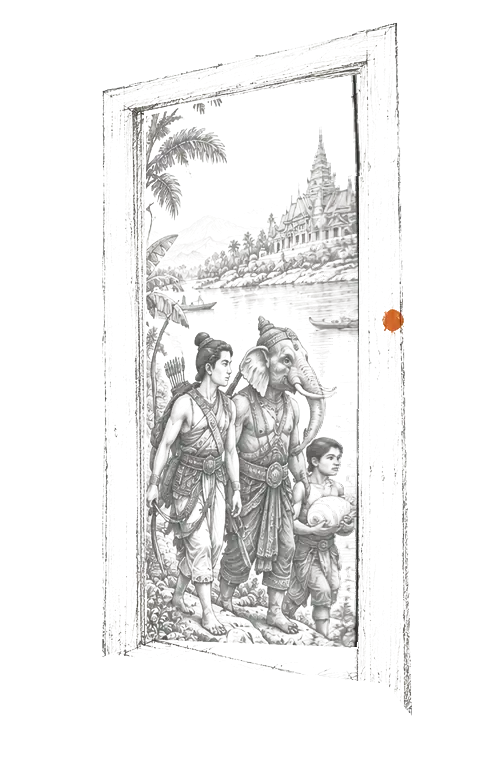
A prince born with a bow sets out to free his aunt, abducted by a devouring spirit, with his two brothers, one born with an elephant's head, the other in the form of a shell. The road is strewn with monsters and giants. Twenty thousand lines, and a metre that the country's pupils learned from this very text.
Timeline
- 1500–1650Classical epicsThao Hung, Sinxay, the Phra Lak Phra Lam. Verse long before prose.
- 1944–1970Birth of proseSomjin Nginn, Leup Pha Sun, Bosengkham Vongdara.
- 1979–1990After 1975Dara Viravong, Outhine Bounyavong. Writing in a closed country.
- 1983–1997A rare cinemaSomchith Pholsena, Som-Ok Southiphone. A handful of films in twenty years.
Reading keys
- Family names have existed only since 1943 and people are addressed by their first name, preceded by a particle of politeness.
- The name may indicate belonging: the Lao of the plains, the Hmong and the mountain groups have different systems, and the Hmong have old clan names.
- Kinship terms encode age and the side of the family, and one calls strangers by a kinship term.
- Residence after marriage is often with the wife's parents, which reverses what a reader expects.
- The secret war, the bombings and the role of the Hmong recruited by the Americans are subjects on which every account is situated.
- The regime in place since 1975 practises prior censorship, and there is no independent publishing.
- The abolished monarchy and the fate of the last king, who died in a re-education camp, are not spoken of.
- Restraint is a value, and one avoids direct conflict as one avoids complaint.
- Theravada Buddhism dominates among the Lao of the plains, with the temporary passage through the monastery and the morning alms to the monks.
- The phi, spirits of places, of houses and of the dead, are the object of a constant cult, and the baci rite, in which cotton threads are tied around the wrists, calls back the souls of the body.
- The mountain groups, Hmong, Khmu and others, have their own religions, with shamans and sacrifices, distinct from Buddhism.
- The naga, serpent of the waters, protects the Mekong and appears in architecture as in the narratives.
- White is the colour of mourning, and funerals include a wake and then a cremation, with an offering to the monks.
- The baci, a ceremony of thread-tying, marks births, departures, returns and recoveries.
- Boun Bang Fai, the festival of bamboo rockets fired to ask for rain, and Pi Mai in April organise the calendar.
- The sinh, a woven skirt worn by women, and its patterns indicate the region and the occasion.
- Sinxay, a seventeenth-century epic, is the text that the country had taught and that serves as a moral reference.
- The Lao version of the Ramayana, with its own episode, and the narrative of Thao Hung Thao Cheuang, an epic about the peoples of the north, complete the classical stock.
- The narrative of the toad king, who declares war on the god of rain, explains the rocket rites and is still told.
- The narratives collected in English and in Lao and put online by an American university constitute the accessible documented corpus.
- Laos is not a variant of Thailand: the languages are close, the history and the political regime very different.
- The bombings from 1964 to 1973 took place during an undeclared war, which explains their long invisibility.
- The country has some fifty groups and the Lao identity covers only part of the population.
- The slenderness of the written corpus does not measure the tradition: palm-leaf manuscripts numbered in the tens of thousands before 1960.
Tales and mythologies 3
- Epicທ້າວຮຸ່ງທ້າວເຈືອງAnonymous · 1500not translated into EnglishThe most complete manuscript was found in Bangkok in 1941, and the book appeared only forty-six years later.Literature
- EpicPhra Lak Phra LamພະລັກພະລາມAnonymous · 1500The great Indian epic spread throughout Southeast Asia, and each country received it by shifting it to its own setting.Literature
Available in English 3
The books from this country that can be read in English, in the original or in translation.
- EpicPhya Khankhaak, the Toad KingພະຍາຄັນຄາກAnonymous · 1500The narrative explains why it rains, and villages still fire rockets into the sky so that it will continue.Literature
- ChronicleHistory of LaosPhongsavadan LaoMaha Sila Viravong · 1957A country that has just gained independence needs an account of itself to give to its secondary-school pupils.Literature
- Short storiesMother's Belovedແຜ່ນດິນແມ່Outhine Bounyavong · 1980Everything that is printed must serve the building of the regime, and it is still possible to describe a village without drawing a moral from it.Literature
A selection to begin with 10 / 15
- EpicPhya Khankhaak, the Toad KingພະຍາຄັນຄາກAnonymous · 1500The narrative explains why it rains, and villages still fire rockets into the sky so that it will continue.Literature
- ChronicleນິທານຂຸນບູຣົມAnonymous · 1520not translated into EnglishThe founding chronicle of Laos, between the myth of the celestial origins of the Tai peoples and royal history.Literature
- NarrativeMaha Vessantara SadokAnonymous · 1799not translated into EnglishThe story of the Buddha's last life before the Awakening, the most chanted of the jatakas in Laos.Literature
- PoetryສານລຶບພະສູນAnonymous · 1830not translated into EnglishThe Siamese armies have just destroyed Vientiane, and it will take a century and a half before this grief is read as that of a nation.Literature
- NovelພະພຸດທະຮູບສັກສິດSomchine Nginn · 1944not translated into EnglishThe country's modern literature was born in the forties, under the protectorate, and its first novel is a detective novel.Literature
- ChronicleHistory of LaosPhongsavadan LaoMaha Sila Viravong · 1957A country that has just gained independence needs an account of itself to give to its secondary-school pupils.Literature
- CinemaLe PrintempsAnonymous · 1977Two years after the proclamation of the Republic, a film is needed to celebrate it, and the country has nothing to make one with.Cinema
- Short storiesMother's Belovedແຜ່ນດິນແມ່Outhine Bounyavong · 1980Everything that is printed must serve the building of the regime, and it is still possible to describe a village without drawing a moral from it.Literature
- CinemaSiang peun chak thong haiSomchith Pholsena · 1983Production in the eighties was entirely state-run and served the memory of the revolution.Cinema
- CinemaບົວແດງSom-Ok Southiphone · 1988State cinema is made with the technical support of Vietnam and the Soviet Union, for lack of any equipment on the spot.Cinema