Malaysia
- works
- 37
- 33 books · 4 films
- period covered
- 1600–2000
- language of writing
- Malay
An old Malay court narrative tells of Hang Tuah, the perfect warrior who, on the orders of the sultan of Malacca, kills his best friend Hang Jebat, who had rebelled against an unjust sovereign. The Singapore studios drew two films from it five years apart, in 1956 and 1961, the first on the side of the loyal man, the second on the side of the rebel. Two heroes, a single scene, and a debate that Malaysia has never closed: must one obey a master who is wrong.
Read moreShow less
It comes from an ancient, written court literature. The Malay world produced chronicles, poems and prose narratives, written in Jawi, that is in Arabic script, and kept in the palaces of Malacca, Johor, Kedah and Perak. The Malay Annals trace the sultans back to Alexander the Great, and the Kedah chronicle also links them to the conqueror, through a king come from Rome: the prestigious genealogy borrowed from abroad is an institution here.
The modern form was born in the twenties with the novel of manners, and it inherited a constraint specific to the country. Malaysia brings together Malays, Chinese, Indians and the peoples of Borneo, and its cultural policy defined national literature as that written in Malay. Novels in English, Chinese and Tamil nevertheless exist, and this catalogue gives a few of them, such as the one in which four students from different communities see their friendship come apart in the Singapore of the fifties.
What awaits the reader is a highly written literature, inherited from a court tradition, in which loyalty and shame are the main springs. The novel that opens this page asks a question in its title, and asks it about a woman.
A way to begin
Iakah Salmah?
Ahmad bin Haji Muhammad Rashid Talu · 1928
Regarded as the first Malay novel set in a local setting: an educated young woman of Penang, free of rights.
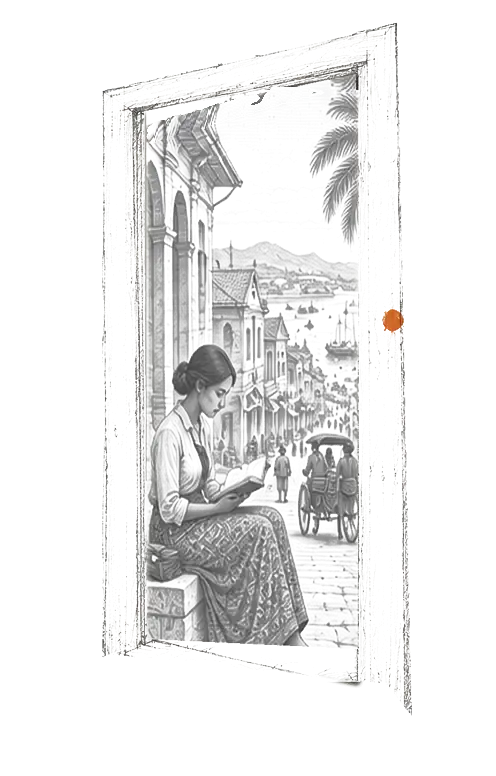
Is it Salmah? In Penang in the twenties, Salmah, educated at a Western school but faithful to Islam, embodies the modern woman, and her education challenges a society attached to its customs. Through her and the families around her, the novel debates the causes of Malay society's backwardness and pleads for women to be educated and win their freedom.
Timeline
- 1600–1800HikayatCourt chronicles and tales, from Hang Tuah to the Malay Annals, copied from hand to hand.
- 1760–1770The witness takes up the penRaja Chulan, then Munshi Abdullah. The author gives his name and tells what he saw.
- 1925–1940Birth of the novelSyed Sheikh al-Hadi, Ahmad Rashid Talu, Pak Sako: the condition of women and colonial satire open up prose.
- 1957–1986The independence generationKeris Mas, Usman Awang, Shahnon Ahmad, A. Samad Said.
- 1976–1985The other languagesLloyd Fernando in English, K. S. Maniam from within the Tamil community, Fang Beifang in Chinese.
- 1981–2000National cinemaJins Shamsuddin, Jamil Sulong, U-Wei Haji Saari, Aziz M. Osman: history and the novel reach the screen.
Reading keys
- The Malay name reads as a filiation: bin means "son of", binti "daughter of". Ahmad bin Ismail is Ahmad, son of Ismail, and there is no transmitted family name.
- The title of haji, borne after the pilgrimage to Mecca, becomes part of the name and signals a social status.
- Chinese and Tamil names coexist with Malay names and immediately signal the community, central information in a country where the law varies according to it.
- Kinship terms encode age, and one calls an elder brother or sister, an older person uncle or aunt.
- The policy of preference in favour of the Malays, instituted after the riots of 1969, is a subject not approached head-on.
- Religion is protected by law: criticising Islam or proposing a conversion is liable to prosecution, and the Islamic courts have jurisdiction over Muslims.
- The interethnic riots of 1969 are a tacit limit of what may be recounted.
- Shame, malu, is an operative social category: a dishonoured character suffers a real damage that the narrative treats as such.
- Sunni Islam is the state religion and concerns the Malays by legal definition: to be Malay legally presupposes being Muslim.
- Buddhism, Hinduism, Christianity and the Chinese religions are practised by the other communities, with their temples and their festivals.
- The pre-Islamic stock survives with semangat, a vital force present in people, plants and objects, and the pawang, a ritual specialist, described as early as 1900.
- The hantu, multiple spirits with precise names, including the pontianak, a woman who died in childbirth and comes back, belong to a living bestiary.
- Muslim mourning is brief, with burial on the same day and readings on the seventh and fortieth days.
- Yellow is the royal colour and its use was reserved, which the older narratives signal.
- Ramadan and Eid, with the obligatory return to the village, bring the country to a halt, as do the Chinese New Year and Deepavali, all public holidays.
- The sarong, the baju and the keris, a wavy-bladed dagger that contains a force of its own, are objects with a social and ritual charge.
- The Malay Annals and the Story of Hang Tuah are the founding texts, known through school and through cinema.
- The debate between Hang Tuah and Hang Jebat, loyalty against justice, is a reference that every Malaysian understands without explanation.
- The Hikayat Pelanduk Jenaka, the cycle of the cunning mouse-deer who triumphs over the big animals, is the animal narrative stock.
- The pontianak and the hantu are a common bestiary, widely exploited by popular cinema.
- Malay and Indonesian are two standards of the same language, and a Malay book can be read in Jakarta.
- Being Malay is a legal category that includes religion: conversion out of Islam is legally almost impossible.
- The keris is not a decorative weapon but a charged object, with a name and a history of its own.
- National literature is defined by language and not by nationality, so that an important part of the country's production is administratively excluded from it.
Tales and mythologies 4
- TaleHikayat Pelanduk JenakaAnonymous · 1650not translated into EnglishThe clever mouse deer who becomes king of the forest, in an animal tale of the Malay world.Literature
- ChronicleMarong Mahawangsa: The Kedah AnnalsHikayat Merong MahawangsaAnonymous · 1800The fabulous origins of the kings of Kedah, between Rome, China and Islam.Literature
- ChronicleThe Genealogy of KingsSulalatus SalatinTun Seri Lanang · 1612The chronicle of the sultans of Malacca, written at the court of Johor to tell the origin and greatness of a dynasty.Literature
- EpicThe Epic of Hang TuahHikayat Hang TuahAnonymous · 1700The saga of the hero who served the sultan of Malacca, combining battles, journeys, love affairs and the art of governing.Literature
Available in English 12
The books from this country that can be read in English, in the original or in translation.
- NovelPrince of Mount TahanPutera Gunung TahanIshak Haji Muhammad (Pak Sako) · 1937A satire of British administration, written when political speech was still under surveillance.Literature
- NovelSalinaA. Samad Said · 1961The common people of a wretched district of Singapore, in the years after the war.Literature
- NovelStorms of YesterdayBadai SemalamKhadijah Hashim · 1968A poor young girl torn between her studies and her duty to her sick mother.Literature
- NovelInterlockInterlokAbdullah Hussain · 1971A historical novel about the formation of a nation made up of three peoples, Malay, Chinese and Indian.Literature
- Short storiesSpilled RiceNasinya TumpahFatimah Busu · 1972The poverty of a peasant family in Kelantan, seen through a little girl put in charge of her younger siblings.Literature
- NovelSrengengeShahnon Ahmad · 1973A village divided between those who want to clear a hill and those who believe it is inhabited.Literature
- NovelScorpion OrchidLloyd Fernando · 1976Four students from different communities, in the troubled Singapore of the end of the colonial era.Literature
- NovelThe Last Days of an ArtistHari-hari Terakhir Seorang SenimanAnwar Ridhwan · 1979A village storyteller sees his art decline in a changing world, from the colony to the Japanese occupation.Literature
- NovelThe HeadhunterNgayauAmil Jaya · 1979A headhunting expedition, in the Sarawak of the longhouses.Literature
- NovelThe ReturnK. S. Maniam · 1981The child of Tamil immigrants discovers English schooling and grows apart from his own people, around the time of independence.Literature
- NovelThe Big Businessman from Kuala LumpurSaudagar Besar dari Kuala LumpurKeris Mas · 1982An ambitious entrepreneur and a village he wants to relocate, at a time when the state is pushing the Malays towards business.Literature
- NovelElephant Herd群象Chang Kuei-hsing · 1998A young Chinese man from Borneo looks for his uncle among the communist guerrillas of the Borneo jungle.Literature
A selection to begin with 10 / 37
- NovelSalinaA. Samad Said · 1961The common people of a wretched district of Singapore, in the years after the war.Literature
- Short storiesSpilled RiceNasinya TumpahFatimah Busu · 1972The poverty of a peasant family in Kelantan, seen through a little girl put in charge of her younger siblings.Literature
- NovelSrengengeShahnon Ahmad · 1973A village divided between those who want to clear a hill and those who believe it is inhabited.Literature
- NovelScorpion OrchidLloyd Fernando · 1976Four students from different communities, in the troubled Singapore of the end of the colonial era.Literature
- NovelThe Last Days of an ArtistHari-hari Terakhir Seorang SenimanAnwar Ridhwan · 1979A village storyteller sees his art decline in a changing world, from the colony to the Japanese occupation.Literature
- NovelThe HeadhunterNgayauAmil Jaya · 1979A headhunting expedition, in the Sarawak of the longhouses.Literature
- CinemaBukit KepongJins Shamsuddin · 1981An isolated police post facing a communist attack, in British Malaya in 1950.Cinema
- CinemaRanjau sepanjang jalanJamil Sulong · 1983A family of rice farmers struggling against nature, brought to the screen from a Malay novel.Cinema
- CinemaThe ArsonistKaki BakarU-Wei Haji Saari · 1995A proud, incendiary father and a son who seeks his own path, on a plantation.Cinema
- CinemaLeftenan AdnanAziz M. Osman · 2000An officer of the Malay Regiment facing the Japanese invasion, in a patriotic epic.Cinema