Mali
- works
- 21
- 15 books · 6 films
- period covered
- 1300–1999
- language of writing
- French
In 2012, librarians of Timbuktu saved their manuscripts by having them taken out of the city in small parcels. Trunks, rice sacks, motorbikes, then canoes on the Niger: hundreds of thousands of volumes in Arabic and in African languages, kept for generations in family libraries, were conveyed to Bamako during the occupation of the city. They deal with astronomy, law, medicine, poetry, trade. Some are five centuries old.
Read moreShow less
That written mass contradicts a tenacious received idea about West Africa. Timbuktu, Djenné and Gao were university cities fed by the trade in salt and gold, and present-day Mali occupies the territory of three successive empires whose chronicles are written. Alongside that learned writing in Arabic, another transmission functioned without interruption: that of the griots, whose families pass down the epic of Sunjata Keïta, and who recite it at the shrine of Kangaba during a ceremony that comes round every seven years.
Malian literature stands exactly in that gap, between the archive and the voice. Amadou Hampâté Bâ, trained in the Quranic school and in the colonial school, spent his life collecting the Fulani tradition and making books of it, without ever pretending that a book was the equivalent of a recitation. Massa Makan Diabaté, the grandson of a griot, rewrote the Mandinka epic. In 1968, Yambo Ouologuem published a novel accusing the African elites of having taken part in slavery, received a literary prize in Paris, then found himself accused of plagiarism and disappeared from the scene for forty years.
What awaits the reader is a prose that owns its debt to recited speech, with its opening formulas and its addresses to the audience. The novel that opens this page tells of a cunning colonial interpreter, and the narrator warns from the start that he has the story from somebody.
A way to begin
The Fortunes of Wangrin
Amadou Hampâté Bâ · 1973
A delightful picaresque novel: a cunning interpreter under colonisation, by a great Malian storyteller.
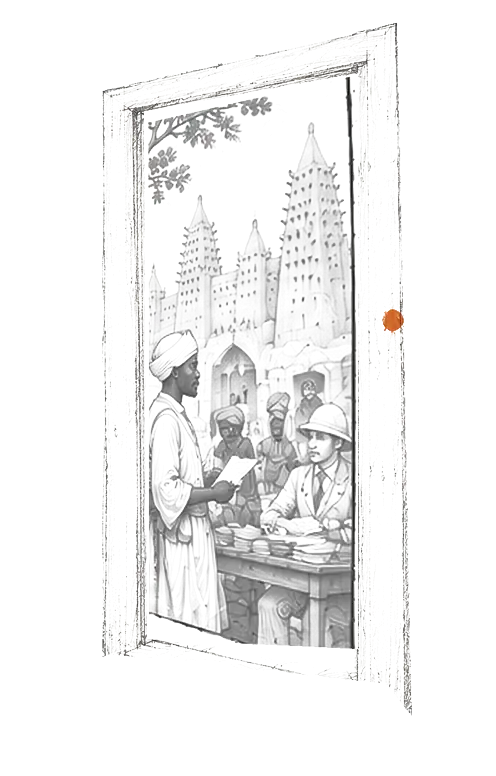
Born under a prophecy of ruin, Wangrin leaves the colonial school, becomes the district commander's interpreter and learns to play the colonisers and his own people against each other. Under the protection of a god, he grows rich at the expense of the traders and the administration, and gives the poor a share of what he takes.
Timeline
- 1952–1957Before independenceOuane, Fily Dabo Sissoko, Seydou Badian. Writing on the eve of 1960.
- 1968–1975RuptureOuologuem's Bound to Violence; Aoua Kéita tells her life as an activist.
- 1973Hampâté BâThe Fortunes of Wangrin, taken down from the mouth of its own character.
- 1975–1988Birth of cinemaSouleymane Cissé, Sega Coulibaly, Adama Drabo. Bamako is filming.
- 1990–1999A recognised cinemaFalaba Issa Traoré, Ascofaré, and Cheick Oumar Sissoko's Genesis.
Reading keys
- The surname, the jamu, says everything: Keïta, Traoré, Diabaté, Kouyaté refer to precise lineages with their trades and their alliances.
- The griots, called jeli, bear names distinct from those of the nobles and form a hereditary caste of speech. A Kouyaté is a griot, a Keïta is a noble: that is immediate social information.
- The sinankunya, joking kinship between certain lineages or ethnic groups, authorises ritual insult and forbids violence. A scene of abuse may be a scene of alliance.
- The castes of blacksmiths and of cobblers have their prohibitions and their prerogatives, and marriage between castes remains difficult.
- Slavery internal to West African societies is the subject that Ouologuem named and that cost him his place. It remains difficult.
- The Tuareg rebellions of the north and the occupation of 2012 are raw subjects.
- The griot says what the noble cannot say: direct speech is delegated, and a character who speaks for himself in a negotiation commits a fault.
- The drought and the famine of the nineteen seventies and eighties are a shared narrative stock.
- Islam is very much in the majority, with the Sufi brotherhoods and a long tradition of scholars in Arabic.
- The old cults survive, among them the komo and the Bambara initiatory societies, with their masks and their altars. They coexist with the mosque.
- Wells, trees and crossroads have their spirits, and the nyama, forces released by death or transgression, are dangerous.
- The blacksmith is also a diviner and a master of initiation, and his status is religious as much as technical.
- Muslim mourning is brief, burial takes place on the same day and condolences last three days, then continue on the fortieth.
- The white of the garment and bogolan, cloth dyed with mud, have codified ritual uses.
- The masks of the komo and the kono come out on dates that are not public and their appearance suspends the ordinary order.
- The ceremony of rebuilding the shrine of Kangaba, every seven years, is the great gathering of Mandinka memory.
- The epic of Sunjata Keïta, founder of the empire of Mali in the thirteenth century, is the narrative that everyone knows, recited by the griots and published by several authors.
- The chronicles of Timbuktu, written in Arabic in the seventeenth century and translated into French at the beginning of the twentieth, report the Songhai and Mandinka dynastic traditions.
- The Bambara and Fulani tales, with the hare and the hyena, form the domestic narrative stock.
- The figure of the griot and its vocabulary are assumed to be known by any Malian text.
- West Africa is not an area without writing: Mali preserves hundreds of thousands of manuscripts, some of them from the fifteenth century.
- The griot is not a picturesque storyteller but a hereditary professional of speech, with rights and obligations.
- Caste is not a relic: it still organises marriages and trades.
- The accusation of plagiarism made against Ouologuem in 1968 is today reread as a trial made of a novelist who practised montage.
Tales and mythologies 2
- EpicJanjon et autres chants populaires du MaliMassa Makan Diabaté · 1970not translated into EnglishThe songs of the Mandinka griots, including that of the hero Fakoli, transcribed by an heir to the spoken word.Literature
- EpicThe Epic of SundiataSunjataAnonymous · 1300The epic of the founder of the Mali empire, which each line of griots tells in its own way.Literature
Available in English 3
The books from this country that can be read in English, in the original or in translation.
- NovelCaught in the StormSous l'orageSeydou Badian · 1957An educated young girl, promised by her father to a rich merchant, in the days of the colony.Literature
- NovelBound to ViolenceLe Devoir de violenceYambo Ouologuem · 1968Seven centuries of an imaginary Sahelian empire, where the African masters sell their subjects before the Europeans do.Literature
- NovelThe Fortunes of WangrinL'Étrange Destin de WangrinAmadou Hampâté Bâ · 1973An interpreter in the colonial administration who plays tricks on his masters as he does on his own people.Literature
A selection to begin with 10 / 21
- NovelCaught in the StormSous l'orageSeydou Badian · 1957An educated young girl, promised by her father to a rich merchant, in the days of the colony.Literature
- NovelBound to ViolenceLe Devoir de violenceYambo Ouologuem · 1968Seven centuries of an imaginary Sahelian empire, where the African masters sell their subjects before the Europeans do.Literature
- Feature filmThe Young GirlDen MusoSouleymane Cissé · 1975A young mute woman, raped and then rejected by her family because she is expecting a child.Cinema
- NarrativeFemme d'AfriqueAoua Kéita · 1975not translated into EnglishThe life of a midwife in colonial Africa, from bush posts to political action, told in the first person.Literature
- Feature filmIt's FinishedA BannaKalifa Dienta · 1980A couple of teachers from Bamako visiting their native village, where an uncle sows discord.Cinema
- NovelToiles d'araignéesIbrahima Ly · 1982not translated into EnglishA teenage girl who refuses a forced marriage, and the prison into which she is thrown to make her yield.Literature
- Feature filmThe Sacred PagneBamunanFalaba Issa Traoré · 1990A champion cyclist whom leprosy drives from his place in the village.Cinema
- Feature filmFire!Ta DonaAdama Drabo · 1991A young forester from the city looks for the ancient remedy that could put an end to the fires.Cinema
- Feature filmFaraw! Mother of the DunesFaraw ! Une mère des sablesAbdoulaye Ascofaré · 1997The day of a Songhai mother who single-handedly keeps her family afloat, at the edge of the desert.Cinema
- Feature filmGenesisLa GenèseCheick Oumar Sissoko · 1999The biblical story of the patriarchs transposed to the Sahel: clan quarrels that threaten to turn into a cycle of vengeance.Cinema