Malta
- works
- 9
- 9 books
- period covered
- 1842–1965
- language of writing
- Maltese
The Maltese language has been spoken for eight centuries and has had a stable orthography only since 1924. A writers' association founded in 1920 proposed an alphabet in 1921, published in 1924 the first rules of writing, and the colonial government made them official on 1 January 1934, declaring Maltese an official language alongside English, in place of Italian. Before that, everyone wrote the language as they saw fit, and the island's writers published in Italian.
Read moreShow less
Maltese is a Semitic language issued from the Arabic of Sicily, written in Latin characters, with more than half its vocabulary borrowed from Italian and English: the only case of its kind in Europe. Its recognition was the stake of a political war between the partisans of Italian, a lettered elite close to the Church, and the British administration, each using the language of the people as an argument. Maltese literature was therefore constituted by an administrative act as much as by books.
The form is the poem and the historical novel, and the scale is that of an island of a few hundred thousand inhabitants. The price is that narrowness: a tiny market, no publishing industry, authors who are priests or teachers, and a body of work translated late or never. Dun Karm, held to be the national poet, wrote in Italian until his forties before moving to Maltese and writing the words of the anthem. The tale collection of the Jesuit Manwel Magri, published between 1902 and 1907, fixed the island's narrative stock at the very moment when the language was looking for its alphabet.
What awaits the reader is a literature of foundation, in which one sees a language provide itself with an alphabet, a grammar and a novel in two generations. The novel that opens this page, published in 1889, tells of an abduction and a long quest in fifteenth-century Malta, under Spanish rule, and the University of Malta regards it as the first literary novel in Maltese.
A way to begin
Ineż Farruġ
Anton Manwel Caruana · 1889
Regarded by the University of Malta as the first literary novel in Maltese: an abduction and a long quest, free of rights.
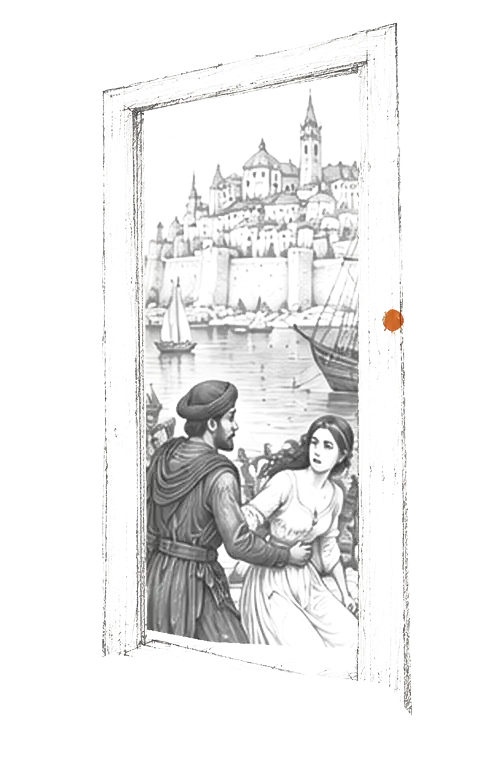
Malta, in the fifteenth century, under Spanish rule. On a whim, Don José has Ineż abducted and takes her off the island, leaving her fiancé Ġużeppi at a loss. It is his friend Wenzu who, on the strength of a few words heard from a slave, sets off on a long series of adventures to find her. The story also brings to life the society of the harbour districts.
Timeline
Reading keys
- Surnames are Sicilian or Italian for the most part, Borg, Camilleri, Vassallo, and a few come from Arabic, which says nothing about actual ancestry.
- Official first names are often Italian or English while everyday usage is Maltese, so that the same author appears in two forms.
- The family nickname, the laqam, distinguishes the branches of one and the same name in a village, and it is commonly used.
- Parish kinship and belonging to a brotherhood count in the narratives as much as filiation.
- The language question, Italian against English against Maltese, was the great political conflict of the first half of the twentieth century and leaves traces in families.
- The siege of 1940 to 1942, the bombings and the collective medal awarded by the British king are the central national narrative.
- The place of the Church, the confrontation of the nineteen sixties between the archbishopric and the labour party, and divorce authorised only in 2011 are subjects still hot.
- Immigration by sea and the fate of the migrants rescued offshore are a constant public debate.
- Catholicism is practised and institutional, with one parish per village and brotherhoods that organise social life.
- The patron saint's festival, with its rivalry between two saints in one and the same locality, is a complete institution, fireworks included.
- Saint Paul's shipwreck on the island, recounted in Acts, is the claimed founding narrative and a national holiday.
- The Neolithic temples of Gozo are explained in tradition by a giantess builder, and the creatures of folklore, Kaw kaw, Belliegħa, served to keep children quiet.
- The summer festi, with statues carried in procession, firecrackers and bands, are the summit of the calendar and the raw material of the social novel.
- Holy Week includes processions with life-size statues and costumed figures in every village.
- The carnival of Valletta, authorised by the knights since the sixteenth century, has its floats and its competitions.
- Mourning is marked by black and by anniversary masses announced in the press, a usage still common.
- Manwel Magri's tale collection, published between 1902 and 1907, is the canonical corpus, with its sixty-two narratives.
- The siege of 1565 against the Ottomans is the historical episode that every text assumes is known, and it provides the setting of the historical novels.
- The Knights of Saint John, their order and their architecture are a permanent reference, admired and contested.
- Għana, an improvised sung contest, is the popular form to which the poets refer as to an origin.
- Maltese is a Semitic language, the only official one in the European Union, and not an Italian dialect despite its Latin alphabet and its vocabulary.
- Malta is not a British or an Italian dependency: independent in 1964, a republic in 1974, a member of the Union since 2004.
- Maltese literature does not begin in 1889: it existed in Italian and in Latin for centuries, and the catalogue keeps only the Maltese-language side of it.
- A catalogue of three works measures the state of French translations, not the production of a country that today has dozens of authors.
- The island is not an isolated rock: it was a crossroads of languages, which its literature records word by word.
Tales and mythologies 1
- TaleOld Folktales of the Maltese IslandsĦrejjef MissirijietnaManwel Magri · 1902At the beginning of the twentieth century, Maltese does not yet have a fixed spelling, and Italian still dominates the letters of the island.Literature
Available in English 1
The books from this country that can be read in English, in the original or in translation.
- NovelShadows of the TruthLeli ta' Ħaż-ŻgħirĠużè Ellul Mercer · 1938The author, an activist of the Labour Party, had seen his satirical stories condemned by the Church ten years earlier.Literature
A selection to begin with 7 / 9
- PoetryIl-Ġifen TorkGiovanni Antonio Vassallo · 1842not translated into EnglishMalta is then a British colony, and Italian dominates education and letters there.Literature
- NovelElvira jew Imħabba ta' TirannGiuseppe Folliero de Luna · 1863not translated into EnglishAt the origins of the Maltese novel, a book written by a teacher of Neapolitan origin in the middle of the nineteenth century.Literature
- NovelShadows of the TruthLeli ta' Ħaż-ŻgħirĠużè Ellul Mercer · 1938The author, an activist of the Labour Party, had seen his satirical stories condemned by the Church ten years earlier.Literature
- PoetryNirienKarmenu Vassallo · 1938not translated into EnglishThe first collection of a Maltese Romantic poet, the singer of suffering and of the search for God.Literature
- NovelTaħt Tliet SaltnietĠużè Aquilina · 1938not translated into EnglishThe historical novel of a young lawyer from Gozo, who was to become the great lexicographer of the Maltese language.Literature
- PoetryIl-Jien u lil hinn minnuDun Karm · 1938not translated into EnglishA Maltese priest, alone before the silence of God, between doubt and faith, in a long poem in the Maltese language.Literature
- NovelAħna SinjuriJoseph J. Camilleri · 1965not translated into EnglishA Maltese novel of the 1960s, by a schoolteacher and educationist of the literary revival movement.Literature