Mauritius
- works
- 9
- 8 books · 1 film
- period covered
- 1822–1993
- language of writing
- French and Creole
In 1788, a French botanist published the story of two children brought up together in a valley of the Isle de France, separated by society, and in which the girl dies in a shipwreck rather than take off her clothes in order to swim. "Paul et Virginie" became one of the most widely read books of the century, translated everywhere, illustrated, set to music. It fixed for two hundred years the image of a paradisal and innocent island. The island in question is today called Mauritius, and its literature writes against that book.
Read moreShow less
For nothing there is innocent. The island was uninhabited before the arrival of the Europeans: everyone came, and most were brought. Slaves from Africa and Madagascar first, then, after the abolition of 1835, nearly half a million Indian workers under contract, the largest migration of that kind in the world, whose landing building at Port Louis is today listed by UNESCO. Hindus, Muslims, Creoles, Chinese, Franco-Mauritians: a society entirely made up of arrivals, in which everyone knows by which boat their own people came and on what date. No memory there precedes the others.
The form that results is a permanent multilingualism. One speaks Creole, one is schooled in English, one often writes in French, one prays in Hindi, Tamil, Arabic or Chinese, and a single paragraph may pass from one language to another. Charles Baissac published as early as 1888 the Creole tales of the island with their translation, a century before Creole was taken seriously. Ananda Devi, in 1989, set her first novel in an alley of Port Louis, in the home of a prostitute and her daughter, and one is as far from Virginie's valley as it is possible to be.
What awaits the reader is a literature of intimate violence and social constraint, written in a careful language about lives that are not careful. The novel that opens this page follows a girl sold to a flesh merchant of the rue la Poudrière in Port Louis, and studies of its author see it as the foundation of all her work.
A way to begin
Rue la Poudrière
Ananda Devi · 1989
The first novel by Ananda Devi, Neustadt Prize 2024: a girl from the poor districts of Port Louis.
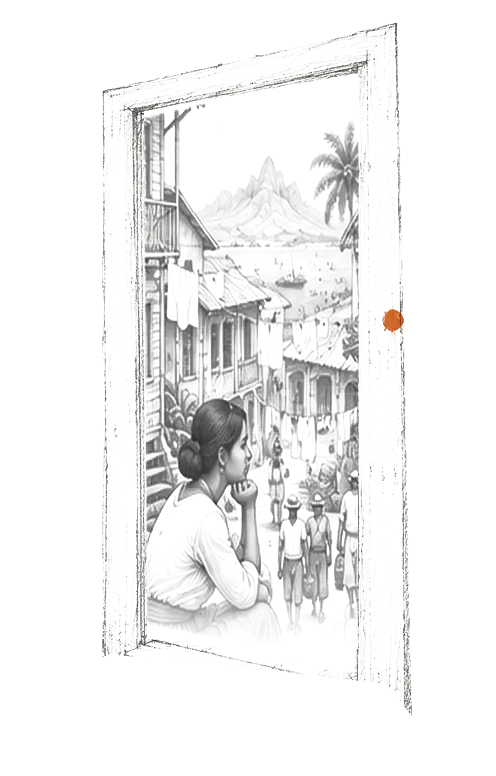
In the poor district of Dockers Flats in Port Louis, Paule, a girl nobody wanted and who was given a man's name, tells her life from her birth. She has been sold to Mallacre, sorcerer and flesh merchant of the rue la Poudrière. Amid prostitution, alcohol, superstition and perverted family ties, she looks for a way to escape the fate reserved for her people.
Timeline
- 1735–1810Isle de FranceThe French colony leaves a literature of travel, among it Paul et Virginie, written in 1788.
- 1835–1910IndentureThe arrival of Indian labourers creates a plural society and traditions in Bhojpuri and Creole.
- 1930–1970Island poetryMalcolm de Chazal and Robert-Edward Hart write a poetry read as far as France.
- 1968–1990IndependenceCreole becomes a language of writing and militant theatre takes the stage in Port-Louis.
- 1989–2020The Mauritian novelAnanda Devi, Nathacha Appanah and their contemporaries carry the Mauritian novel abroad.
Reading keys
- The name indicates the community and often the region of origin: a Ramgoolam comes from Bihar, an Ah Chuen from southern China, a Baissac from a Franco-Mauritian family, a Dieudonné from a Creole line.
- The names of freed slaves were assigned at the abolition and indicate no European ancestry.
- Caste survives in Hindu alliances without being publicly named.
- Creole kinship terms extend the family to the neighbours, and a "tantine" is not necessarily a relative.
- Relations between communities are expressed through marriage, housing and school, never head-on. The riots of 1968 and 1999 are landmarks that the texts summon without recounting.
- The question of the Chagos and the displacement of the Chagossians between 1968 and 1973 is a major political subject and an open wound.
- Domestic violence and incest are recurring themes of contemporary Mauritian literature, treated head-on by women writers.
- Creole was long considered a patois that should not be written. Its use in a text is a position taken.
- A Hindu majority, Catholicism, Islam, Tamil worship, Buddhism: the feasts of each are public holidays for all, which gives an exceptionally crowded calendar.
- Longanis, Creole sorcery, and practices of protection against the evil eye run through the communities.
- The pilgrimage of Grand Bassin, where hundreds of thousands of people walk to a sacred lake at Maha Shivaratri, is the largest Hindu gathering outside India.
- Father Laval, a Breton missionary who was beatified, is the object of a popular cult followed by non-Catholics.
- Funeral rites differ according to community: Hindu cremation, swift Muslim burial, Creole wake with songs. The narrative immediately signals whom it is speaking about.
- White is the colour of Hindu mourning, black that of Christian mourning.
- Sega, sung and danced to ravanne drums, was born in slavery and remains the music of the island.
- Chinese New Year, Divali, Eid, Christmas and Maha Shivaratri follow one another and give everybody's year its rhythm.
- The Creole tales published by Baissac in 1888, with Compère Lièvre and his tricks, are the common narrative stock.
- The Ramayana and the Mahabharata, brought by the indentured labourers, are recited and performed, and provide references that everyone understands.
- The dodo, extinct in the seventeenth century, has become the emblem of the country and the symbol of what does not come back.
- "Paul et Virginie" is a universally known reference in Mauritius, and a universally discussed one.
- The image of a tropical paradise comes from a French novel of 1788 and not from the island itself. Mauritian authors have been fighting it for a century.
- Mauritius has no indigenous population: nobody was there before, which entirely changes the meaning of the word "origin".
- Mauritian Creole is not a damaged French but a language in its own right, with its grammar and its literature.
- Official multiculturalism is a state discourse that literature examines rather than celebrates.
Tales and mythologies 1
- TaleLe Folk-lore de l'île MauriceCharles Baissac · 1888not translated into EnglishHalf a century after abolition, the tales once told by former slaves are no longer being told.Literature
Available in English 4
The books from this country that can be read in English, in the original or in translation.
- PoetrySens-PlastiqueMalcolm de Chazal · 1945Thousands of thoughts in which man is read in the flower and the stone, by a Mauritian engineer whom André Breton hailed.Literature
- NovelAdvocate of the IsleLe Notaire des NoirsLoys Masson · 1961A young heir to a notary's practice takes the side of the blacks, in a Mauritius of cyclones, poverty and anger.Literature
- NovelBlood-Red Sweatलाल पसीनाAbhimanyu Unnuth · 1977Two generations of Indian indentured labourers against the cane planters of Mauritius, in the nineteenth century, in a novel written in Hindi.Literature
- TheatreToufann: A Mauritian FantasyToufannDev Virahsawmy · 1991Shakespeare's The Tempest reinvented in Mauritian Creole, between robots, screens and séga.Literature
A selection to begin with 7 / 9
- PoetryLes Essais d'un bobre africainFrançois Chrestien · 1822not translated into EnglishIt is the first literary text written in Mauritian Creole, printed when slavery was still practised on the island.Literature
- PoetrySens-PlastiqueMalcolm de Chazal · 1945Thousands of thoughts in which man is read in the flower and the stone, by a Mauritian engineer whom André Breton hailed.Literature
- NovelAdvocate of the IsleLe Notaire des NoirsLoys Masson · 1961A young heir to a notary's practice takes the side of the blacks, in a Mauritius of cyclones, poverty and anger.Literature
- NovelBlood-Red Sweatलाल पसीनाAbhimanyu Unnuth · 1977Two generations of Indian indentured labourers against the cane planters of Mauritius, in the nineteenth century, in a novel written in Hindi.Literature
- NovelÀ l'autre bout de moiMarie-Thérèse Humbert · 1979not translated into EnglishTwins with nothing in common, in the mixed society of Mauritius, by a novelist settled in France.Literature
- TheatreToufann: A Mauritian FantasyToufannDev Virahsawmy · 1991Shakespeare's The Tempest reinvented in Mauritian Creole, between robots, screens and séga.Literature
- CinemaÀ Lucy (Maasai Connection)Radha Jaganathen · 1993Long before the debates on restitution, a filmmaker imagines Maasai coming to fetch Lucy from a museum in Paris.Cinema