Mongolia
- works
- 24
- 16 books · 8 films
- period covered
- 1240–1997
- language of writing
- Mongolian
The founding chronicle of the Mongols has survived only in Chinese. Written around 1240, shortly after the death of Genghis Khan, it recounts his origins, his betrayals and his victories with a frankness unusual for a court text. The original Mongolian manuscript disappeared without a trace. What remains is a phonetic transcription in Chinese characters, made by the Ming administration in order to learn the enemy's language, with a translation on facing pages. The national narrative of an empire was preserved by those who had overthrown it.
Read moreShow less
That dependence on the neighbours runs through the country's history. The Mongols had several writings, including a vertical one borrowed from the Uyghurs, then Cyrillic imposed in 1941, and their old written literature is largely religious, translated from Tibetan, Buddhism having become the learned culture of the monasteries and of the princes. Danzanravjaa, a nineteenth-century monk and poet, wrote in Mongolian and in Tibetan and ran in the Gobi desert a theatre for which he composed the plays himself.
Modern literature was born with the satellite state, in 1921, and it paid the usual price. Natsagdorj, considered its founder, published in 1933 a poem about his native land that all Mongolians know, and died in 1937 after a spell in prison. The purges of the nineteen thirties destroyed nearly eight hundred monasteries, killed thousands of monks and burnt the libraries they housed. Cinema was Soviet before it was Mongolian, and recent literature is written partly abroad: Galsan Tschinag, a Tuvan herder become a writer, publishes in German.
What awaits the reader is a poetry of landscape and of the horse that is never decorative, in a country where distance and cold are the primary facts. The narrative that opens this page tells of a Tuvan shepherd childhood in the Altai, and it was written in German, a language its author had learned in Leipzig.
A way to begin
The Blue Sky
Galsan Tschinag · 1994
A Tuvan shepherd childhood in the Altai, told in German by Galsan Tchinag and translated into French.
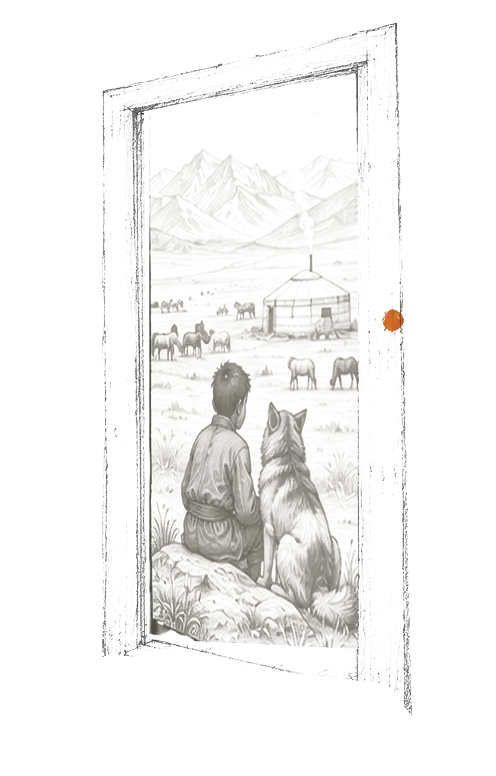
In the fifties, on the pastures of the High Altai, a boy of five or six tends the animals too weak to follow the herd, with his dog Arsylang and an old woman the family has adopted as a grandmother. He dreams of a thousand sheep, while the new power reaches the mountain.
Timeline
- 1400Chronicles and wisdomAnonymous tales from the time of Genghis Khan, passed on by storytellers.
- 1840–1860The last men of lettersDanzanravjaa, Injinash. Monastery poetry before the revolution.
- 1929–1945Revolutionary literatureNatsagdorj, Rinchen, Damdinsüren found modern letters.
- 1936–1962Soviet cinemaTrauberg and Kheifits film the country, then Mongols take up the camera.
- 1980–1998The end of the regimeDashbalbar, Mend-Ooyo, and Galsan Tschinag, who writes in German.
Reading keys
- There is no family name in the European sense: everyone bears the name of his father followed by his own name, and is designated by the second. Dashdorjiin Natsagdorj is Natsagdorj, son of Dashdorj.
- Clan names were abolished in the twentieth century and then restored in 1997, so that many families had to choose one.
- Names are often concrete words or wishes, and some ugly first names were given in order to divert evil spirits.
- Respect for elders imposes forms of address and an order of precedence in the yurt, where every place is assigned.
- The purges of 1937 and 1938, with the destruction of the monasteries and the execution of thousands of monks, are a subject opened since 1990.
- Dependence on the Soviet Union and the place of China are politically charged subjects.
- The Kazakh minority of the west and the Tuvans have their own traditions, little represented in national production.
- Restraint is valued, and one does not complain about material conditions, which are a fact and not a subject.
- Tibetan Buddhism is in the majority, implanted in the sixteenth century, with its monasteries, its recognised reincarnations and its learned literature in Tibetan.
- Shamanism survives and is undergoing a revival, with the ongon, spirits of the ancestors, and the masters of places to whom milk and vodka are offered.
- Tengri, the sky, and the earth Umay belong to the old Turco-Mongolian stock, and the ovoo, a heap of stones at the top of passes, is circled three times in the direction of the sun.
- The epic of Geser, shared with Tibet and the Buryats, is the great heroic cycle.
- Mourning includes Buddhist rites, and the body was long exposed rather than buried, a practice forbidden in the twentieth century.
- The blue of the sky is the colour of honour, and the khadag, a blue silk scarf, accompanies offerings.
- Naadam in July, with wrestling, archery and horse races ridden by children, is the national festival.
- Tsagaan Sar, the lunar new year at the end of winter, imposes hierarchical visits and a strict order of precedence.
- The chronicle of 1240 on the origins of Genghis Khan, with the grey wolf and the white doe as ancestors, is the claimed founding text.
- The epic of Geser and the cycle of the Nine Tales of the Magic Corpse, the Mongolian version of an Indian collection that passed through Tibet, form the narrative stock.
- The narratives about the two steeds of Genghis Khan and the wise discourse of the orphan, from the fifteenth century, are school texts.
- The horse, the ovoo and the yurt are references that every text assumes to be legible.
- Genghis Khan is in Mongolia a founder of a state and a national hero, not the bloodthirsty conqueror of the European and Chinese narratives.
- Mongolian is not a Turkic language, and Cyrillic indicates no kinship with Russian: it was imposed in 1941.
- Nomadism is not an archaism but an economy that still concerns an important part of the population.
- The old literature is largely Buddhist and translated from Tibetan, which shifts the idea of a purely oral culture.
Tales and mythologies 2
- PoetryЧингис хааны хоёр загал морины туужAnonymous · 1300not translated into EnglishTwo horses of Genghis Khan, wounded by being poorly recognised, and the temptation of freedom.Literature
- ChronicleThe Secret History of the MongolsМонголын нууц товчооAnonymous · 1240The oldest chronicle of the line of Genghis Khan, long preserved in a Chinese transcription.Literature
Available in English 6
The books from this country that can be read in English, in the original or in translation.
- PoetryA Debate Between an Orphan Boy and Nine Great Meritorious Ministers of Chinggis KhanЧингисийн есөн өрлөгтэй өнчин хүүгийн цэцэлсэн шастирAnonymous · 1300An orphan child who debates wine with the nine great ministers of Genghis Khan.Literature
- NarrativeThe Rejected GirlГологдсон хүүхэнTsendiin Damdinsüren · 1929A servant sold as a child, in the first major prose text of revolutionary Mongolia.Literature
- PoetryMy HomelandМиний нутагDashdorjiin Natsagdorj · 1933The poem that Mongolian schoolchildren recited under socialism, and which makes the landscape the homeland.Literature
- PoetryWhere Was I Born?Би хаана төрөө вэ?Begziin Yavuukhulan · 1959The poem that Mongolian schoolchildren learn, in which every word counts like a day of the year.Literature
- NovelGolden HillАлтан овооMend-Ooyo Gombojav · 1993A sacred hill in south-eastern Mongolia, and the nomadic childhood attached to it, between memory and legend.Literature
- NovelThe Blue SkyDer blaue HimmelGalsan Tschinag · 1994A Tuvan herder's childhood in the Altai of the fifties, when the regime reaches the mountains.Literature
A selection to begin with 10 / 24
- PoetryA Debate Between an Orphan Boy and Nine Great Meritorious Ministers of Chinggis KhanЧингисийн есөн өрлөгтэй өнчин хүүгийн цэцэлсэн шастирAnonymous · 1300An orphan child who debates wine with the nine great ministers of Genghis Khan.Literature
- PoetryMy HomelandМиний нутагDashdorjiin Natsagdorj · 1933The poem that Mongolian schoolchildren recited under socialism, and which makes the landscape the homeland.Literature
- Feature filmHis Name Is Sukhe-BatorЕго зовут Сухэ-БаторIosif Kheifits · 1942The leader of the Mongol uprising of 1921, brought to the screen in the middle of the war by Soviet and Mongolian studios.Cinema
- Feature filmTsogt TaijЦогт тайжYuri Tarich · 1945A fresco from 1945 about a seventeenth-century prince who rose up against the Manchus and the Tibetan clergy.Cinema
- Feature filmMessenger of the PeopleАрдын элчDejidiin Jigjid · 1959The first directorial work of a former cinematographer, awarded the year of its release at the Moscow festival.Cinema
- PoetryWhere Was I Born?Би хаана төрөө вэ?Begziin Yavuukhulan · 1959The poem that Mongolian schoolchildren learn, in which every word counts like a day of the year.Literature
- NovelТунгалаг ТамирChadraabalyn Lodoidamba · 1962not translated into EnglishTwo brothers from the banks of the Tamir, one a servant to a rich herder, the other a bandit with a code of honour, caught up in the revolution.Literature
- Feature filmThe Five Colours of the RainbowСолонгын таван өнгөBadamsüren Nagnaidorj · 1979The fate of a Mongolian painter, from religious art to the revolution.Cinema
- Feature filmHeaven's WillТэнгэрийн сахилChoymbolyn Jumdaan · 1991A brother and sister separated as children, whom an amulet leads to recognise each other too late.Cinema
- NovelGolden HillАлтан овооMend-Ooyo Gombojav · 1993A sacred hill in south-eastern Mongolia, and the nomadic childhood attached to it, between memory and legend.Literature