Norway
- works
- 58
- 38 books · 20 films
- period covered
- 900–1994
- language of writing
- Norwegian
In May 1943, Knut Hamsun sent his Nobel prize medal to Joseph Goebbels. On 7 May 1945, he published in an Oslo daily an obituary of Hitler that made him a warrior for humanity. His readers threw away or burnt his books, and the justice system declared him to have permanently weakened mental faculties in order to avoid trying him for treason, before sentencing him in 1948 to a fine that ruined him.
Read moreShow less
The country became independent late, in 1905, after four Danish centuries and a century of Swedish union, and it found itself without a written language of its own. Two norms were constructed, one from the usage inherited from Denmark, the other by Ivar Aasen from the speech of the valleys, and the choice between them remains a social choice that the school administers. The Sami, for their part, were schooled in Norwegian until the nineteen sixties, with a ban on using their language in the boarding schools.
The Norwegian form is a play in a drawing room and a consciousness speaking alone. Ibsen sets the action in the present, in bourgeois interiors where the past comes back up through conversation, and he wrote it for twenty-seven years outside the country. Hamsun opened in 1890 a prose that follows the leaps of a starving brain, and Europe would remember it. The price is old: Hans Jæger's book on the bohemia of Kristiania was seized in 1885, its author imprisoned and dismissed from his post. Nordahl Grieg, poet and war correspondent, died in 1943 in a bomber over Berlin. And 1987 had to be waited for before a feature film was shot in the Sami language, by Nils Gaup.
What awaits the reader is a literature of isolation and of the outdoors, in which nature is not a refuge but a given, and a theatre that invented modern dialogue. The novel that opens this page, published in 1890, follows in the streets of Kristiania a man who does not eat and who writes all the same; its author is the one of the first paragraph.
A way to begin
Hunger
Knut Hamsun · 1890
A starving young writer in the streets of Kristiania: the novel the Nobel Foundation regards as the first truly modern one in Norwegian literature. Free of rights.
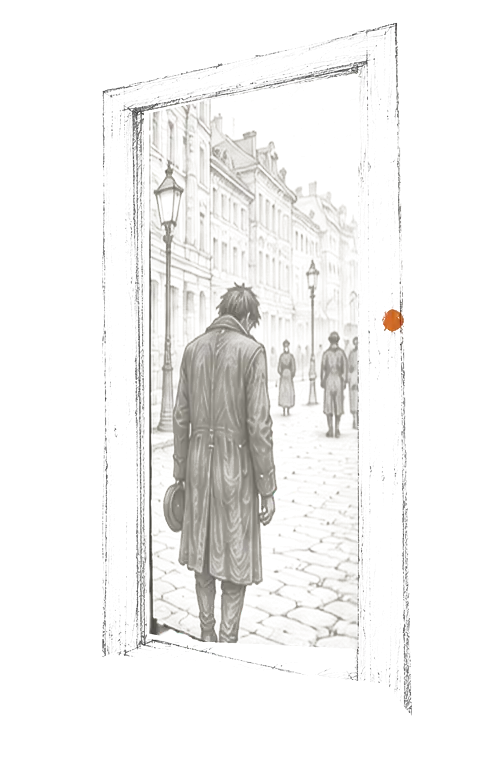
A nameless young writer wanders through Kristiania, starving, living only from the occasional sale of an article. He pawns his belongings, gives almost all the money to a beggar, lies to strangers for no reason, refuses food he is offered, follows two women in the street and names one of them Ylajali. As his body weakens, his mind races, and he still struggles to keep up appearances.
Timeline
- 1150–1350SagasOld Norse, shared with Iceland, produces a prose without equal in Europe.
- 1850–1900Golden ageIbsen brings the bourgeoisie and its lies onto the stage. All Europe follows.
- 1890–1940ModernityHamsun invents the interior monologue, and will later disgrace himself.
Reading keys
- Surnames in -sen are filiation names frozen in the nineteenth century, and many families bear on the contrary a farm name, adopted on leaving the countryside, which indicates a precise valley.
- The first name alone suffices in almost every situation, and formal address has disappeared from ordinary usage.
- Sami names were translated or replaced by the administration during the period of Norwegianisation, and their resumption is an act claimed since the nineteen eighties.
- Cohabitation without marriage has long been ordinary and calls for no comment in a narrative.
- Collaboration, the Quisling government and the fate of the compromised writers, Hamsun in the front rank, are not settled, and republishing his books remains a debated decision.
- The policy of Norwegianisation of the Sami, the commission of inquiry into its effects and the conflicts over pasture land and energy are raw subjects.
- Oil, the wealth of the sovereign fund and the gap between ecological discourse and the export of hydrocarbons provide the ordinary irony of contemporary texts.
- The choice of written norm, one or the other, is an immediate social and regional marker.
- State Lutheranism, separated from the state in 2012, coexists with a strong pietist tradition in the west and the south, severe and communal, that the novels set against the town.
- The living legends are not the gods but the spirits of places: the huldre, woman of the forest with a cow's tail, the draug of the sea, the nøkk of the rivers.
- Sami shamanism, with its drum, was repressed and burnt by the missions in the eighteenth century, and its return is recent.
- Nordic mythology belongs to the learned stock rather than to belief, transmitted by the Icelandic texts and not by local tradition.
- 17 May, constitution day, is celebrated in regional costume and in children's processions, and the costume indicates the family's valley of origin.
- Midsummer is marked by fires at the water's edge, and the closing of the towns during the July holidays is a social fact that the narratives use.
- Confirmation, religious or civil, is a general rite of passage, with a reception and gifts.
- The cabin in the mountains or by the fjord is the place where family affairs are settled, and moving from the chalet to the flat states a social decline.
- The collection of Asbjørnsen and Moe, published from 1841, holds the place of the Grimms: trolls, the youngest son who succeeds, princess and white bear.
- Peer Gynt, the character of a dramatic poem of 1867, is the national liar whose lines are quoted like proverbs.
- The great texts of the period 1880 to 1900 form a common repertoire of plays about marriage and money, performed and performed again every season.
- The Sami joik, a song without beginning or end that designates a person or a place, is a reference cited in the literature of the north.
- Two written norms coexist officially, and a text in Nynorsk is neither a dialect nor an archaisation, but a choice of language.
- Ibsen wrote in a language close to the written Danish of his time, and reading him in modern Norwegian already presupposes an updating.
- The Sami are not a marginal population but an indigenous people with a parliament, territorial rights and cultural institutions.
- The country is not a member of the European Union, having refused it in two referendums, and its wealth is recent: until the nineteen sixties, it was a country of emigration.
- The omnipresent nature of the texts is not a romantic setting but a constraint: distances, darkness, sea, isolation.
Tales and mythologies 1
- TaleNorwegian Folk TalesNorske FolkeeventyrPeter Christen Asbjørnsen and Jørgen Moe · 1844A collection published in instalments and in volumes from 1841 to 1844, in a written language close to the speech of the country.Literature
A selection to begin with 10 / 58
- TheatrePeer GyntHenrik Ibsen · 1867A verse drama in which a young Norwegian braggart, banished from his village, searches for himself among the trolls and then at the ends of the earth.Literature
- NovelFra Kristiania BohemenHans Jæger · 1885not translated into EnglishTwo young people of the capital between the café, alcohol and revolt against bourgeois morality.LiteraturePublic domain
- NovelKristin LavransdatterSigrid Undset · 1922A wealthy farmer's daughter chooses the man she loves against the wishes of her family, and bears the weight of it all her life.LiteraturePublic domain
- NovelThe Fourth Night WatchDen fjerde nattevaktJohan Falkberget · 1923A priest newly arrived in a mining town loves a married woman, and his faith is shaken by it.Literature
- PoetryAll That Is Mine DemandFrihetenNordahl Grieg · 1943Fighting verse written in exile for an occupied country, which received it by radio and through smuggling.LiteraturePublic domain
- CinemaKon-TikiThor Heyerdahl · 1950Six men who set out from Peru on a primitive craft film their own crossing of the Pacific.Cinema
- CinemaNine LivesNi livArne Skouen · 1957A lone man, frozen and unable to walk, is carried towards the border by people who risk their lives for him.Cinema
- CinemaLake of the DeadDe dødes tjernKåre Bergstrøm · 1958Six friends investigate the disappearance of their host, and the legend of a forest lake begins to answer back.Cinema
- CinemaThe Wayward GirlUng fluktEdith Carlmar · 1959A film about two young people who flee the city for an abandoned farm, where the arrival of a vagrant disturbs their isolation.Cinema
- CinemaPathfinderOfelašNils Gaup · 1987An adventure film in which a young Sami, the sole survivor of his people, agrees to act as guide to the raiders who killed his family.Cinema