Pakistan
- works
- 27
- 13 books · 14 films
- period covered
- 1884–1999
- language of writing
- Urdu
Saadat Hasan Manto was tried six times for obscenity, three times before 1947 in British India, three times afterwards in the new Pakistan. The same stories, the same courts, two successive states, the same charge and, each time, acquittal or a fine. He wrote very short narratives about prostitutes, pimps, madmen, and about what Partition had done to ordinary people. He drank, he had no money, he sold his stories one by one to pay his rent, and he died at forty-two. He is today held to be the greatest short-story writer in the Urdu language, and India and Pakistan both claim him.
Read moreShow less
His case tells of a founding difficulty. Pakistan was created in 1947 on an idea, that of a state for the Muslims of the subcontinent, and it inherited a problem of language: Urdu, chosen as the national language, was the mother tongue of almost nobody, while Punjabi, Sindhi, Pashto and Baluchi each carried an old literature. Making a national literature therefore meant privileging one language against the others, which cost the country its eastern half in 1971.
The dominant form is the brief short story and the poem. Faiz Ahmed Faiz, arrested in 1951, wrote his greatest texts in prison, in an Urdu that borrows from classical love poetry to speak of politics, so that one and the same line may be read as a lover's complaint or as a call. Cinema had a golden age in the nineteen sixties, with studios in Lahore and in Karachi, before the islamisation of the nineteen eighties closed the cinemas, and it has since reconstituted itself with reduced means.
What awaits the reader is a dry writing, without explicit judgement, in which the author refuses to say who is in the wrong and leaves the reader alone with the scene. The collection that opens this page dates from 1936, and its first story, the author's very first, returns to the days of 1919 in Amritsar.
A way to begin
آتش پارے
Saadat Hasan Manto · 1936
Saadat Hasan Manto's first collection, free of rights: eight stories, including the author's very first, set in the Amritsar of 1919.
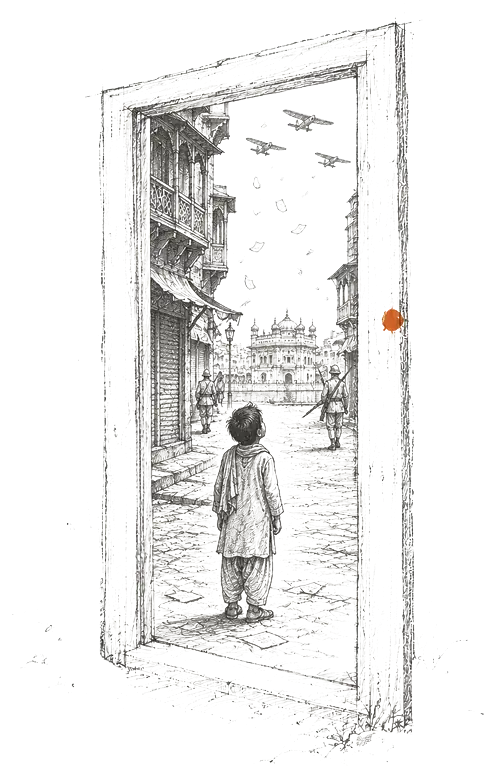
Eight stories, including the author's very first. In Tamasha, in Amritsar, military planes circle over the city and armed police patrol the deserted bazaars; little Khalid, six, takes the leaflets dropped from the sky for the announcement of a show. The other pieces are titled Khooni Thook, Inqalab Pasand, Ji Aaya Sahab, Mahigir, Taqat ka Imtehan, Deewana Shayr and Chori.
Timeline
- 1936–1955Manto and PartitionThe Urdu short story says what official history leaves out.
- 1948–1962Lahore producesCinema takes off; Jago Hua Savera makes the country known abroad.
- 1960–1980Writing in EnglishAttia Hosain, Taufiq Rafat, Bapsi Sidhwa. A second literature.
- 1966–1979Popular cinemaArmaan, Zarqa, Maula Jatt. The Punjabi film breaks every record.
- 1988–1998Diaspora and returnKureishi writes London; Samina Peerzada films from Lahore.
Reading keys
- The name indicates the language and often the region: Punjabi, Sindhi, Pashto and Baluchi names are not to be confused, and a name in -zai or Khan refers to the Pashtun world.
- The title of sayyid designates a descendant of the Prophet, socially very marked, and the biradari, extended kinship groups, organise marriages and politics.
- Marriage between cousins is frequent and valued, which tightens families and feeds the plots.
- The kunya and terms of respect are in constant use, and one does not call an elder by their first name alone.
- The army, religion and the question of Kashmir form three subjects whose criticism exposes one to prosecution or to violence.
- Blasphemy carries the death penalty, which radically bounds the literary space since the nineteen eighties.
- The Partition of 1947 is recounted as a tearing away, and Manto is its witness of reference.
- The secession of Bangladesh in 1971 is a subject little approached head-on in national production.
- Sunni Islam is in the majority, with an important Shia minority and deeply implanted Sufi currents, whose shrines attract crowds.
- The mazar, tombs of Sufi saints, are places of music, dance and trance, regularly attacked by rigorist movements.
- Sufi poetry in Punjabi and in Sindhi, that of Bulleh Shah and of Shah Abdul Latif, is sung in the shrines and known to all.
- The Ahmadis, declared non-Muslim by law in 1974, and the Christian and Hindu minorities occupy a precarious legal position.
- Muslim mourning is brief, with burial on the same day, three days of condolences and a commemoration on the fortieth.
- Black dominates Shia mourning, and Ashura gives rise to processions and to public lamentations.
- Ramadan and the two Eids order the calendar, and Eid al-Kabir commits the economy of a family.
- Qawwali, a Sufi chant performed in a group in the shrines, may last for hours and provokes trance.
- The great tragic love cycles of the Punjab and of Sindh, Hir and Ranjha, Sassi and Punnun, Sohni and Mahiwal, are sung and quoted as parables.
- The ballads of the Punjab collected between 1884 and 1900, with the original text on facing pages, form the documented corpus.
- The Sufi poetry of Bulleh Shah and of Shah Abdul Latif is a shared stock, used in the mosque as at a demonstration.
- The Rigveda was probably composed in the Indus basin, which the country rarely mentions and which archaeologists recall.
- Urdu is the mother tongue of only a minority: Punjabi dominates demographically, and each province has its literature.
- Pakistan is not an Arab country: the languages are Indo-Iranian and the history is that of the subcontinent.
- Classical love poetry serves as a political language, and reading a ghazal as a simple love poem may make one miss its meaning.
- The Kalash of the Chitral valley still practise a pre-Islamic polytheism, the only one in the area, which the image of a uniformly Muslim country erases.
Tales and mythologies 1
- EpicThe Legends of the PanjâbRichard Carnac Temple · 1884The songs of the wandering bards of the Punjab, collected at the end of the nineteenth century by a British officer.Literature
Available in English 9
The books from this country that can be read in English, in the original or in translation.
- PoetryThe Call of the Marching Bellبانگِ دراMuhammad Iqbal · 1924Patriotic songs, memories of Europe and calls for a Muslim awakening: Iqbal's first Urdu collection.Literature
- NovelTwilight in DelhiAhmed Ali · 1940The old Muslim society of a fallen imperial capital, its pigeons and its poets, caught at the moment when it ceases to exist.Literature
- NovelRiver of Fireآگ کا دریاQurratulain Hyder · 1959Two thousand years of Indian history, from Antiquity to Partition, through figures reborn from age to age.Literature
- NovelSunlight on a Broken ColumnAttia Hosain · 1961The end of a world of Muslim landowners in Lucknow, seen by a young girl growing up in it.Literature
- NovelThe Weary Generationsاداس نسلیںAbdullah Hussein · 1963Thirty-five years of the Punjab before the partition, seen by a man whom the war moved from one world to another.Literature
- NovelThe Crow EatersBapsi Sidhwa · 1978A Parsi family saga in Lahore, written in the vein of farce by a novelist from the same community.Literature
- NovelBastiبستیIntizar Hussain · 1979A man who changed country in 1947 lives through, twenty-four years later, the war that splits his new country in two.Literature
- PoetryArrival of the MonsoonTaufiq Rafat · 1985Poems that make the language of the former colonizer speak of a country, its seasons and its families.Literature
- NovelThe Buddha of SuburbiaHanif Kureishi · 1990The English suburbs seen by a boy of two worlds, between everyday racism and the drawing rooms' appetite for the exotic.Literature
A selection to begin with 10 / 27
- CinemaThe Day Shall DawnJago Hua SaveraA. J. Kardar · 1959Fishermen of East Bengal caught between the river and the moneylenders, played by unknowns before the camera.Cinema
- NovelRiver of Fireآگ کا دریاQurratulain Hyder · 1959Two thousand years of Indian history, from Antiquity to Partition, through figures reborn from age to age.Literature
- NovelSunlight on a Broken ColumnAttia Hosain · 1961The end of a world of Muslim landowners in Lucknow, seen by a young girl growing up in it.Literature
- NovelThe Weary Generationsاداس نسلیںAbdullah Hussein · 1963Thirty-five years of the Punjab before the partition, seen by a man whom the war moved from one world to another.Literature
- CinemaNailaSharif Nayyar · 1965Two half-brothers in love with the same cousin, in a melodrama drawn from a popular novel.Cinema
- CinemaArmaanPervez Malik · 1966An exchange of identities between two friends on the eve of an arranged marriage, and a cousin's secret.Cinema
- CinemaZarqaRiaz Shahid · 1969A Palestinian dancer faces an occupying officer, in a film of sung struggle.Cinema
- NovelThe Crow EatersBapsi Sidhwa · 1978A Parsi family saga in Lahore, written in the vein of farce by a novelist from the same community.Literature
- CinemaMaula JattYunus Malik · 1979A peasant vendetta fought with axes, where violence answers violence under the eye of a mocked police force.Cinema
- NovelBastiبستیIntizar Hussain · 1979A man who changed country in 1947 lives through, twenty-four years later, the war that splits his new country in two.Literature