Panama
- works
- 24
- 24 books
- period covered
- 1809–1982
- language of writing
- Spanish
For seventy-six years, a strip of land crossing the country did not belong to the country. The Canal Zone, sixteen kilometres wide and eighty long, was territory of the United States: its own government, its police, its schools, its courts, its flag, and Panamanians who needed a permit to move about in it. The country was cut in two by an internal border, with on the other side wages paid in gold for Americans and in silver for the others. The zone was returned only in 1979, and the canal in 1999.
Read moreShow less
That cut is the central subject of Panamanian literature. Joaquín Beleño wrote in 1951 the diary of a young Panamanian worker in the zone, the segregation, the daily humiliation. The country also has a history of passage: an isthmus crossed since the sixteenth century by the silver of Peru, then by the gold seekers of California, then by the railway, with at each stage the arrival of populations that stay. Spanish, West Indian Creole English, Chinese and seven indigenous languages are spoken there, in a country smaller than Ireland.
The dominant form is the narrative of the port city and its mixtures, with a poetry that remembers elsewhere. Rogelio Sinán published in 1947 the monologue of a woman on a night of full moon, a text held to be the door to the modern novel in the country. Ricardo Miró had given in 1909 the poem that all schoolchildren recite, written from Barcelona about longing for the homeland. Luisita Aguilera Patiño published in 1953 a novel for young readers that brings back the indigenous world before the Spaniards, and the Guna of the San Blas archipelago have preserved a ritual corpus to which access is controlled by their own authorities.
What awaits the reader is a literature of passage and of the internal border, in which one is at home without being there. The poem that opens this page was written in Barcelona, where its author was consul, six years after the separation from Colombia, and the country's main literary competition now bears his name.
A way to begin
My Country
Ricardo Miró · 1909
The emblematic poem of Panama's national poet, free of rights.
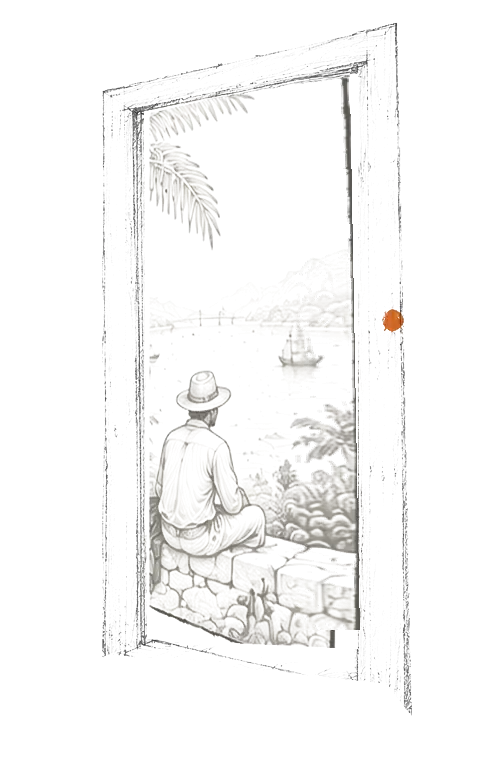
Far from his country, the poet addresses the homeland, so small, stretched across an isthmus between two seas, whose music resounds in him like the sea in a shell. He admits he might never have known how much he loved it without being far away, and says what it is to him: memories, the rustling palm, the old paths of childhood.
Timeline
- 1809–1903Before the RepublicVíctor de la Guardia, Amelia Denis de Icaza. Writing a Colombian province.
- 1918–1937ModernismoRicardo Miró, Gaspar Octavio Hernández, María Olimpia de Obaldía.
- 1929–1947SinánOnda, then Plenilunio: Panamanian narrative joins the avant-garde.
- 1941–1953The Canal Zone novelBeleño, Jurado, Mario Augusto Rodríguez. The canal and its men.
- 1960–1979ContemporariesTristán Solarte, Gloria Guardia, Chang Marín. Poetry holds the country together.
Reading keys
- The Spanish usage of two surnames applies, and one classifies by the father's name.
- The English and French names of the West Indians who came to build the canal, Beleño, Duncan, Prescott, signal an Afro-Antillean community distinct from the Spanish-speaking Afro-colonials.
- Chinese names, present since the building of the railway, and Guna, Emberá and Ngäbe names complete the picture.
- The Guna are matrilineal and matrilocal: the husband settles with his wife's family, and the house belongs to the women.
- The Canal Zone, the segregation that reigned there and the riots of 1964 are the country's memorial base.
- The American invasion of 1989 and the number of its civilian victims remain contested.
- The distinction between Spanish-speaking Afro-colonials and English-speaking Afro-Antilleans is a social hierarchy rarely named.
- Guna ritual knowledge is framed by their authorities, and certain texts cannot be published without the authorisation of the general congress.
- Catholicism is in the majority, with a West Indian Protestantism implanted on the coast and an evangelical advance.
- The Guna have a religion of their own, with Baba and Nana, a sung corpus transmitted by specialists, and puberty rites that last several days.
- La Tulivieja, a woman with a face riddled with holes who looks for the child she drowned, is the best-known figure of the popular stock.
- The Congo, an Afro-colonial tradition of Portobelo, mixes dance, coded language and the memory of marronage, and its Black Christ draws a mass pilgrimage.
- The wake and the nine days of prayers organise the mourning, with a commemoration at the end of a year.
- Black is worn in mourning.
- The pilgrimage to the Black Christ of Portobelo, on 21 October, gathers tens of thousands of people dressed in purple.
- The Guna mola, a cloth sewn in superimposed layers by the women, encodes patterns and a history, and its purchase by tourism has modified its production.
- The Bab Igala, the sung corpus of the Guna, is the major ritual stock, and access to it is controlled by the Guna authorities themselves.
- The narratives collected in 1938 by a Swedish ethnographer with a named Guna collaborator, Rubén Pérez Kantule, constitute a rare case of a credited indigenous co-author.
- The collection of tales and beliefs published in 1953 is the Hispanic documented corpus of reference.
- La Tulivieja and the figures of the isthmus are a bestiary shared with Costa Rica and Nicaragua.
- Panama is not only a canal: the country has had a literature since the beginning of the nineteenth century and a history of passage much older.
- The Canal Zone was not a military base but a civil territory under foreign sovereignty, with its towns and its schools.
- The Guna are matrilineal and have a territorial autonomy recognised since 1938, with their own institutions.
- Molas are not a decorative craft but garments whose patterns carry meanings, today partly erased by the market.
Tales and mythologies 1
- NarrativeAn Historical and Ethnological Survey of the Cuna IndiansErland Nordenskiöld and Rubén Pérez Kantule · 1938The knowledge of a people of the isthmus, written down by one of its own and arranged by Swedish ethnographers.Literature
Available in English 1
The books from this country that can be read in English, in the original or in translation.
- PoetryMy CountryPatriaRicardo Miró · 1909A poet posted abroad who discovers, through distance, what his young country means to him.Literature
A selection to begin with 10 / 24
- PoetryOndaRogelio Sinán · 1929not translated into EnglishA Panamanian student in Rome, steeped in the avant-gardes, who writes in free verse for a country that has remained modernist.Literature
- PoetryCumbiaDemetrio Korsi · 1935not translated into EnglishThe popular festival of the isthmus, its drums and its frictions with the American neighbour, in the language of the street.Literature
- NovelLa india dormidaJulio B. Sosa · 1936not translated into EnglishIndigenous resistance to the Spanish conquest, and a love story that neither side accepts.Literature
- PoetryPoemas de ausenciaRicardo J. Bermúdez · 1937not translated into EnglishThe first book of a twenty-three-year-old student, who will become an architect and build part of the capital.Literature
- NovelSan CristóbalRamón H. Jurado · 1944not translated into EnglishA ruined sugar mill, and the memory of the cane cutters who toiled there under unjust masters.Literature
- Short storiesLuna en VeraguasMario Augusto Rodríguez · 1948not translated into EnglishThe second collection by a schoolteacher from Veraguas turned journalist, between village festivals, love affairs and grudges.Literature
- Short storiesShumio-Ara: cuentos de Bocas del ToroJosé María Sánchez Borbón · 1948not translated into EnglishThe jungle, the rivers and the banana plantations of the Caribbean archipelago where the author was born.Literature
- NovelLuna verdeJoaquín Beleño · 1951not translated into EnglishThe American enclave on the isthmus during the war, seen through a young Panamanian worker who learns humiliation there.Literature
- NovelEl secreto de AntaturaLuisita Aguilera Patiño · 1953not translated into EnglishThe pre-Hispanic world told to young readers by a philologist of folklore.Literature
- NovelEl ahogadoTristán Solarte · 1957not translated into EnglishA Caribbean island of the isthmus where a boy's death awakens beliefs as much as suspicions.Literature