Paraguay
- works
- 22
- 15 books · 7 films
- period covered
- 1905–1998
- language of writing
- Spanish
Paraguay is the only country in America where an indigenous language is spoken by the majority of the population, including by those with no Indian ancestry. Guaraní has been co-official since 1992, it is heard in the street, on the radio, at the market and in the Assembly, and a large part of Paraguayans speak it better than Spanish. The constant mixing of the two is called jopara, and there is no shame in using it. Nowhere else on the continent has the language of the defeated become that of everybody, the winners included.
Read moreShow less
That singularity comes from a particular history. The Jesuits organised in the seventeenth century reductions where people wrote, printed and performed in Guaraní, with a printing press built on the spot. Then the country isolated itself under a fifty-year dictatorship that closed the borders. Then it lost the War of the Triple Alliance, from 1864 to 1870, which killed a considerable part of its population and almost all its adult men. A nation rebuilt by women, in an Indian language, and which has never quite stopped counting its dead.
Written literature came late and concentrated on power. Augusto Roa Bastos published in 1974 a novel constructed like a file, in which the nineteenth-century dictator dictates, crosses out and contradicts himself, and in which Spanish is shot through with Guaraní. The book was written in exile, and its author, stripped of his nationality, recovered it only in 1989. Gabriel Casaccia had opened the way in 1952 with a ferocious portrait of a provincial village. Cinema is almost non-existent: a few films of the nineteen fifties and sixties shot by Argentine crews, then in 1969 a day in a country town filmed by a collective of young Paraguayan filmmakers.
What awaits the reader is a Spanish inhabited by another language and an obsession with personal power. The novel that opens this page lets us hear Doctor Francia dictating circulars, notes and memories to his secretary, and many have read in it a veiled attack on Stroessner.
A way to begin
I the Supreme
Augusto Roa Bastos · 1974
Paraguay's first dictator caught in the trap of his own dictation: counted among the hundred best Spanish-language novels of the century.
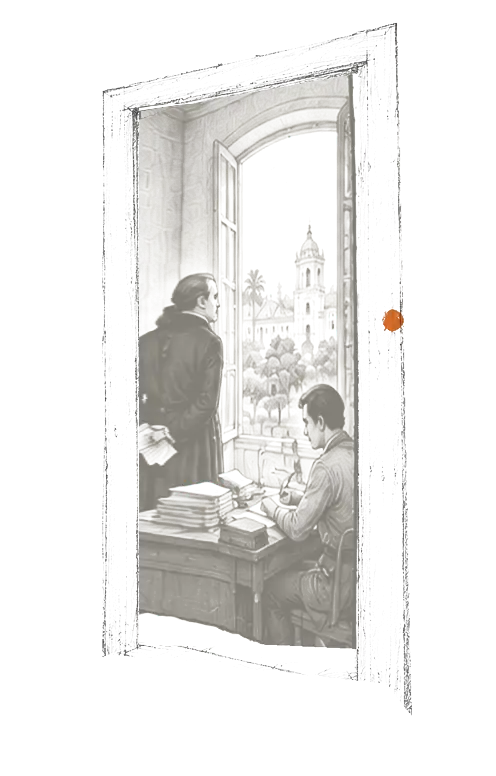
Asunción, 1840. Dr Francia, the Supreme, who has ruled Paraguay for a quarter of a century, learns that a lampoon nailed to the cathedral door imitates his decrees. He charges his secretary with tracing the handwriting in the archives, and dictates circulars, notes and memories to him. His words contradict and correct themselves, a compiler's notes comment on them, and the text itself comes apart in places.
Timeline
- 1900–1930ModernismoFaríña Núñez, Ortiz Guerrero, Molinas Rolón. Guarani enters the verse.
- 1948–1955The 1940s generationElvio Romero, Campos Cervera, Casaccia. Nearly all write in exile.
- 1937–1965A rare cinemaBauer, Catrani, Saguier. A handful of films in half a century.
- 1974I, the SupremeRoa Bastos writes from exile the great dictator novel.
- 1978–1998Under and after StroessnerRodríguez-Alcalá, Rivarola Matto, and a cinema starting up again.
Reading keys
- The Spanish usage of two surnames applies, and one classifies by the father's name.
- Family names are Hispanic, sometimes German or Italian, but the place names and the everyday vocabulary are Guaraní.
- Guaraní kinship terms are used in Spanish, and relatives are designated by words that distinguish the paternal from the maternal side.
- The extended family and godparenthood organise solidarities, and compadrazgo is very active politically.
- The War of the Triple Alliance, from 1864 to 1870, is the founding trauma, and the figure of Marshal López is venerated by one part of the country and detested by another.
- Stroessner's dictatorship, from 1954 to 1989, the longest on the continent, and the archives of terror found in 1992 are raw subjects.
- The condition of the indigenous peoples of the west, who speak languages other than Guaraní, is little approached.
- Guaraní is spoken but still little written, and its literary use is a decision.
- Catholicism is very much in the majority, with an intense Marian cult around the Virgin of Caacupé and a mass pilgrimage in December.
- The Guaraní stock survives in the narratives, with Ñanderuvusu the creator, the earth supported by pillars and the expectation of the destruction of the world.
- The quest for the Land Without Evil, a religious migration of the Guaraní towards a place where one does not die, has been documented since the sixteenth century and produced real displacements.
- The Pombero, a nocturnal spirit who whistles and takes children, and the Jasy Jatere are living figures that are named with caution.
- The wake and the nine days of prayers organise the mourning, with a commemoration at the end of a year.
- Mate and tereré, a cold shared infusion, structure sociability and the conversation scenes.
- The pilgrimage to Caacupé, on 8 December, gathers hundreds of thousands of walkers.
- Ñandutí lace, woven like a spider's web, and ao poí are objects of gift and identity markers.
- The legends of the creation and the destruction of the world collected in 1914 among the Apapocúva-Guaraní are the founding cosmogonic corpus.
- The Ayvu Rapyta, sacred Mbyá chants entrusted to an ethnographer in 1959, is the canonical version of that tradition.
- The Pombero, the Jasy Jatere and the Kurupi form the nocturnal bestiary that every Paraguayan knows.
- The memory of the war of 1870 and the figure of the residentas, the women who followed the army, are a common reference.
- Guaraní is not a residual language spoken by an indigenous minority: it is the everyday language of the majority of Paraguayans.
- Jopara is neither a creole nor a degradation: it is an avowed mixture that everybody practises.
- The Jesuit reductions were not ordinary missions: books were printed there in Guaraní on presses built on the spot.
- The war of 1870 destroyed the country more deeply than any other war on the continent, and its literature has never come out of it.
Tales and mythologies 1
- PoetryAyvu RapytaAnonymous · 1959not translated into EnglishThe sacred chants of the Mbyá-Guaraní, in which the word precedes the creation of the world.Literature
Available in English 2
The books from this country that can be read in English, in the original or in translation.
- NovelI the SupremeYo el SupremoAugusto Roa Bastos · 1974The country's first dictator, trapped by his own dictation, in a fragmented form that questions the writing of power.Literature
- NovelThe Knots of SilenceLos nudos del silencioRenée Ferrer · 1988The first novel of a writer from Asunción, in which a couple travelling in Paris reveal the Paraguayan dictatorship.Literature
A selection to begin with 10 / 22
- PoetrySurgenteManuel Ortiz Guerrero · 1922not translated into EnglishThe first book, in Spanish, by the poet whose verses the whole country sings.Literature
- DocumentaryIn the Hell of ChacoEn el infierno del ChacoRoque Funes · 1932A South American war filmed while it was being fought, by a cameraman who came without having been sent.Cinema
- NovelLa babosaGabriel Casaccia · 1952not translated into EnglishA lakeside town near Asunción, painted without indulgence from exile.Literature
- CinemaCodiciaCatrano Catrani · 1955A drama of the subtropical forest, in which gold found on a dead man stirs up greed.Cinema
- CinemaThunder Among the LeavesEl trueno entre las hojasArmando Bó · 1958A labour dispute at a logging operation, filmed in Paraguay from a screenplay by the future author of I the Supreme.Cinema
- CinemaLa sangre y la semillaAlberto Du Bois · 1959The war seen not through the battles but through those who survive on the margins, a woman about to give birth and a wounded soldier.Cinema
- CinemaEl puebloCarlos Saguier and Jesús Ruiz Nestosa · 1969The ordinary life of a Paraguayan town under the dictatorship, filmed by a collective of young filmmakers.Cinema
- CinemaCerro CoraCerro CoráGuillermo Vera · 1978The great conflict of 1864-1870 brought to the screen under the Stroessner dictatorship, which financed the film and made it a tribute to Marshal López.Cinema
- NovelThe Knots of SilenceLos nudos del silencioRenée Ferrer · 1988The first novel of a writer from Asunción, in which a couple travelling in Paris reveal the Paraguayan dictatorship.Literature
- CinemaThe Call of the OboeO toque do oboéClaudio MacDowell · 1998A sleepy small town awakened by the music of a stranger and by old silent films, in a Brazilian-Paraguayan film.Cinema