Netherlands
- works
- 50
- 31 books · 19 films
- period covered
- 1260–1993
- language of writing
- Dutch
Galileo's last book, banned in Rome, came off the presses of Leiden in 1638. Descartes published in the Netherlands, Spinoza was printed there after his death and without an author's name, and Rousseau's political treatise, condemned in Geneva and in Paris in 1762, had been manufactured in Amsterdam by a Genevan printer settled there. For two centuries, the Dutch Republic was the workshop of the books that the rest of Europe was burning.
Read moreShow less
That tolerance was first of all commercial. The same city that printed Spinoza had had him excluded from its community in 1656, and the Reformed Church regularly obtained bans that the booksellers circumvented: one published what one did not preach. The country grew rich through distant trade and a company that governed an archipelago, and literature long held that subject at a distance. Society itself was organised in separate pillars, Protestant, Catholic, socialist, each with its schools and its newspapers, until the nineteen sixties.
The Dutch form is the examination of conscience, dry and without indulgence: Marcellus Emants has a mediocre murderer confess in 1894, Willem Frederik Hermans constructs in 1951 a novel in which the narrator is always right and wrong about everything, then in 1958 that of a man who obeys a double of whom no one can say whether he exists. The price is that of the unsaid. Multatuli had to write in 1860 a novel of indictment for the country to look at what its administration was doing to Java. Hella Haasse returns to the colonial childhood in 1948, the year of the Indonesian war. Anne Frank's diary appeared in 1947 in a version cut by her father, and Etty Hillesum's notebooks waited until 1981.
What awaits the reader is a clear, ironic prose that grants nobody extenuating circumstances, and a relation to the colony that works through the whole twentieth century. The novel that opens this page was written in Brussels in less than a month, in 1859, by a former official of the Dutch East Indies, under a Latin pseudonym meaning "I have borne much".
A way to begin
Max Havelaar
Multatuli (Eduard Douwes Dekker) · 1860
Named in 2002 the most important work in the Dutch language, free of rights: a nested novel against the colonial system.
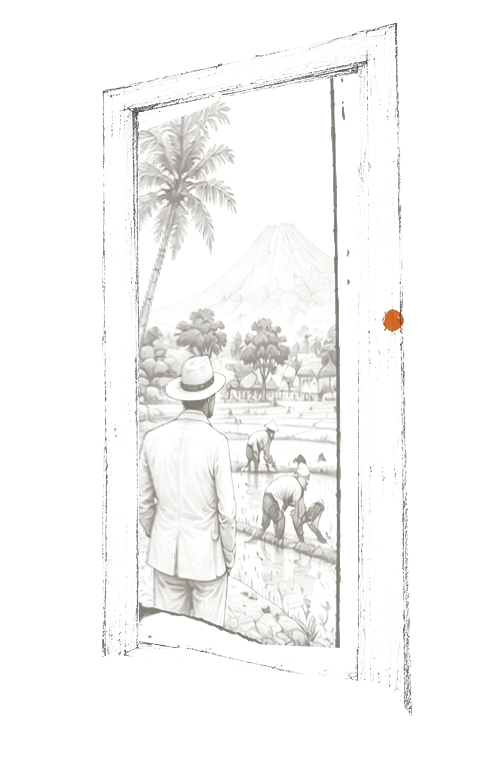
Batavus Droogstoppel, a coffee broker in Amsterdam, pious and miserly, receives a bundle of manuscripts from a former schoolfellow fallen into poverty. Thinking he will find something useful for the coffee trade, he entrusts their editing to a young German apprentice. The story follows Max Havelaar, new assistant resident in western Java, who discovers how the native chiefs strip the peasants bare under the eyes of the colonial administration, and decides to act.
Timeline
- 1600–1670Golden AgeVondel in the theatre, Spinoza in philosophy, and a painting that dominates Europe.
- 1860Max HavelaarOne book forces the Netherlands to look at what it is doing in Java.
- 1942–1944The diary of Anne FrankWritten in an Amsterdam annexe, now one of the most read books in the world.
Reading keys
- The particles van, de, van der are not noble and are classified under the initial of the name that follows, which is disconcerting in French indexes.
- Official first names are often the names of grandparents, and everyday usage employs an entirely different abbreviated form.
- The familiar form of address is general and hierarchy is expressed by other means, which makes relations of power less legible in dialogues.
- Direct frankness is a norm of politeness and not an aggression, and a character who softens his words passes for a hypocrite.
- The colonial past, in Indonesia above all, the war of 1945 to 1949 and the vocabulary used to name it are a debate reopened over the past twenty years by official inquiries.
- The deportation of the Jews of the Netherlands, proportionally one of the deadliest in Western Europe, calls into question the efficiency of the local administration.
- The Atlantic slave trade and slavery in Suriname and the Antilles were the object of state apologies in 2022, after a long absence from the curricula.
- Tolerance is a national narrative of which contemporary authors regularly make the critique.
- Calvinism formed the moral language of the country, with its guilt, its sobriety and its self-examination, including in atheist authors.
- The south is Catholic and the north Protestant, an old separation that explains two distinct literary temperaments.
- The orthodox Reformed Churches of the bible belt keep strict rules and provide the material of many novels of rupture.
- The country is today among the most secularised in the world, and the surviving rites are all the more visible there.
- Orange is the colour of the reigning house and not of the flag, and its collective use obeys precise occasions.
- Saint Nicholas on 5 December, with its mocking poems read aloud, is the major family festival, and the figure of his black servant has been the object of public conflict for fifteen years.
- The meal is frugal and the invitation to coffee is measured, one biscuit per person, a detail that authors exploit for social comedy.
- Funerals are sober, cremation common, and the speeches are delivered by relatives.
- The 1860 novel about the Indies is the country's civic reference, quoted in political debates as an argument.
- Erasmus's Praise of Folly, in 1511, written in Latin by a man of Rotterdam, founds a tradition of learned irony.
- Anne Frank's diary is read by all and is the object of constant discussion about the versions and the cuts.
- The golden age, the dyke, the polder and consultation are the images that every text assumes are legible.
- Holland designates two provinces, not the country: the French usage is a metonymy that the Dutch correct.
- Dutch is also the language of Flanders: literature in the Dutch language extends beyond the state, and the catalogue separates the two for convenience.
- Historical tolerance was a commercial policy and not a principle: the same society excluded Spinoza.
- The Netherlands was a major colonial power until 1949, which the image of a small peaceful country makes one forget.
- The catalogue stops at the beginning of the nineteen nineties, which reflects the state of French translations.
Tales and mythologies 1
- PoetryOf Reynaert the FoxVan den vos ReynaerdeAnonymous · 1260An animal satire of the thirteenth century, in which cunning triumphs without moral correction and in which no one, from the king to the clergy, comes out of the portrait unscathed.Literature
A selection to begin with 10 / 50
- EssayThe Praise of FollyMoriae EncomiumErasmus · 1511A paradoxical speech composed in jest for an English friend: the goddess Folly mocks the scholars, monks and princes of Christian Europe on the eve of the Reformation.Literature
- NovelA Posthumous ConfessionEen nagelaten bekentenisMarcellus Emants · 1894The Dutch bourgeoisie of the late nineteenth century, seen by a murderer who believes himself governed by his heredity and his milieu.LiteraturePublic domain
- DiaryThe Diary of a Young GirlHet AchterhuisAnne Frank · 1947Amsterdam under the occupation, seen from a hiding place by a Jewish teenage girl.Literature
- NovelThe Black LakeOeroegHella S. Haasse · 1948Java in the last decades of the Dutch colony, where a childhood friendship runs up against the boundary between colonisers and colonised.Literature
- NovelThe Darkroom of DamoclesDe donkere kamer van DamoklesWillem Frederik Hermans · 1958The occupied Netherlands, where a man obeys a double that only he can see and whose existence no one can vouch for.Literature
- Feature filmTurkish DelightTurks fruitPaul Verhoeven · 1973Amsterdam at the end of the sixties, where the passion of a sculptor and a young woman is lived without any restraint.Cinema
- DiaryAn Interrupted LifeHet verstoorde levenEtty Hillesum · 1981Amsterdam under the German occupation, seen by a young woman who chooses the inner life in the face of persecution.Literature
- Feature filmBrandende liefdeAte de Jong · 1983A love chronicle of a young painter and the married model who sits for him, in a bourgeois Amsterdam where everything plays out between a rented room and a staircase.Cinema
- Feature filmThe IllusionistDe IllusionistJos Stelling · 1983A silent tale in which a stage performer reenacts his childhood as a miller's son, and in which dream, memory and sleight of hand cease to be distinct.Cinema