Peru
- works
- 47
- 30 books · 17 films
- period covered
- 1608–1998
- language of writing
- Spanish
In 1615, an Andean nobleman completed a letter of one thousand one hundred and eighty-nine pages intended for the king of Spain. Felipe Guamán Poma de Ayala recounts in it the history of his people, denounces the abuses of the corregidors and the priests, proposes a reform of government, and illustrates it all with three hundred and ninety-eight drawings by his own hand, in which Spaniards are seen striking Indians and Incas measuring the sky. The manuscript never reached the king. It was found in 1908 in the Royal Library of Copenhagen, without anyone knowing how it had got there, and it is still there.
Read moreShow less
That document is today the richest source on the Andean world, and it poses the question that runs through all Peruvian literature: who speaks, and in what language. The country was the seat of an empire administered without alphabetic writing, by means of knotted cords, the quipus, of which we can read only the numbers. It counts today Quechua and Aymara among its official languages, and one of the rare theatre texts in Quechua, performed in the eighteenth century, stages a general in love with a daughter of the king.
The most original form was born of that fracture. José María Arguedas, raised by Quechua servants and who spoke that language before Spanish, wrote from 1935 a Spanish prose whose syntax and images come from Quechua, in order to render a world that Spanish does not know how to say. He took his own life in 1969. César Vallejo had already, in 1922, disarticulated the language to the point of inventing words. Andean cinema followed, with in 1961 a film shot entirely in Quechua.
What awaits the reader is a Spanish language worked from within by another, and a literature that has never stopped translating. The novel that opens this page is a comedy about a mad serial writer, and its author won the Nobel.
A way to begin
Aunt Julia and the Scriptwriter
Mario Vargas Llosa · 1977
A youthful love hidden from the whole family and the wild serials of a radio drudge: a novel by Mario Vargas Llosa, Nobel laureate.
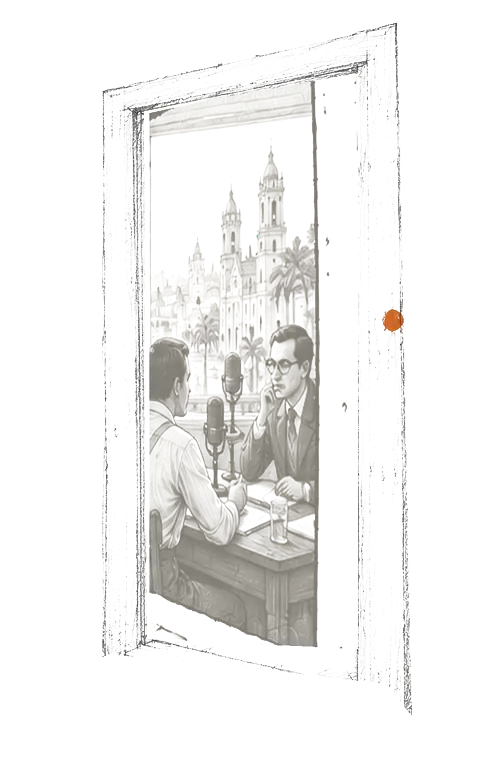
In 1950s Lima, Varguitas, eighteen, a law student who dreams of writing, writes the news bulletins for a radio station. He falls for Julia, a relative by marriage, a divorcee of thirty-two, and their love must be hidden from the whole family. To the same station comes, from Bolivia, Pedro Camacho, a galley slave of the serial, whose episodes, given in alternate chapters, grow ever more extravagant.
Timeline
- 1615An Indian chronicleGuaman Poma writes to the king of Spain to describe what is done to the Indians. His letter runs to a thousand pages.
- 1930–1970IndigenismArguedas, raised among Quechuas, writes between two languages and two worlds.
- 1960–1970The BoomVargas Llosa takes part in the explosion of the Latin American novel.
Reading keys
- The Spanish usage of two surnames applies, and one classifies by the father's name.
- Quechua and Aymara names, Guamán, Condori, Mamani, Quispe, signal an Andean origin and were long a motive for discrimination.
- The ayllu, a group of kinship and collective work, organises the Andean communities, with obligations of reciprocity, ayni, that are not refused.
- Compadrazgo binds families beyond blood and provides the device of many narratives.
- The armed conflict from 1980 to 2000, with its seventy thousand dead, three quarters of them Quechua speakers, is a subject on which every account is situated.
- Racism towards Andean and Amazonian populations is structural and rarely named head-on by the literature of Lima.
- The forced sterilisations of the nineteen nineties are a documented subject now before the courts.
- The hierarchy between the coast, the sierra and the forest organises society, and the word serrano is used as an insult.
- Catholicism is in the majority and was superimposed on the Andean cults without erasing them: the churches are built on the temples and the saints have taken the place of the huacas.
- The Pachamama, the earth, receives offerings before any undertaking, and a few drops are poured on the ground before drinking.
- The apus, spirits of the mountains, are persons with whom one negotiates, and landscapes are never neutral.
- The Lord of Miracles, an image painted by an Angolan slave in the seventeenth century, gives rise in October to the largest procession in America.
- The wake and the commemoration on the eighth day and on the first anniversary organise the mourning, with a meal shared with the dead person.
- The purple of the Lord of Miracles is worn throughout the month of October in Lima.
- The payment to the earth, in August, consists in burying offerings before the sowing, and its omission has consequences in the narratives.
- Inti Raymi, the festival of the sun reconstituted at Cuzco since 1944, is a neo-Inca rite and not a direct survival.
- The rites and traditions of Huarochirí, the only Andean mythological corpus preserved in Quechua, with Cuniraya Viracocha and Pariacaca, are the principal source.
- The Royal Commentaries of the Inca Garcilaso, published in 1609, recount Manco Cápac and Mama Ocllo emerging from Lake Titicaca.
- Inkarrí, the beheaded Inca king whose head is growing a body back under the earth and who will return, is a living and political narrative.
- The traditions of Ricardo Palma, published from 1872, fixed the colonial anecdotal stock that every Peruvian knows.
- Quechua is not a dead language: it is spoken by several million people and it is official.
- The quipu is not a simple abacus: it is a system of recording of which we decipher only the numerical part.
- Peru cannot be summed up by the Incas, whose empire lasted a century out of three thousand years of Andean civilisations.
- Magic realism is not the key to the Peruvian novel: Arguedas proceeds by linguistic transposition and Vargas Llosa by construction.
Tales and mythologies 1
- ChronicleThe Huarochirí ManuscriptRuna ynº niscap MachoncunaAnonymous · 1608The myths of the Andean communities of Huarochirí, set down in Quechua at the very time when the Church was working to make them disappear.Literature
A selection to begin with 10 / 47
- TheatreApu OllantayOllantayAntonio Valdés · 1770A drama in Quechua verse known from eighteenth-century copies, whose origin, an Inca legend brought to the stage or a play written in colonial Peru, remains disputed.Literature
- PoetryTrilceCésar Vallejo · 1922Peru in the early twenties: an Andean poet, marked by grief and confinement, breaks the Spanish language to speak of love, death and family.Literature
- Poetry5 Meters of Poems5 metros de poemasCarlos Oquendo de Amat · 1927A five-metre accordion book, the only one by an Andean poet who died at thirty.Literature
- NovelThe Cardboard HouseLa casa de cartónMartín Adán · 1928An adolescence in Barranco, in fragments of poetic prose written by a sixteen-year-old boy.Literature
- NovelDeep RiversLos ríos profundosJosé María Arguedas · 1958The adolescence of a boy torn between the Indian world and the criollo world, told from the inside in a language shot through with Quechua.Literature
- CinemaKukuliEulogio Nishiyama · 1961A pastoral myth of the Andes, that of the abducting bear, mingled with the festivities in honour of the Virgin of Carmen of Paucartambo, filmed by people from Cuzco in the language of the shepherds.Cinema
- CinemaCuentos inmoralesJosé Carlos Huayhuaca · 1978Four directors, four states of Lima society at the end of the military government, from the bourgeois drawing room to the poor neighbourhood.Cinema
- CinemaLa familia OrozcoJorge Reyes · 1983Seventy years of the country's social history through a family of peasants turned workers, up to the great workers' strikes of Lima.Cinema
- CinemaTúpac AmaruFederico García Hurtado · 1984The great indigenous rebellion of 1780 against colonial power, reconstructed with the communities of the lands where it broke out.Cinema
- CinemaGregorioFernando Espinoza · 1985The Andean migration to the capital in the early eighties, seen from a child's height, between fiction and documentary.Cinema