Philippines
- works
- 26
- 10 books · 16 films
- period covered
- 1838–1993
- language of writing
- Tagalog and English
José Rizal was shot for two novels. A doctor, an ophthalmologist, a polyglot, he published in 1887 and then in 1891 two books in which Spanish priests abuse their power over Filipino villagers, and he wrote them in Spanish, in order to be read in Madrid. The books were banned, circulated clandestinely, were read aloud in the villages, and their author was executed on 30 December 1896 at the age of thirty-five. The revolution broke out. He is today the national hero of a country in which almost no inhabitant can read his novels in their original language.
Read moreShow less
For the Philippines changed colonial language. Three centuries of Spain, fifty years of the United States, and Spanish disappeared from use in two generations, replaced by English and by Tagalog become Filipino. The country has more than one hundred and eighty languages, it is the only one in South-East Asia with a Catholic majority, with a Muslim south predating the arrival of the Spaniards, and its literature is written in at least three languages that do not read one another.
Hence the place taken by cinema, which speaks to everyone. The Philippine industry produced hundreds of films a year, melodramas, action films, comedies, and from that mass production there emerged in the nineteen seventies a generation that filmed the slums of Manila with an unprecedented brutality. Lino Brocka shot in 1976 the story of a young girl raped by her mother's lover, and the film was seen everywhere. Kidlat Tahimik made in 1977 a feature film almost single-handed, on salvaged stock, in which he plays a jeepney driver fascinated by America who ends by detaching himself from it.
What awaits the viewer is a mixture of avowed melodrama and social rage, with not the slightest concern for good taste or measure. The novel that opens this page put the Spanish friars on trial, was banned at once in the archipelago, and is now required reading in every Philippine secondary school.
A way to begin
Noli Me Tangere
José Rizal · 1887
The novel that put the Spanish friars in the Philippines on trial, written in Spanish, free of rights: required reading in every Philippine secondary school.
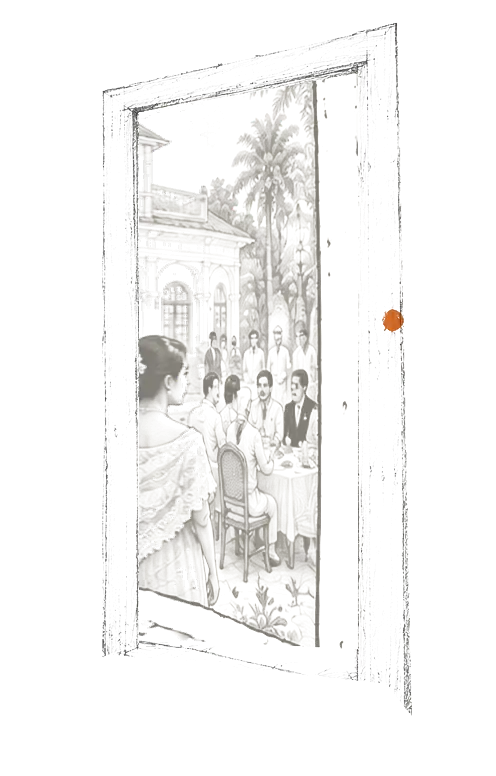
The novel opens with a dinner at the house of the rich Capitán Tiago, where Crisóstomo Ibarra, back from Europe, confronts the arrogance of the Franciscan Dámaso. Around his fiancée María Clara and the town of San Diego cross paths Sisa, a mother driven mad by the disappearance of her two sons, the old philosopher Tasio, the boatman Elías, the officer of the Civil Guard and his wife, and Father Salví, who has his eye on María Clara.
Timeline
- 1887Noli me tángereRizal writes in Spanish the novel that awakens the nation. He will be shot.
- 1944–1965Manila studiosGerardo de Leon, Manuel Silos, Avellana. The golden age of a popular cinema.
- 1961Nick JoaquinThe Woman Who Had Two Navels: Filipino prose in English.
- 1976–1984A second golden ageBrocka, Mike de Leon, Bernal, Diaz-Abaya, Kidlat Tahimik.
- 1984–1993After MarcosSionil José publishes Po-on; Raymond Red opens up independent cinema.
Reading keys
- Family names are Spanish, assigned by decree in 1849 from a catalogue distributed province by province, which explains why whole villages share names beginning with the same letter.
- First names are Spanish, English or compound, and doubled nicknames, Jun-Jun, Ling-Ling, are in constant use including among adults.
- Compadrazgo, godparenthood, creates a network of reciprocal obligations that structures politics and business.
- Respect for elders imposes verbal marks, including the addition of po to every sentence, and the gesture of taking an elder's hand to one's forehead.
- The Marcos dictatorship, from 1972 to 1986, and martial law produced a censorship that cinema circumvented through melodrama.
- The conflict in the Muslim south and the massacres of the recent period are dangerous subjects.
- The extrajudicial killings of the anti-drug campaign of the twenty-tens are a subject treated by independent cinema.
- Shame, hiya, and the debt of gratitude, utang na loob, are operative categories that explain behaviour a foreign reader judges irrational.
- Catholicism is very much in the majority, with spectacular forms: processions of the Black Nazarene, voluntary flagellations and crucifixions on Good Friday.
- The south of the archipelago has been Muslim since the fourteenth century, before the arrival of the Spaniards, which reverses the chronology one supposes.
- The spirits, including the tikbalang and the aswang, a creature that splits in two at night, belong to a living bestiary that cinema exploits.
- The babaylan, a priestess and healer from before colonisation, has become a reference for local feminist thought.
- Mourning includes a wake of several days at home, with cards, food and a collection for the costs, then a mass on the ninth day and on the fortieth.
- White and black are worn in mourning, and mourning is often kept for a year.
- Holy Week brings the country to a halt, and Christmas begins in September: the festive season is the longest in the world.
- The fiesta of each town's patron saint is the social event of the year and serves as a narrative hinge.
- Rizal's two novels are on the compulsory syllabus by a law of 1956, and their characters are types that everyday language summons.
- The Biag ni Lam-ang, an Ilocano epic transcribed in the Spanish period, is the great preserved pre-Hispanic narrative.
- The pasyon, a sung narrative of the Passion of Christ, is chanted during Holy Week and served as a matrix for revolutionary discourse.
- The narratives collected in 1921, more than two hundred tales classified with a comparative apparatus, form the documented corpus.
- The Philippines is not a Spanish-speaking country: Spanish has disappeared from everyday use, and Rizal's novels are read in translation.
- The Islam of the south predates Spanish colonisation, and Christianity is the recent import.
- Melodrama is not a minor genre here: it is the dominant popular form, including among the most political authors.
- Filipino Catholicism has forms that Europe does not recognise, including voluntary crucifixions, and it is no less sincere for that.
Tales and mythologies 1
- TaleFilipino Popular TalesDean Fansler · 1921The tales of the Philippine provinces, recorded within their families by the students of an American professor at the beginning of the twentieth century.Literature
Available in English 9
The books from this country that can be read in English, in the original or in translation.
- PoetryFlorante at LauraFrancisco Balagtas · 1838The great Tagalog poem of the nineteenth century, a story of love and betrayal in an imaginary Albania.Literature
- NovelNoli Me TangereNoli me tángereJosé Rizal · 1887The novel that put the Spanish friars in the Philippines on trial, written in Spanish by a twenty-six-year-old doctor.Literature
- NovelRadiance and SunriseBanaag at SikatLope K. Santos · 1906The first great Tagalog social novel, in which two friends, a socialist and an anarchist, debate Philippine society.Literature
- NovelAmerica Is in the HeartCarlos Bulosan · 1946The great account of Filipino emigration to the United States in the thirties, between autobiography and novel.Literature
- NovelThe Woman Who Had Two NavelsNick Joaquin · 1961A woman who believes she has two navels, and the Filipinos exiled in Hong Kong, between Spain and America.Literature
- NovelThe Preying BirdsMga Ibong MandaragitAmado V. Hernandez · 1969The novel of the agrarian question in the post-war Philippines, which extends Rizal's two great novels.Literature
- NovelDekada '70Lualhati Bautista · 1983A mother of five sons facing the dictatorship: the great Tagalog novel of the seventies.Literature
- NovelDuskPo-onF. Sionil José · 1984The exodus of an Ilocano family to land to be cleared, as the Philippine revolution is born.Literature
- NovelState of WarNinotchka Rosca · 1988A festival, an attack and centuries of colonisation: a great Philippine novel about the Marcos years.Literature
A selection to begin with 10 / 26
- NovelAmerica Is in the HeartCarlos Bulosan · 1946The great account of Filipino emigration to the United States in the thirties, between autobiography and novel.Literature
- CinemaNoli Me TangereNoli me tángereGerardo de Leon · 1961José Rizal's foundational novel brought to the screen for the centenary of its author's birth.Cinema
- NovelThe Woman Who Had Two NavelsNick Joaquin · 1961A woman who believes she has two navels, and the Filipinos exiled in Hong Kong, between Spain and America.Literature
- CinemaA Portrait of the Artist as FilipinoLamberto V. Avellana · 1965An adaptation of a play written in English, in which prewar Intramuros serves as the setting for the end of a Hispanic world that its last heirs refuse to leave.Cinema
- NovelThe Preying BirdsMga Ibong MandaragitAmado V. Hernandez · 1969The novel of the agrarian question in the post-war Philippines, which extends Rizal's two great novels.Literature
- CinemaInsiangLino Brocka · 1976A young girl from Tondo caught between a blinded mother and the man she has installed in her home.Cinema
- CinemaThe Rites of MayItimMike de Leon · 1976A gothic tale shot under martial law, in which the fervour of Lenten rites in a provincial town surrounds a disappearance that is never cleared up.Cinema
- CinemaPerfumed NightmareMababangong bangungotKidlat Tahimik · 1977A jeepney driver fascinated by the conquest of space, between his village and Paris.Cinema
- NovelDekada '70Lualhati Bautista · 1983A mother of five sons facing the dictatorship: the great Tagalog novel of the seventies.Literature
- NovelDuskPo-onF. Sionil José · 1984The exodus of an Ilocano family to land to be cleared, as the Philippine revolution is born.Literature