Portugal
- works
- 59
- 34 books · 25 films
- period covered
- 1517–1988
- language of writing
- Portuguese
When Fernando Pessoa died in Lisbon in 1935, he had published only one book of poems. In his home was found a trunk containing twenty-seven thousand five hundred and forty-three papers, written under dozens of different names, unfinished, taken up again, classified and then reclassified. The state bought the manuscripts in 1979 and 1982 had to be waited for before the fragments of a plotless journal attributed to an assistant bookkeeper were assembled, since become the most widely read Portuguese book in the world.
Read moreShow less
This country made a method of absence. It was the first European maritime empire and the last to give up its colonies, in 1975, after thirteen years of war in Angola, Mozambique and Guinea. Its national epic, published in 1572, recounts a voyage and ends on a warning. The king who disappeared in 1578 in a battle in Morocco has been awaited for four centuries. And two million Portuguese left to work elsewhere while the dictatorship lasted, from 1926 to 1974.
The form is the fragment, the doubling, the voice that declares itself unfit. The price was that of censorship and of war. Eça de Queiroz published in 1876 a novel about a young priest in love with his landlady's daughter and was attacked by the entire Catholic press. In 1972, three women authors published a book of letters on the condition of women: the work was seized, they were prosecuted, and the trial stopped with the Carnation Revolution. The colonial war produced two of the country's greatest books, that of Lobo Antunes in 1979 and that of Lídia Jorge in 1988, written by a military doctor and by an officer's wife.
What awaits the reader is a literature of active melancholy, ironic rather than plaintive, and a cinema that filmed the children of Porto as early as 1942. The novel that opens this page brings together a one-handed soldier, a woman who sees inside bodies and a priest who builds a flying machine beside the vast building site of the Mafra convent, and it was with this book that its author's style was recognised.
A way to begin
Baltasar and Blimunda
José Saramago · 1982
A one-handed soldier, a woman who sees inside bodies and a priest building a flying machine: the novel that made Saramago's name.
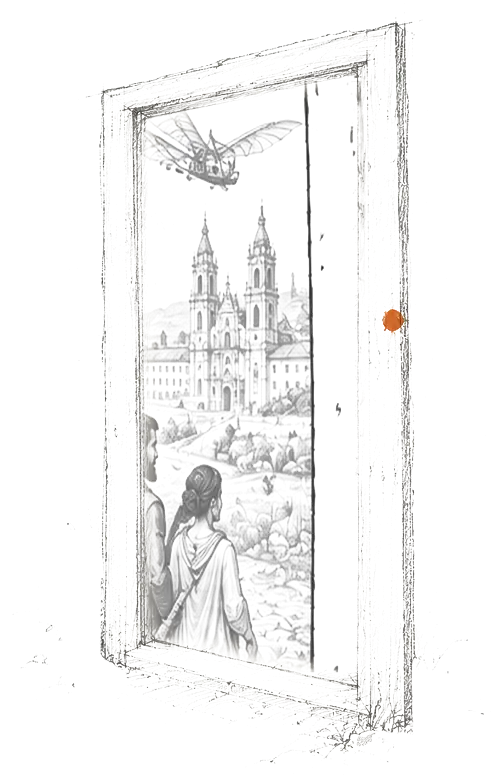
At the beginning of the eighteenth century, King John V, who has no heir, promises the Franciscans a convent if the queen gives him a child, and an immense building site opens at Mafra where the workers wear themselves out. Baltasar, a soldier back from the war with one hand missing, meets Blimunda, who can see inside bodies. Father Bartolomeu de Gusmão takes them in: he is building a machine that flies, and to make it rise he needs human wills that only Blimunda can gather.
Timeline
- 1572The LusiadsCamões sings the navigators and founds the Portuguese literary language.
- 1870–1900RealismEça de Queirós, the Portuguese Flaubert, dissects a society falling asleep.
- 1910–1935PessoaOne man alone, under several names, remakes the whole of modern poetry.
- 1933–1974SalazarForty years of censorship. Literature goes into exile or falls silent.
- 1974Carnation RevolutionFreedom returns. Saramago, long ignored, then writes his great books.
Reading keys
- Names are long, with several elements coming from the father and the mother, and everyday usage retains only one or two, often the last.
- The author's name is sometimes a fragment of the civil name, which multiplies the forms in catalogues.
- Pessoa's heteronyms are not pseudonyms but fictitious authors with their biography and their style, and a text may cite them as persons.
- The saint's name, godparenthood and belonging to a rural parish structure village narratives.
- The colonial war from 1961 to 1974, the return of five hundred thousand people from Africa and the fate of the soldiers are an open subject, central in literature since 1975.
- The Estado Novo, the political police and each person's degree of participation are not settled, and the vocabulary used situates a text.
- Atlantic slavery, of which Portugal was the first European organiser, has recently been approached in the terms of public memory.
- Mass emigration, the money sent home and the return to the village are a permanent social theme, treated without irony.
- Catholicism is in the majority and popular, with the apparitions of Fátima in 1917 as a national event and a mass pilgrimage.
- The Portuguese Inquisition, active until 1821, pursued converted Jews, and that memory surfaces in historical novels.
- Sebastianism, the expectation of the return of the king who disappeared in 1578, is a living political myth that literature summons in order to speak of the present.
- Practices of blessing, promises and wax votive offerings are common and appear in the narratives without explanation.
- The June festivals, grilled sardines and neighbourhood dances in Lisbon and Porto, are the great popular gathering.
- Fado is a codified genre, with its houses and its rules of silence, and not a tourist atmosphere.
- Mourning is worn in black and for a long time in the countryside, with anniversary masses and the upkeep of graves.
- 25 April, the day of the 1974 revolution, is a consensual civic date, celebrated with carnations.
- The maritime epic of 1572 is the founding text, with its giant of the cape of Storms, and its lines are learnt at school.
- Sebastianism and the battle of 1578 provide the political metaphor of waiting.
- The tale collections of Adolfo Coelho in 1879 and of Teófilo Braga in 1883 are the reference corpora, dictated for the most part by illiterate women.
- The Lisbon earthquake of 1755, which set the whole of Europe debating, is a common reference, including in the French tale that opens the page for France.
- Saudade is not a vague sadness but a technical term of this literature, with a history and competing definitions.
- The Portuguese of Portugal is not that of Brazil: pronunciation, syntax and spelling differ, and the 1990 orthographic agreement is contested.
- Portugal is not a province of Spain: independence dates from the twelfth century and mistrust of Madrid is a cultural fact.
- The empire is not a distant past: the colonial war ended in 1974 and a generation of writers fought it.
- The catalogue stops at the beginning of the nineteen nineties, which reflects the state of translations and not current production.
Tales and mythologies 2
- TaleContos Tradicionais do Povo PortuguêsTeófilo Braga · 1883not translated into EnglishTales from all over the country gathered by a scholar who wanted to read in them the soul of the nation.Literature
- TaleTales of Old LusitaniaContos populares portuguesesAdolfo Coelho · 1879Tales collected from storytellers by a philologist who considered this tradition almost erased in his country.Literature
A selection to begin with 10 / 59
- EpicThe LusiadsOs LusíadasLuís de Camões · 1572An epic in the classical manner for a real voyage: the discovery of the route to the Indies, under the eyes of rival gods.Literature
- NovelThe Crime of Father AmaroO Crime do Padre AmaroEça de Queiroz · 1876A newly arrived priest and the young woman at whose house he boards: the provincial town is already watching them.Literature
- CinemaAniki-BóbóManoel de Oliveira · 1942Two kids from Porto fight over the only girl in the gang, and one of them does wrong to give her a present.Cinema
- CinemaOs Verdes AnosPaulo Rocha · 1963Two young people from the provinces meet in a capital under construction, where the boy feels like a stranger.Cinema
- CinemaSunday AfternoonDomingo à TardeAntónio de Macedo · 1966A doctor who treated only the condemned sets his mind on saving one of them, the woman with whom he has just fallen in love.Cinema
- CinemaThe CircleO CercoAntónio da Cunha Telles · 1970A young woman leaves her husband to live differently, in a city that closes in on her from all sides.Cinema
- EssayNew Portuguese LettersNovas Cartas PortuguesasMaria Isabel Barreno, Maria Teresa Horta and Maria Velho da Costa · 1972Three women answer, across three centuries, a abandoned nun, and say everything that could not be said.Literature
- NovelThe Land at the End of the WorldOs Cus de JudasAntónio Lobo Antunes · 1979A man talks all night to a stranger in a bar, and tells of only one thing.Literature
- DiaryThe Book of DisquietLivro do DesassossegoFernando Pessoa · 1982An assistant bookkeeper in Lisbon keeps a diary in which nothing happens, and which he will never finish.Literature
- NovelThe Murmuring CoastA Costa dos MurmúriosLídia Jorge · 1988An officers' wedding in Africa, and a young bride for whom the official versions cease to be enough.Literature