Central African Republic
- works
- 4
- 4 books
- period covered
- 1972–1988
- language of writing
- French
On 4 December 1977, a man had himself crowned emperor. Bokassa sat on a throne in the shape of a gilded eagle, put on a velvet mantle with a train, wore a crown of diamonds and had carriages and horses brought from Europe, in a ceremony inspired by Napoleon's coronation. The expense swallowed a considerable part of the country's annual budget. No foreign head of state came to attend the coronation. The empire would last two years and the country still carries its image.
Read moreShow less
That episode fixed the country's image abroad and shut it in. The Central African Republic is a territory of forest and savanna with no access to the sea, long crossed by the slave caravans and then by the rubber concession companies, whose forced labour left whole regions emptied. The country has never had a port, a railway or an internal market, and its written production has borne the consequences: a few authors, published in Paris, often having left very young. Sango, a language born of trade on the Ubangi, became an official language there alongside French, which is rare in francophone Africa.
That rarity has produced a concentrated form: the short novel, almost a fable. Pierre Makombo Bamboté published in 1972 a novel about a small town where an administrator lays down the law. Étienne Goyémidé told in 1984 of a schools inspector who goes deep into the forest and lives among the Aka Pygmies, discovering that he is as much a foreigner among them as the settler was among his own people. Blaise N'Djehoya reversed the formula in 1988 by sending an African to explore Europe. The price is invisibility: these books exist, can be read in an evening, and almost nobody reads them.
What awaits the reader is a sober and brief prose, often carried by a narrator who learns as he walks. The novel that opens this page is called "The Silence of the Forest", and it sends a Europe-trained school inspector to live among the Pygmies, reversing the pattern of the exploration novel.
A way to begin
Le Silence de la forêt
Étienne Goyémidé · 1984
A Bangui school inspector leaves everything to live among the Pygmies of the forest: Étienne Goyémidé's first novel, brought to the screen.
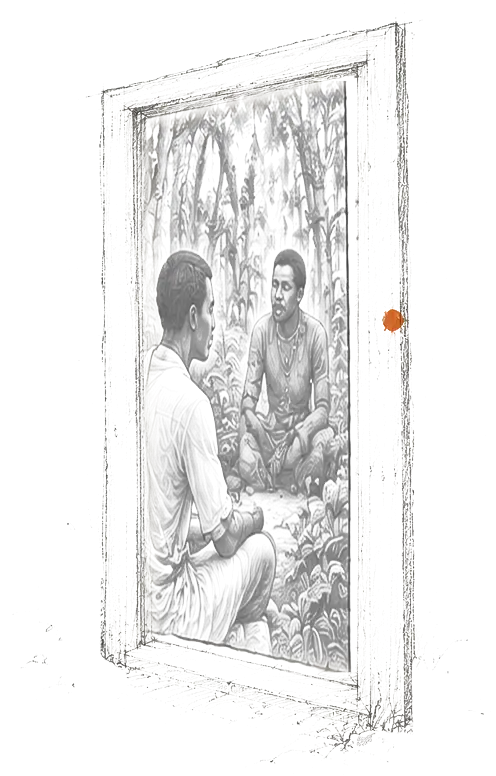
Gonaba, back from studies in France and appointed school inspector in Bangui, has a post, money and rank. Meeting Manga, a Pygmy, awakens his curiosity about the world of the Babinga, and he suddenly decides to abandon everything and live in the heart of the equatorial forest. There he faces the solitary march, hunger and fear, then learns the language of those who take him in and seeks his place among them.
Timeline
- 1962–1984First novelsMakombo Bamboté, then Goyémidé's The Silence of the Forest.
- 1988The Potemkin NegroBlaise N'Djehoya writes from Paris the gaze cast upon Africa.
Reading keys
- Names indicate the group: Banda and Gbaya in the centre and the west, Sango as the national lingua franca, Zande in the south-east, Fulani and Arabic in the north.
- Sango, created as a language of trade on the Ubangi, is today an official language alongside French. A dialogue in Sango indicates a national and not a local context.
- Classificatory kinship extends the terms brother and uncle, with the obligations that follow.
- Initiation, including the ganza among the Banda, marks entry into adulthood more than civil age does.
- Bokassa's reign, from 1966 to 1979, with its crimes, is told through satire or not at all.
- The civil wars since 2013 and the massacres between militias are too recent a subject for the literature of the catalogue.
- The condition of the Aka, called Pygmies, and their relation of dependence on the neighbouring villagers is a subject that Goyémidé addresses head-on, which is rare.
- The forced labour of rubber under the concession companies left a memory that is transmitted without being written.
- A Christian majority, Catholic and Protestant, with an Islam present in the north and along the trade routes.
- Ancestral cults and forest spirits survive beneath Christianity.
- Ngakola, a spirit associated with Banda initiation, occupies a central place in the rites of the centre of the country.
- Sorcery is a grave accusation, with real judicial consequences.
- Funerals include a wake and a deferred lifting of mourning, with expenditure that commits the extended family.
- White kaolin and scarifications mark initiation and contact with the ancestors.
- The collective net hunt of the Aka is a social rite as much as a technique, and its description in a narrative is a scene of society.
- The calendar mixes Christian feasts and initiation ceremonies whose dates are not public.
- The Banda and Gbaya tales, collected from the beginning of the twentieth century, form the documented narrative stock.
- The narratives and polyphonic songs of the Aka, inscribed as intangible heritage, are a known reference.
- The cunning spider and hare circulate as elsewhere in Central Africa.
- The memory of the slave raids come from the north is a shared historical reference.
- Bokassa's coronation is the most widely circulated image of the country and the least representative of its literature.
- The word "Pygmy" is an exonym: those concerned call themselves Aka, Baka or Mbuti according to the region.
- Sango is not a dialect of French but a lingua franca born of river trade, today official.
- The scarcity of the corpus does not indicate the absence of a tradition but the absence of publishing infrastructure.
Tales and mythologies 1
- TaleWanto et l'origine des chosesPaulette Roulon-Doko · 1977not translated into EnglishThe tales are told in the evening, around the lineage fire, and the audience takes up in chorus the song begun by the storyteller.Literature
A selection to begin with 2 / 4
- NovelPrincesse MandapuPierre Makombo Bamboté · 1972not translated into EnglishTogether with another novel published that same year, it moved Central African fiction from speech to writing.Literature
- NovelLe Nègre PotemkineBlaise N'Djehoya · 1988not translated into EnglishThe book appears as France watches a generation of children of immigrants march for equality.Literature