Republic of the Congo
- works
- 19
- 16 books · 3 films
- period covered
- 1898–1998
- language of writing
- French
For three years, the capital of France was in Africa. After June 1940, Brazzaville became the seat of Free France, a radio station was installed there broadcasting towards occupied Europe, and it was there that the conference claiming to redefine relations between the metropole and its colonies was held in 1944. An African city therefore briefly governed a European empire, and it kept from that a density of schools, printing works and literate civil servants out of all proportion to its size.
Read moreShow less
The result is a literary anomaly. This country has produced, for its population, a considerable number of writers: Tchicaya U Tam'si, Sylvain Bemba, Henri Lopes, Emmanuel Dongala, Sony Labou Tansi, and later Alain Mabanckou. Congo is sometimes spoken of as the country that has more poets than kilometres of railway, and the formula is unkind but not false. The river, the forest and an oversized colonial city form the permanent setting of that production, with opposite it, on the other bank, a much larger capital that can be seen with the naked eye.
The form it invented is a French language twisted to the bone. Sony Labou Tansi spoke of writing in a "half-broken French" in order to say what correct French cannot say, and that deliberate twisting, with its neologisms, its repetitions and its insolence, spread throughout African literature. Dongala published in 1974 a first novel about a revolutionary who doubts, Lopes in 1971 stories about the tribalism of the new elites. The price was paid during the civil wars of the nineteen nineties, when several of those authors had to leave and when Brazzaville lost part of its neighbourhoods.
What awaits the reader is a permanent verbal inventiveness and a humour that protects one from nothing. The novel that opens this page has a dictatorship told by the head of state's butler, and its author had been prime minister of the Congo.
A way to begin
The Laughing Cry
Henri Lopes · 1982
A black farce on dictatorship, told by the butler of an African head of state: a classic of modern African literature.
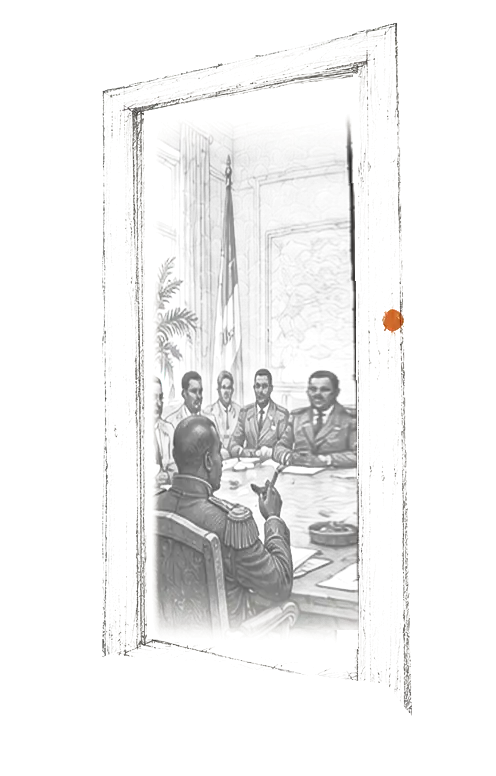
In an African country never named, a coup brings Colonel Bwakamabé Na Sakkadé, known as Tonton, to power. Ministers are searched at the door of the cabinet and treated like schoolboys, posts go to the men of his tribe, and his butler tells of these years, while mistrust spreads through the master's entourage.
Timeline
- 1953–1964First authorsJean Malonga, Sylvain Bemba, Tchicaya U Tam'si.
- 1969–1974Novel and theatreGuy Menga, Henri Lopes, Dongala. A crowded generation.
- 1974–1979First filmsSébastien Kamba makes the first Congolese feature.
- 1981–1988Voices of exileLomami-Tshibamba, Tati-Loutard, Tchichelle Tchivela, Caya Makhélé.
- 1992MatangaDavid-Pierre Fila films mourning and the country's rites.
Reading keys
- Names indicate the group and the region: Kongo in the south, Teke in the centre, Mbochi in the north, and that geography has been political since independence.
- Kongo societies are matrilineal: inheritance and authority pass through the maternal uncle, and a father does not have over his children the rights a French reader assumes for him.
- French baptismal names coexist with lineage names, and the use of one or the other indicates the context.
- Classificatory kinship extends the terms brother and mother to a wide circle.
- The civil wars from 1993 to 1999 and the militias that waged them are a raw subject.
- Tribalism, that is to say the distribution of power according to regions of origin, has been named and denounced in literature since the nineteen seventies.
- Criticism of power proceeds by the fable, satire and the grotesque rather than by the pamphlet.
- Ndoki, sorcery, explains success and misfortune, and the accusation is dangerous.
- Catholicism is in the majority, with important independent African churches, among them Kimbanguism born on the other bank of the river.
- The cult of the ancestors and the nkisi, objects charged with power, belong to the Kongo stock and coexist with the mass.
- The nganga, healer and diviner, is a central character in the narratives, to be distinguished from the malevolent sorcerer.
- Kongo cosmology organises the world into two halves separated by water, that of the living and that of the dead, and that figure of the mirror runs through the literature.
- Mourning, matanga, includes a wake, songs and a deferred lifting of mourning, often a costly one.
- The white of kaolin marks contact with the dead in Kongo rites.
- Widowhood imposes on the woman public prohibitions of dress and of behaviour.
- Rumba and its repertoire, shared with the other Congo, accompany festivities and funerals alike.
- The Kongo tales, with the cunning hare and antelope, are the narrative stock common to both banks.
- The narratives of the kingdom of Loango and its royal institutions provide a claimed historical depth.
- Kimbanguism and the figure of the prophet Simon Kimbangu are references known on both sides of the river.
- Congolese rumba, with its lyrics and its orchestras, constitutes a shared heritage and a common language.
- The two Congos are two distinct countries, separated by a river and by two colonial histories, French and Belgian. Confusing them is the most frequent error.
- Kongo matrilineality entirely changes the reading of family relations in the novels.
- Sony Labou Tansi's "broken French" is not a clumsiness but an avowed procedure.
- Sony Labou Tansi was born on the Belgian side and lived in Brazzaville: his belonging is double and both countries claim him.
Tales and mythologies 1
- TaleNotes on the Folklore of the FjortNotes on the Folklore of the Fjort (French Congo)Richard Edward Dennett · 1898The tales of the Vili of the Atlantic coast, noted down by an English trader at the end of the nineteenth century.Literature
Available in English 5
The books from this country that can be read in English, in the original or in translation.
- PoetryThe BellyLe VentreTchicaya U Tam'si · 1964Poems of mourning born of the Congolese tragedy of 1960, written by a poet who had lived through it on the other bank of the river.Literature
- NovelLife and a HalfLa Vie et demieSony Labou Tansi · 1979A teacher from Brazzaville invents an imaginary country where bloodthirsty dictators succeed one another endlessly.Literature
- NovelThe Laughing CryLe Pleurer-RireHenri Lopes · 1982A black farce about dictatorship, told by the servant of an African head of state.Literature
- NovelThe Fire of OriginsLe Feu des originesEmmanuel Dongala · 1987One man's life, from the bush to the city, which sums up the history of the Congo since the colonial conquest.Literature
- NovelBlue White RedBleu-Blanc-RougeAlain Mabanckou · 1998The Parisian dream of a young man from Pointe-Noire, from the festival of returns to the world of the undocumented.Literature
A selection to begin with 10 / 19
- NovelCœur d'AryenneJean Malonga · 1953not translated into EnglishA love between a young Black man and a young white woman in a colonial post in the Middle Congo.Literature
- PoetryThe BellyLe VentreTchicaya U Tam'si · 1964Poems of mourning born of the Congolese tragedy of 1960, written by a poet who had lived through it on the other bank of the river.Literature
- CinemaThe Ransom of an AllianceLa Rançon d'une allianceSébastien Kamba · 1974A war between two peoples of precolonial Congo, set off by an adultery, shot in the languages of the country.Cinema
- CinemaLa ChapelleJean-Michel Tchissoukou · 1979A comedy shot at the end of the seventies, which sets in the thirties the clash between an evangelizing mission and a village that holds to its own gods.Cinema
- NovelLife and a HalfLa Vie et demieSony Labou Tansi · 1979A teacher from Brazzaville invents an imaginary country where bloodthirsty dictators succeed one another endlessly.Literature
- NovelRêves portatifsSylvain Bemba · 1979not translated into EnglishA novel about the dreams and dramas that imported cinema gave rise to in a capital city of Central Africa.Literature
- PoetryPoèmes de la terreMarie-Léontine Tsibinda · 1980not translated into EnglishA slim booklet of poems, the first book by an author from Kouilou, published in Brazzaville.Literature
- NovelThe Fire of OriginsLe Feu des originesEmmanuel Dongala · 1987One man's life, from the bush to the city, which sums up the history of the Congo since the colonial conquest.Literature
- CinemaMatangaDavid-Pierre Fila · 1994A fiction film about AIDS shot in Congo, which takes the funeral wake as its setting and rumour as its material.Cinema
- NovelBlue White RedBleu-Blanc-RougeAlain Mabanckou · 1998The Parisian dream of a young man from Pointe-Noire, from the festival of returns to the world of the undocumented.Literature