Czechia
- works
- 57
- 37 books · 20 films
- period covered
- 1824–1979
- language of writing
- Czech
In September 1817, Václav Hanka announced that he had found in the bell tower of a Bohemian church a manuscript of poems in Old Czech, and a second appeared the following year, sent anonymously to the museum in Prague. The two texts immediately became the most read and the most translated in the country, proof of a national literature earlier than the German one. They are forgeries, and 1886 had to be waited for, and a campaign of articles in Tomáš Masaryk's review, before the demonstration was accepted.
Read moreShow less
That desire for proofs is explicable. After 1620, Czech became again a language of the countryside, Prague spoke German, and the national revival of the nineteenth century had to remake a vocabulary, dictionaries, a theatre and an audience. The city was then triple, Czech, German and Jewish: Kafka wrote there in German and is today catalogued as a Czech author. Then the ruptures follow one another, 1938, the expulsion of three million Germans in 1945, 1948, 1968, and each removes from the country a part of its writers.
The Czech form is the irony of the little man who survives by playing the fool. Hašek published his soldier in instalments from 1921 and died before finishing, leaving the novel incomplete, and that manner runs on to Hrabal. The price is that of normalisation. After 1968, Hrabal circulated in samizdat a narrative about an employee who pulps forbidden books, officially published in 1989. Milan Kundera was stripped of his nationality in 1979. Václav Havel did four years in prison. Jaroslav Seifert received the Nobel prize in 1984 while he was barely publishable at home. Vojtěch Jasný's film about the collectivisation of a village, shot in 1969, was banned and its author left.
What awaits the reader is a serious comedy, a mistrust of big words and characters who prefer beer to heroism. The narrative that opens this page, published in 1855, follows a year in the life of a grandmother in a Bohemian valley; its author began it after the death of her eldest son, and it has been reprinted more than three hundred times in Czech.
A way to begin
The Grandmother
Božena Němcová · 1855
A year of country life in Bohemia, seen through a grandmother and her grandchildren: the most read book of the Czech nation, free of rights.
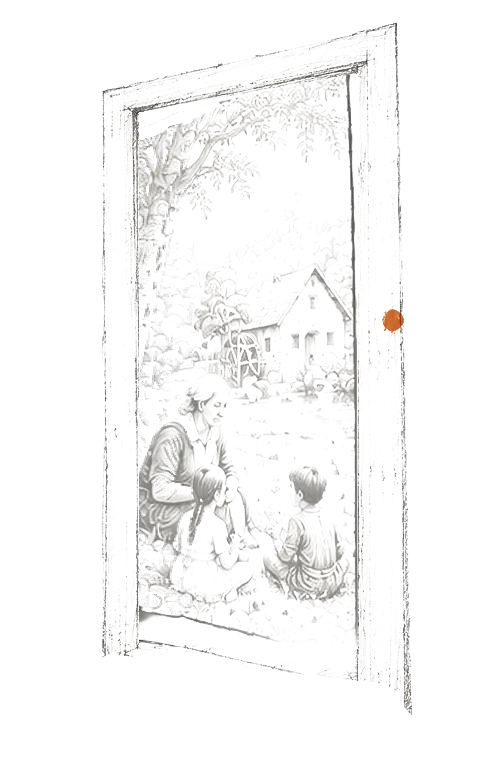
A grandmother comes to live with her daughter's family, whose husband serves a princess, at the edge of a Bohemian valley. She raises her grandchildren, tells them of her youth, nurses, advises and arranges the neighbourhood's marriages, and wins the princess's friendship. In the woods wanders Viktorka, a girl who lost her reason after being seduced by a soldier: the grandmother teaches the children not to judge her.
Timeline
- 1780–1850National revivalWriting in Czech is learned again, a language pushed aside by German.
- 1900–1938PragueKafka writes in German, Hašek in Czech. Two ways of laughing at disaster.
- 1963–1968Czech New WaveForman, Menzel, Chytilová. An insolence the tanks will come to crush.
- 1968–1989NormalisationKundera leaves, Havel stays and goes to prison, Hrabal publishes in samizdat.
Reading keys
- Female family names take the ending in -ová, and first names decline: the same person appears in several forms according to the grammatical function.
- The diminutive is systematic and graded, and its use measures familiarity, which translation almost always erases.
- The name day, inscribed in the calendar, is celebrated as much as the birthday, with flowers and visits.
- German surnames are frequent and indicate no German belonging, the population of Bohemia having been mixed for centuries.
- The expulsion of three million Sudeten Germans in 1945, with its violence, is a subject that literature has approached since 1990 and that remains politically charged.
- The normalisation after 1968, the lists of banned writers and each person's degree of accommodation are a matter of unsettled accounts.
- The Slánský trial of 1952 and the state antisemitism of that period are documented but little present in the national narrative.
- The place of the Roma, expelled and then assigned to particular quarters, and the sterilisation of Roma women until recent years are subjects established by official inquiries.
- The country is one of the most dechristianised in Europe, a distant effect of the Counter-Reformation imposed after 1620 on a country that had become Hussite before everybody else.
- Jan Hus, burnt in 1415, is a national reference more political than religious, and his name situates a discourse.
- Prague bears a reputation for occultism, the alchemists of Rudolf II and the golem of the ghetto, and literature uses it as an already written setting.
- The creatures of the popular ballads, the noonday demon, the water spirit, the returning bride, are fixed by Erben's collection in 1853 and known to all.
- The burning of the witches on the night of 30 April, with fires and an effigy, opens the spring, and 5 July celebrates Cyril and Methodius, 6 July Jan Hus.
- The Christmas eve includes the carp bought alive and the potato salad, and people fast during the day in order to see the golden pig.
- The beer hall is a complete social place, with its communal tables and its regulated conversations, and a novel settles there without having to explain it.
- Funerals are brief and often civil, and cremation is in the majority, which distinguishes the country from its Catholic neighbours.
- The old legends of Bohemia, fixed by Cosmas of Prague in the twelfth century and then developed by Jirásek in 1894, give father Čech, princess Libuše and the foundation of Prague.
- Erben's ballads, in 1853, and Božena Němcová's tales, from 1845, are the two common school corpora.
- The soldier Švejk, in 1923, has become a word of everyday language, and his way of obeying to the point of absurdity serves as a model of ironic conduct.
- The forged manuscripts of 1817 remain a cultural reference: the invention of a glorious fake is part of the national repertoire, down to the character of Jára Cimrman.
- Kafka wrote in German, in Prague, and his classification among Czech authors is a catalogue decision: the reader should know that it is debated.
- Czech and Slovak are two distinct languages, and Czechoslovakia was a common state from 1918 to 1992, not a single nation.
- Bohemia is not Eastern Europe: it was one of the most industrialised regions of Europe in 1900, and its literature speaks of towns and factories.
- The French word bohème comes from a confusion with the Roma and has nothing to do with historical Bohemia.
- The Czechoslovak New Wave was interrupted by 1968, which explains why the catalogue stops abruptly and why several authors pursue their work abroad.
Tales and mythologies 1
- PoetryA Bouquet of Czech FolktalesKytice z pověstí národníchKarel Jaromír Erben · 1853Ballads drawn from folk legends, in which every fault calls for a punishment.Literature
A selection to begin with 10 / 57
- NovelThe Good Soldier ŠvejkOsudy dobrého vojáka ŠvejkaJaroslav Hašek · 1921A simpleton, or one who seems to be, goes through the Great War by obeying too well.LiteraturePublic domain
- NovelThe TrialDer ProzessFranz Kafka · 1925A clerk arrested for no reason searches in vain for the court that is trying him.LiteraturePublic domain
- CinemaJourney to the Beginning of TimeCesta do pravěkuKarel Zeman · 1955Four boys row up a river that carries them back to the ancient ages of the Earth.Cinema
- CinemaVoyage to the End of the UniverseIkarie XB 1Jindřich Polák · 1963A long voyage to Alpha Centauri, and a crew who must live with the time lost on Earth.Cinema
- CinemaDiamonds of the NightDémanty nociJan Němec · 1964Two young men who have escaped from a transport to the camps, hunted down in the forest.Cinema
- TheatreThe MemorandumVyrozuměníVáclav Havel · 1965A satire of an administration where an artificial language, meant to specify everything, makes all speech impossible.Literature
- NovelThe JokeŽertMilan Kundera · 1967An ironic postcard, the Stalinist years and, much later, a revenge in Moravia.Literature
- CinemaAll My Good CountrymenVšichni dobří rodáciVojtěch Jasný · 1969Seven friends from a Moravian village caught up in the early years of communism.Cinema
- PoetryThe Plague ColumnMorový sloupJaroslav Seifert · 1970Poems of farewell by an old poet to his city, in the wake of the invasion of 1968.Literature
- NovelToo Loud a SolitudePříliš hlučná samotaBohumil Hrabal · 1976Monologue of a worker who saves books from the paper press.Literature