Russia
- works
- 107
- 73 books · 34 films
- period covered
- 1185–1992
- language of writing
- Russian
Anna Akhmatova composed her Requiem without ever writing it down. After her son's arrest, she noted a poem on a piece of paper, handed it to a friend who learnt it by heart, then burnt the sheet over an ashtray. The cycle lived some fifteen years in the memory of a few people. It appeared in Munich in 1963 without her agreement, and in the Soviet Union only in 1987, twenty-one years after her death.
Read moreShow less
This country treats literature as an affair of state, and that is what gives it its weight. For want of an assembly, a free press and independent courts, the novel and the poem served as public debate, and the authorities read them as such. Prior censorship, the great reviews that decided everything, the Writers' Union that distributed flats and withdrew the right to publish, then samizdat typed in five copies: the material history of these texts is part of the texts. The French reader inherits a canon constituted in those conditions, and gains by knowing which ones.
The Russian form is the long novel in which God, money and murder are discussed over six hundred pages, and the poem that fits into one stanza. The price is stated in facts. Pushkin's personal censor was the tsar. Dostoevsky was placed before a firing squad in 1849, then spent four years in the Omsk penal colony. Chernyshevsky wrote his novel in 1863 in a fortress. Mandelstam died in 1938 in a transit camp. Bulgakov's novel appeared in 1967, more than a quarter of a century after his death. Pasternak had to refuse the Nobel prize in 1958. Brodsky was tried in 1964 for parasitism, then expelled in 1972, and Solzhenitsyn stripped of his nationality in 1974, the year after the appearance of his inquiry into the camps.
What awaits the reader is a literature that asks the last questions without precaution and that laughs far more than is said. The novel that opens this page, published in 1842, sends a gentleman buying up dead serfs from estate to estate; it was meant to be the first of three volumes, and the author burned the second shortly before his death.
A way to begin
Dead Souls
Nikolai Gogol · 1842
A gentleman buys up dead serfs from estate to estate in a Russian province: the novel Gogol called a poem. Free of rights.
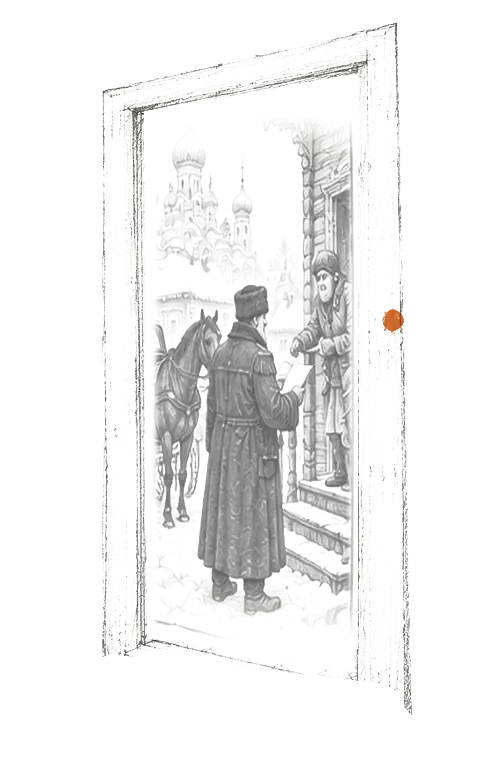
Pavel Chichikov, a gentleman of middling age and middling means, arrives in a provincial capital and charms officials and landowners. His design: to buy up "dead souls", deceased serfs whom the census lists still count as living. He goes from estate to estate, to the sentimental Manilov, the widow Korobochka, the swaggering Nozdryov, the gruff Sobakevich and the miser Plyushkin.
Timeline
- 1185Kievan Rus'The Tale of Igor's Campaign, at the disputed origins of three literatures.
- 1820–1840Golden AgePushkin and Lermontov found the Russian literary language.
- 1840–1880The great novelGogol, Turgenev, Dostoevsky, Tolstoy. The Russian novel dominates the century.
- 1890–1917Silver AgeChekhov, Blok, Akhmatova, Mandelstam. A flowering the revolution will cut down.
- 1917–1930Avant-gardesMayakovsky, Eisenstein, the formalists. An explosion, then the tightening of control.
- 1932–1953Socialist realismThe doctrine takes hold. Bulgakov writes for the drawer, Shalamov to survive.
- 1956–1985Thaw and dissidenceSolzhenitsyn, Tarkovsky. You publish elsewhere, or not at all.
Reading keys
- Everyone bears a first name, a patronymic formed on the father's in -ovich or -ovna, and a family name: the polite form of address is first name plus patronymic, and a character called by his first name alone is being addressed by an intimate.
- Diminutives are innumerable and graded, from Ivan to Vanya and then Vanyushka, and moving from one form to another marks a change of relation that translation erases.
- Female family names take an ending in -a, Karenin and Karenina designating a couple, which is disconcerting when French makes them uniform.
- The family names invented by writers are often speaking names, drawn from an object or a defect, and the comedy of names is a constant device in Gogol.
- The war of 1941 to 1945, called the Great Patriotic War, is the founding narrative, and questioning it is today framed by criminal law.
- The assessment of the Stalinist period, the camps and the number of victims are subjects of open conflict, and the associations that documented them have been dissolved.
- The war in Ukraine begun in 2022 is the sharpest division of current literary life, between those who left, those who keep silent and those who approve.
- Religion, the army and homosexuality are framed by recent laws, and a contemporary text is also read through what it avoids.
- Orthodoxy is a cultural framework more than a majority practice, with its icons, its fasts and its saints, and it has been closely tied to power since the nineteenth century.
- The Old Believers, separated since the seventeenth-century schism, form a world apart, with its prohibitions, and provide a recurrent novelistic device.
- The pre-Christian stock surfaces in the tales and the epics: Baba Yaga in her house on chicken legs, the domovoi of the hearth, the rusalki of the waters.
- Islam is the country's second religion, Tatar and Caucasian, and the peoples of Siberia have a shamanism repressed and then reappeared.
- Easter is the central festival, with the night vigil, the painted eggs and the ritual greeting, and the New Year inherited the tree and the presents under the Soviet regime.
- Red is the colour of the beautiful and the sacred before being political, and the red corner of the izba is that of the icons.
- The commemorative meals take place on the third, the ninth and the fortieth day after a death, then every year, and the mirrors are covered.
- 9 May, victory day, with parades and portraits of the dead carried in procession, is the major civic rite.
- Afanasyev's collection of tales, published between 1855 and 1863, is the reference corpus, with Baba Yaga, Koshchei the deathless and the firebird.
- The byliny, epic songs of Kiev and Novgorod collected from the last singers of the North, give the bogatyrs, Ilya Muromets at their head.
- The Tale of Igor's Campaign, around 1185, is the only great literary text of Kievan Rus', and it is claimed at once by Russia, Ukraine and Belarus, which make of it three different inheritances.
- Pushkin's lines are recited by heart by everyone, and an allusion to Onegin reads like a proverb in France.
- The Russian soul is a nineteenth-century construction, exported by the translators, and not a key to reading: one gains by reading the books as interventions in precise debates.
- Russia is a multinational empire: part of what is written in Russian is written by Tatar, Jewish, Armenian or Ukrainian authors, and the language does not state the belonging.
- Socialist realism is not the whole of Soviet literature: the catalogue mixes official texts, tolerated texts and texts published abroad.
- The date of a Russian book is often that of its writing and not of its appearance, the gap sometimes reaching several decades.
- The Tale of Igor's Campaign does not belong to one only of the three East Slavic states, and the claim is a political fact of which the reader must be warned.
Tales and mythologies 2
- PoetryThe Song of Igor's CampaignСлово о полку ИгоревеAnonymous · 1185The verse account of an unsuccessful campaign by a Russian prince against the Polovtsians, in 1185, and an appeal for unity among the princes.Literature
- TaleRussian Fairy TalesНародные русские сказкиAlexander Afanasyev · 1863A Russian collection of tales from the oral tradition, published in the mid-nineteenth century and often compared to that of the Grimms.Literature
A selection to begin with 10 / 107
- NovelEugene OneginЕвгений ОнегинAlexander Pushkin · 1833A novel in verse written from 1823 to 1831 and published chapter by chapter, the story of a jaded dandy and a provincial girl.Literature
- NovelWhat Is to Be Done?Что делать?Nikolay Chernyshevsky · 1863A novel written in prison and published in 1863, which offered Russian youth a model of “new men”.LiteraturePublic domain
- NovelCrime and PunishmentПреступление и наказаниеFyodor Dostoevsky · 1866A novel of 1866: a poor student in Saint Petersburg kills a pawnbroker to test a theory, and has to live with his act.LiteraturePublic domain
- PoetryTristiaOsip Mandelstam · 1922Collection of 1922 in which Rome, Greece, the exiled Latin poet and the Petersburg of the revolutionary years answer one another.LiteraturePublic domain
- NovelDoctor ZhivagoДоктор ЖивагоBoris Pasternak · 1957A novel completed in 1955: a poet-physician swept away, with those he loves, by war, revolution and their aftermath.Literature
- CinemaThe Cranes Are FlyingЛетят журавлиMikhail Kalatozov · 1957A 1957 film about a young Muscovite whom the war separates from the man she loves.Cinema
- CinemaBallad of a SoldierБаллада о солдатеGrigori Chukhrai · 1959A film of 1959 about a young soldier given six days to go and see his mother, and about his journey.Cinema
- PoetryRequiemРеквиемAnna Akhmatova · 1963A cycle of poems written mostly during the Great Terror, and first published in 1963, in Munich.Literature
- NovelThe Master and MargaritaМастер и МаргаритаMikhail Bulgakov · 1967A posthumous novel, published in 1967: the devil on a visit to Moscow, and the Roman prosecutor of Judea.Literature
- EssayThe Gulag ArchipelagoАрхипелаг ГУЛАГAleksandr Solzhenitsyn · 1973An essay in three volumes, the first of which appeared in Paris in 1973: the Soviet concentration camp universe, told by a former prisoner.Literature