Samoa
- works
- 3
- 2 books · 1 film
- period covered
- 1979–1996
- language of writing
- English
On 28 December 1929, in Apia, the New Zealand military police opened fire on a procession of the Mau, the movement demanding self-government under the motto “Samoa mo Samoa”, Samoa for the Samoans. Some ten Samoans were killed, among them the chief Tupua Tamasese Lealofi III. It was not until 2002 that the New Zealand government presented its country's apologies in Apia.
Read moreShow less
The western islands of the archipelago became German in 1899 and passed under New Zealand administration in 1914; the influenza epidemic of 1918 killed more than one inhabitant in five there. They regained their independence in 1962 and took the name of Samoa in 1997. Society rests on fa'a Samoa, the “Samoan way”: extended families, the aiga, led by titled chiefs, the matai, who administer the family's land. Christianity, which arrived with the missionaries of the London Missionary Society in 1830, has merged into it.
Literature written in English was born in the 1970s with Albert Wendt, who published in 1973 a first novel about a Samoan student in New Zealand, brought to the screen in 1979 by Paul Maunder, then in 1979 a saga of three generations. Sia Figiel gave in 1996 a first novel awarded a Commonwealth prize, in which a teenage girl tells her story through the “we” of her village. The price, here, is the detour: these books are published in Auckland, and the first film about Samoans in New Zealand is a New Zealand production.
What awaits the reader is an English in which Samoan words surface, titles, ranks and ceremonies, and characters torn between the village and money. The novel that opens this page appeared in Auckland in 1979 and received the following year the Wattie Book of the Year Award; it was translated into French in Papeete in 2009.
A way to begin
Leaves of the Banyan Tree
Albert Wendt · 1979
Three generations of a Samoan family between custom and money: the great saga of the Pacific, awarded a prize in 1980.
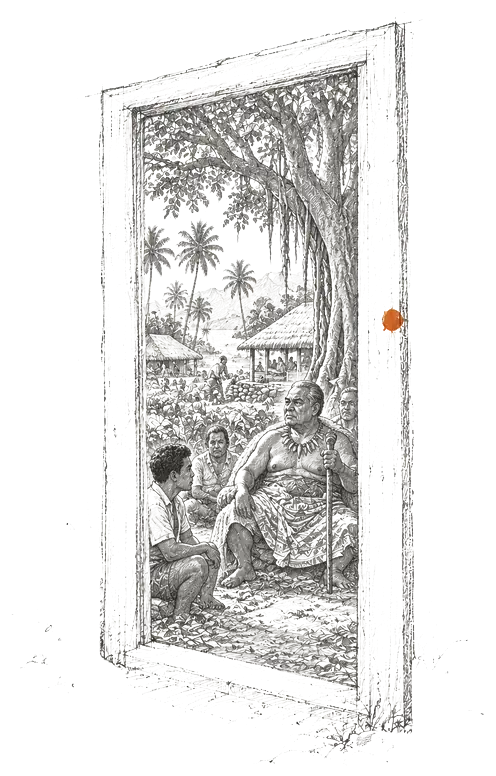
In the village of Sapepe, Tauilopepe, head of the family, devotes himself to making the family plantation prosper and to winning wealth and rank, under the motto “God, money and success”, at the expense of his wife and his son. Pepe, this rebellious son, is expelled from the town school. The novel then follows Lalolagi, the grandson, raised by Tauilopepe and sent to boarding school in New Zealand.
Timeline
- 1929The MauThe Apia shooting against the self-government movement, “Samoa mo Samoa”.
- 1962IndependenceWestern Samoa becomes an independent state; it takes the name of Samoa in 1997.
- 1973–1996The Samoan novelAlbert Wendt, Paul Maunder's film, then Sia Figiel's first novel.
Reading keys
- The matai title precedes the Christian name of the person who holds it, and one person may hold several titles from different branches of his genealogy.
- The title is conferred during a ceremony, the saofa'i, after the family has agreed, with speeches, recitation of genealogies, a kava ceremony and a feast.
- The ali'i are the high-ranking chiefs, the tulafale the orator chiefs who speak in their name.
- Men and women can receive a title, but women account for only about one matai in ten.
- One addresses a matai with a vocabulary of respect, and the young give way to elders and people of rank.
- The 1929 shooting and the 1918 influenza, for which New Zealand was held responsible, remain sensitive subjects with the former administering power.
- Land, more than four-fifths of it held according to custom and administered by the matai, is not sold, and land disputes are family disputes.
- The tension between village tradition and money, which Wendt's novels stage, touches on values that are not discussed lightly.
- Christianity, brought in 1830, has merged into fa'a Samoa, and most families begin the day with a prayer.
- Every evening, around dusk, the village observes the sa, a time of prayer announced by a bell or a conch, during which no one moves about.
- Sunday is devoted to church, rest and the quiet of the villages, and social life resumes after the service.
- The conversion of the great chief Malietoa Vainu'upo brought about that of a large part of the population.
- Fine mats, the 'ie toga, are offered at weddings, births, deaths and the bestowing of titles, and their value is at once material and emotional.
- The kava ceremony, the 'ava, welcomes distinguished guests: a few drops are poured before drinking.
- Traditional tattooing covers the waist and thighs down to the knees in men, the pe'a, and the upper thighs in women, the malu.
- In the traditional house, the fale, one sits on the ground, legs crossed or covered, before speaking, eating or drinking.
- The Mau and its motto, “Samoa mo Samoa”, are the reference point of Samoan nationalism.
- Robert Louis Stevenson lived at Vailima from 1890, wrote a book on colonial interference in the archipelago and lies buried at the summit of Mount Vaea.
- Albert Wendt, born in Apia, taught literature at the University of Auckland from 1988, after having headed Samoa College.
- Sia Figiel received in 1997 the Commonwealth Writers' Prize for the best first book of her region.
- Samoa, an independent state, is not American Samoa, a territory of the United States to the east of the archipelago.
- Until 1997 the country was officially called Western Samoa, a name found in older books.
- The 1979 film is a New Zealand production, by a New Zealand director, attached here to Samoa by its subject.
- The pe'a is not a mere ornament: it was traditionally worn by the matai.
A selection to begin with 2 / 3
- CinemaSons for the Return HomePaul Maunder · 1979The love of a Samoan student and a young New Zealand woman, after Albert Wendt's first novel.Cinema
- NovelWhere We Once BelongedSia Figiel · 1996The adolescence of a girl in a Samoan village, where “I” is always said as “we”.Literature