Singapore
- works
- 18
- 13 books · 5 films
- period covered
- 1849–1998
- language of writing
- English, Chinese, Malay and Tamil
An island that became an independent State in 1965, after two years within Malaysia, and that writes in four official languages: English, Chinese, Malay and Tamil. Until independence, Singapore was the cultural capital of the Malay world: the studios of the Shaw brothers and of Cathay-Keris shot most of the cinema in Malay there, and the writers' movement Asas 50 was founded there. Each language has its history, its newspapers, its journals and its prizes, and the four literatures long grew side by side without reading one another much. The official account makes the city begin in 1819, with Stamford Raffles; part of recent literature contests this beginning and looks for another.
A way to begin
If We Dream Too Long
Goh Poh Seng · 1972
A young clerk is bored in the changing city of the sixties and dreams of the sea: the book many regard as the first Singaporean novel in English.
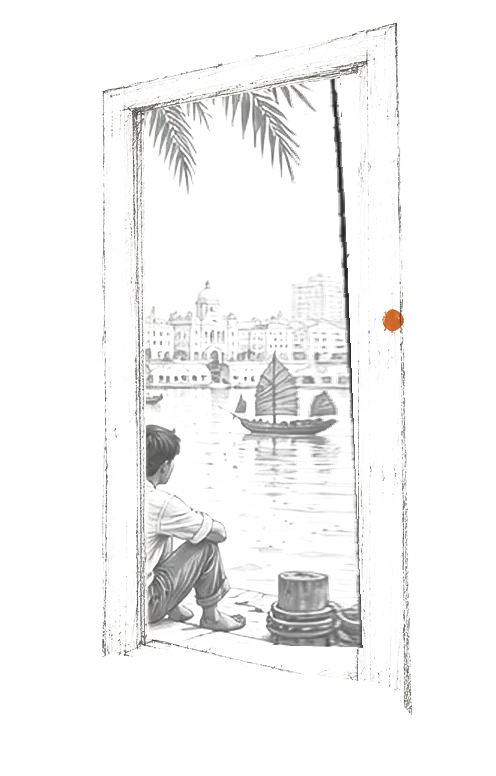
In 1960s Singapore, Kwang Meng, who has just left school, is bored in a clerk's job. Shy and sensitive, he does not share the values that drive his school friends. He takes an afternoon off, claiming to be ill, to go swimming, comes home to a father who complains as always, frequents a bar where he grows close to Lucy, and dreams of faraway lands and of merging into the sea he loves.
Timeline
- 1819–1867The city of the straitA British trading post attracts Malay scholars; Munsyi Abdullah writes the story of his life there.
- 1933–1965The Malay studiosRajhans, Majumdar, P. Ramlee, Hussain Haniff: Singapore makes the cinema of the whole Malay world.
- 1942–1945SyonanThe Japanese occupation feeds the first poems of Masuri S. N. and, much later, Tamil novels.
- 1950–1965Rooted literaturesAsas 50 in Malay, Miao Xiu in Chinese: writers tell the city where they live.
- 1965–1985A new country in four languagesThumboo, Goh Poh Seng and Catherine Lim seek a national voice; Kuo Pao Kun moves from Chinese to English.
- 1990–2000The revivalEric Khoo relaunches cinema, Alfian Sa'at contests the official account, Ma Ilangkannan tells of the Tamils.
Reading keys
- The Chinese name is read surname first: Goh Poh Seng belongs to the Goh family, and many place an English first name in front, as with Catherine Lim or Eric Khoo.
- The Malay name has no transmitted surname: bin and binti mean “son of” and “daughter of”, and Masuri bin Salikun is Masuri, son of Salikun.
- Tamil names often place before the given name the initial of the father's name.
- The name is enough to place the community, and the civil register records it.
- Race and religion are subjects framed by law, not to be broached lightly; the riots of 1964 serve as a reminder.
- Detention without trial, provided for by the Internal Security Act, struck writers and artists, among them a playwright of this catalogue, from 1976 to 1980.
- The censorship of films and plays was long strict.
- Singlish, English mixed with Malay, Hokkien and Tamil, has been fought by official campaigns, and writing it remains a stand.
- Buddhism, Taoism, Islam, Christianity and Hinduism coexist, often in the same street, and the Chinese religions mix ancestor worship and popular deities.
- The Malays are Muslim; the Tamils, mostly Hindu, have their temples and their festivals, such as Thaipusam.
- The seventh lunar month is that of the hungry ghosts, for whom offerings are burned at the roadside.
- The spirits of the Malay world, such as the pontianak, peopled the cinema shot in the city's studios.
- Chinese New Year, Eid, Deepavali and Christmas are public holidays.
- Chinese funerals last several days, under tents set up at the foot of public housing blocks, and the coffin, like the grave, is a matter of rank there, which a famous monologue from the country stages.
- White is the colour of mourning among the Chinese.
- The popular food centres, the hawker centres, are a social place in their own right, where all the communities cross paths.
- The British foundation of 1819 and the figure of Raffles.
- The Japanese occupation from 1942 to 1945, when the island was called Syonan, and the massacres that targeted the Chinese population.
- The exit from Malaysia in 1965, experienced as an imposed rupture.
- The public housing towers, where most of the population lives, and the Merlion, a tourist emblem created in 1964, which poets have taken up to question the country's identity.
- “Singaporean” does not tell the language: an author may write in English, Chinese, Malay or Tamil, and each literature has its readers.
- Before 1965, the border with Malaysia does not exist: a writer born in Penang or Kuala Lumpur may have made his whole career in Singapore, and vice versa.
- The so-called “Malay” cinema of the fifties was shot in Singapore, by Chinese studios, with directors often from India.
- Chinese has been written there in simplified characters since the seventies, but older works are in traditional characters.
A selection to begin with 10 / 18
- CinemaLeila MajnunB. S. Rajhans · 1934A legend of thwarted love, brought to the screen in Malay by actors from popular theatre.Cinema
- CinemaHang TuahPhani Majumdar · 1956The legend of the most loyal warrior of Malacca, told in colour and song.Cinema
- PoetryAwan putihMasuri S. N. · 1958not translated into EnglishThe first poems of a Singapore schoolteacher, born of war and the hope of independence.Literature
- CinemaMusang BerjanggutP. Ramlee · 1959A Malay tale turned into a comedy, in which a king's court covers itself in ridicule.Cinema
- CinemaHang JebatHussain Haniff · 1961The legend of Malacca told from the rebel's side, against blind loyalty.Cinema
- PoetryUlysses by the MerlionEdwin Thumboo · 1979Poems that seek a shared identity for a nation made up of several peoples.Literature
- Poetrydown the lineArthur Yap · 1980The collection of a great Singaporean poet writing in English, attentive to the spoken language of his island.Literature
- TheatreThe Coffin Is Too Big for the HoleKuo Pao Kun · 1985A satirical monologue on the individual, the family and the administration in Singapore in the eighties.Literature
- Cinema12 StoreysEric Khoo · 1997A day in a public housing tower, where outward success hides loneliness.Cinema
- PoetryOne Fierce HourAlfian Sa'at · 1998A first collection of anger and irony, which challenges the official narrative of the city-state.Literature