Slovenia
- works
- 40
- 24 books · 16 films
- period covered
- 1836–1995
- language of writing
- Slovenian
The Slovenian anthem is the seventh stanza of a drinking song. France Prešeren wrote it in 1844 and arranged his stanzas on the page in the shape of a wine glass; the Austrian censors forbade its printing, and the poem appeared only in 1848, when censorship fell. The stanza retained does not celebrate the nation: it raises the glass to all peoples and wishes for the end of quarrels.
Read moreShow less
This country had books well before it had a state. The first printed work in Slovenian dates from 1550, a complete Bible follows in 1584, the work of the Reformation, and the Counter-Reformation burnt part of those volumes. Independence had to wait until 1991. Between the two, two million speakers built a complete literary apparatus, grammars, reviews, theatres, inside Austria and then Yugoslavia, while losing Trieste and part of Carinthia, so that major Slovenian authors are Italian or Austrian citizens.
The form is the lyric poem and the short story, and the country made its reputation on density rather than on volume. The price is that of one orthodoxy after another. Srečko Kosovel died in 1926 and his most radical poems were published only in 1967. Edvard Kocbek, a Christian and a resistance fighter, published in 1951 narratives that evoke executions committed by the partisans, and he was set aside from public life for twenty years. Boris Pahor, deported to Natzweiler and to Dachau, wrote in Slovenian in Trieste and remained unknown in Italy until his ninetieth year.
What awaits the reader is a literature that holds within few pages, attentive to the mountain, to the border and to bad conscience. The novel that opens this page, published in 1938, is set in a Persian fortress where a master promises his soldiers paradise; the first edition carried an ironic dedication to Mussolini, and the book inspired the Assassin's Creed video games.
A way to begin
Alamut
Vladimir Bartol · 1938
Alamut: a sect leader manufactures his soldiers' faith, in the novel that gave rise to the maxim "nothing is true, everything is permitted".
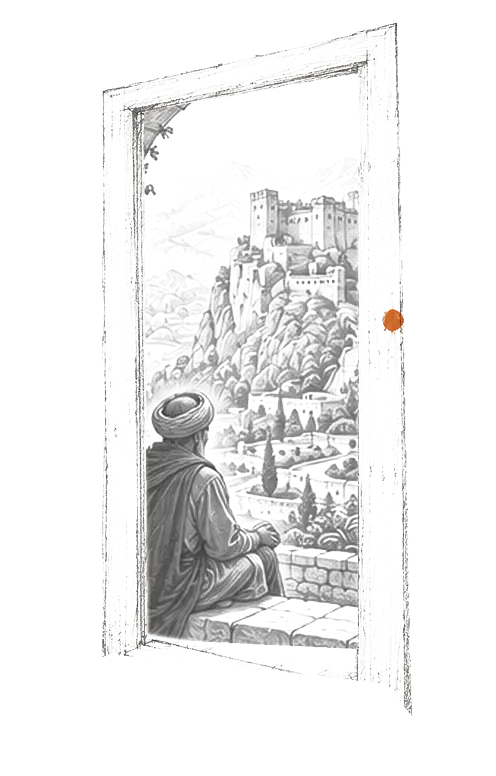
In the eleventh century Hassan ibn Sabbah, leader of the Ismailis, holds the fortress of Alamut and gathers an army against the Seljuk empire. Halima, a young slave, enters the gardens hidden behind the fortress, where houris are trained. Ibn Tahir, a young volunteer, is chosen among the fedayeen, who are taught that death in the master's service opens paradise at once; Hassan drugs them with hashish and has them carried into the gardens, which they take for the promised paradise.
Timeline
- 1835–1870RomanticismPrešeren, Levstik. Slovene gives itself a poetry before a state.
- 1899–1918Slovene ModernaCankar, Župančič, Kette, Murn. Four names found the prose and the verse.
- 1927–1938Avant-gardeKosovel, dead at twenty-two, then Bartol's Alamut.
- 1948–1965PostwarKocbek unsettles, Kosmač tells, and cinema is born with Štiglic.
- 1971–1989The last YugoslaviaZupan, Kovačič, Jančar, and a cinema coming into its own.
Reading keys
- Names decline, and the female family name may take a distinct form according to the region, modern administrative usage having made it uniform.
- House names, inherited from the farm and not from the family, are still used in the Alpine villages, and a character may be called by his house.
- German and Italian surnames are numerous on the margins, indicating nothing of present belonging.
- The name of the saint celebrated, godparent kinship and belonging to a precise valley place a character more surely than his occupation.
- The executions committed at the end of the war by the partisans against the home guards, long taboo, have since 1990 been an open conflict of memory that runs through literature.
- The relation to Yugoslavia, the independence of 1991 and the brief war that followed it are recounted in divergent ways according to the generations.
- The Italian border, the exodus of the Italians of Istria and the fate of the Slovenian minority of Trieste are subjects with a double reading.
- The persons erased from the registers in 1992, nationals of the other Yugoslav republics, form a legal dispute still raw.
- Catholicism is in the majority and was the national institution under Austria, which explains the anticlericalism of part of twentieth-century literature.
- The Reformation gave the language its first books, and that Protestant debt is claimed in a country made Catholic by the Counter-Reformation.
- The mythology reconstituted from the collections sets Kresnik the solar hero, Kurent the flute player and the death of winter that is driven out at carnival.
- The legend of the chamois with golden horns, guardian of the garden of Triglav whose death opens the era of desolation, is the central mountain narrative.
- The carnival of Ptuj, with its kurenti covered in sheepskins, bells and feathered masks, drives out winter and gathers tens of thousands of people.
- 8 February, the day of Prešeren's death, is the national festival of culture: the country takes a holiday for a poet.
- The processions of Holy Week and the mountain pilgrimages serve as landmarks in rural narratives.
- The cemeteries are decked with flowers and lit on 1 November, and the funeral vigil gathers the neighbourhood before the burial.
- Prešeren is the absolute reference, and his lines are quoted like proverbs, down to the love poem whose stanza initials form the name of the beloved woman.
- Martin Krpan, Fran Levstik's character in 1858, a salt smuggler who saves the emperor and is sent home, is the popular figure of the cunning and despised Slovenian.
- The chamois with golden horns and the nineteenth-century tale collections form the Alpine narrative stock.
- Ivan Cankar, at the beginning of the twentieth century, fixed the figure of the mother and that of the poor village, which the literature that follows discusses endlessly.
- Slovenia is not a piece of the Balkans: it was Austrian, it is Alpine and Catholic, and its horizon is Vienna and Trieste as much as Belgrade.
- Slovenian is not Serbo-Croatian: it is a distinct South Slavic language, with a grammatical dual, and it is not mutually intelligible with it.
- The country has one of the oldest printed traditions in Central Europe, which contradicts the idea of a young culture.
- Boris Pahor was an Italian citizen, Kosovel died before Yugoslavia: literary nationality here does not follow political borders.
- The catalogue stops around 1990, before the generation translated into French over the past twenty years, and that does not measure the country's production.
Tales and mythologies 1
- NarrativeZlatorogAnonymous · 1868not translated into EnglishThe high valleys of the Julian Alps, where one man's greed threatens the domain of the mountain fairies.Literature
A selection to begin with 10 / 40
- PoetryThe Baptism on the SavicaKrst pri SaviciFrance Prešeren · 1836Bohinj, at the end of the eighth century, when the ancestors of the Slovenes are converted to Christianity by force.Literature
- NovelNa klancuIvan Cankar · 1902not translated into EnglishA poor district below a prosperous town, where a woman struggles alone with her children against poverty.Literature
- PoetryPesmiSrečko Kosovel · 1927not translated into EnglishThe Karst annexed by Italy after 1920, whose memory a student from Ljubljana keeps in his first poems.Literature
- NarrativeFear and CourageStrah in pogumEdvard Kocbek · 1951Occupied Slovenia and its partisan hideouts, where everyone must choose between what duty commands and what humanity allows.Literature
- NovelMesto v zalivuBoris Pahor · 1955not translated into EnglishTrieste and the Karst in September 1943, when German occupation follows Fascism.Literature
- Feature filmStronghold of ToughsGrajski bikiJože Pogačnik · 1967A post-war institution for lost children, in a Slovenia whose administration ignores those it locks away.Cinema
- Feature filmBlossoms in AutumnCvetje v jeseniMatjaž Klopčič · 1973A farm in the Slovenian countryside, where a middle-aged man from the city discovers a love he no longer expected.Cinema
- Feature filmIdealistIgor Pretnar · 1976The villages of Slovenia at the turn of the century, where the Church and the notables control the school and those who teach in it.Cinema
- Feature filmHang on, Doggy!Sreča na vrviciJane Kavčič · 1977A modern housing estate in the Slovenian capital in the late seventies, where a child has to find a place for a very large dog.Cinema
- TheatreVeliki briljantni valčekDrago Jančar · 1985not translated into EnglishA closed institution that stands for the totalitarian state, in Yugoslavia in the mid-eighties.Literature